

Imagine you’re thousands of miles away, trying to sell a property or manage a business in Dubai, only to have your legal documents rejected because of a missing stamp you didn’t know existed. It’s a frustrating reality for many who find the “chain of trust” broken by a single administrative oversight. You likely already know that securing legal authority in the Emirates from abroad is a bureaucratic marathon, and getting the UAE embassy attestation for power of attorney right is the most critical hurdle. It’s perfectly normal to feel overwhelmed by the shifting requirements of different government bodies and the fear of wasting time on a document that might be turned away.
This guide simplifies that journey, showing you how to navigate the attestation process with absolute precision. We’ll show you how to leverage the latest 2026 digital updates to ensure your document is accepted the first time, without you ever needing to board a plane. We’ll break down the essential five-step attestation chain, from your local notary to the final Ministry of Justice approval, including the new combined legalization formats that are streamlining the process for international residents.
Key Takeaways
- Understand why the UAE requires an international validation chain to recognize legal signatures executed in your home country.
- Follow a clear, five-step roadmap that takes your document from local notarization to final UAE Ministry of Justice approval.
- Learn how the 2026 digital pilot programs and combined legalization formats can accelerate your UAE embassy attestation for power of attorney.
- Identify the specific documentation requirements and drafting standards needed to prevent costly rejections by UAE authorities.
- Discover how modern, online-first services manage the complex logistics of cross-border attestation on your behalf.
Understanding UAE Embassy Attestation for Power of Attorney
Attestation is far more than a simple formality; it’s a rigorous security protocol that transforms a local legal document into an internationally recognized instrument. When you’re standing in London, New York, or Sydney, your signature carries weight within that local jurisdiction. However, once that document crosses into the UAE, local authorities have no inherent way to verify your identity or the credentials of the person who witnessed your signature. This is where UAE embassy attestation for power of attorney becomes the essential bridge. It creates a “chain of trust” that allows a Dubai bank or a Sharjah court to treat your foreign document with the same legal weight as one signed locally.
The UAE doesn’t accept foreign-notarized documents at face value because legal standards and notary registrations vary wildly between countries. To maintain the integrity of its legal system, the UAE requires a multi-step validation process. While many nations rely on the Apostille Convention to simplify document sharing between member states, the UAE’s specific administrative requirements often demand this more comprehensive legalization chain to ensure absolute document validity. This process involves three primary stakeholders:
- Home Country Notary: They verify your identity and witness the physical signing of the Power of Attorney.
- Ministry of Foreign Affairs (MOFA): Your local government body confirms that the notary is a registered professional with the authority to act.
- UAE Embassy: The final international step, where the UAE’s own diplomatic mission validates the document for use within the Emirates.
When is Overseas Attestation Mandatory?
You’ll need to complete this process whenever you cannot be physically present in the UAE to sign documents before a local notary. It’s a non-negotiable requirement for high-value activities such as selling or purchasing real estate, where the Dubai Land Department demands verified proof of authority. Similarly, if you’re managing a UAE-based business from abroad, you’ll need an attested POA for corporate governance, like appointing a manager or signing board resolutions. Even managing vehicle transfers or resolving property disputes from a foreign jurisdiction requires a fully validated UAE embassy attestation for power of attorney to be recognized by government departments and courts.
Beyond legal representation, maintaining the physical condition of your investment is crucial for remote owners. To ensure your property meets premium standards for short-term rentals or sale viewings, you can explore Holiday Home Cleaning as part of your comprehensive property care strategy.
Choosing Between Special and General POA from Abroad
Selecting the right document type is a critical strategic decision. A special power of attorney UAE is typically the most efficient and secure path for overseas grantors. It limits your representative’s authority to a single, specific task, such as selling a specific villa or renewing a trade license. UAE banks and government entities often prefer this specificity because it reduces the risk of unauthorized actions. In contrast, a General POA grants broad powers that can be risky to manage from a distance. Many UAE authorities may even reject a General POA if it doesn’t explicitly mention the exact transaction you’re trying to complete, potentially forcing you to start the entire expensive attestation process over again.
The 5-Step Process for Attesting an Overseas POA for the UAE
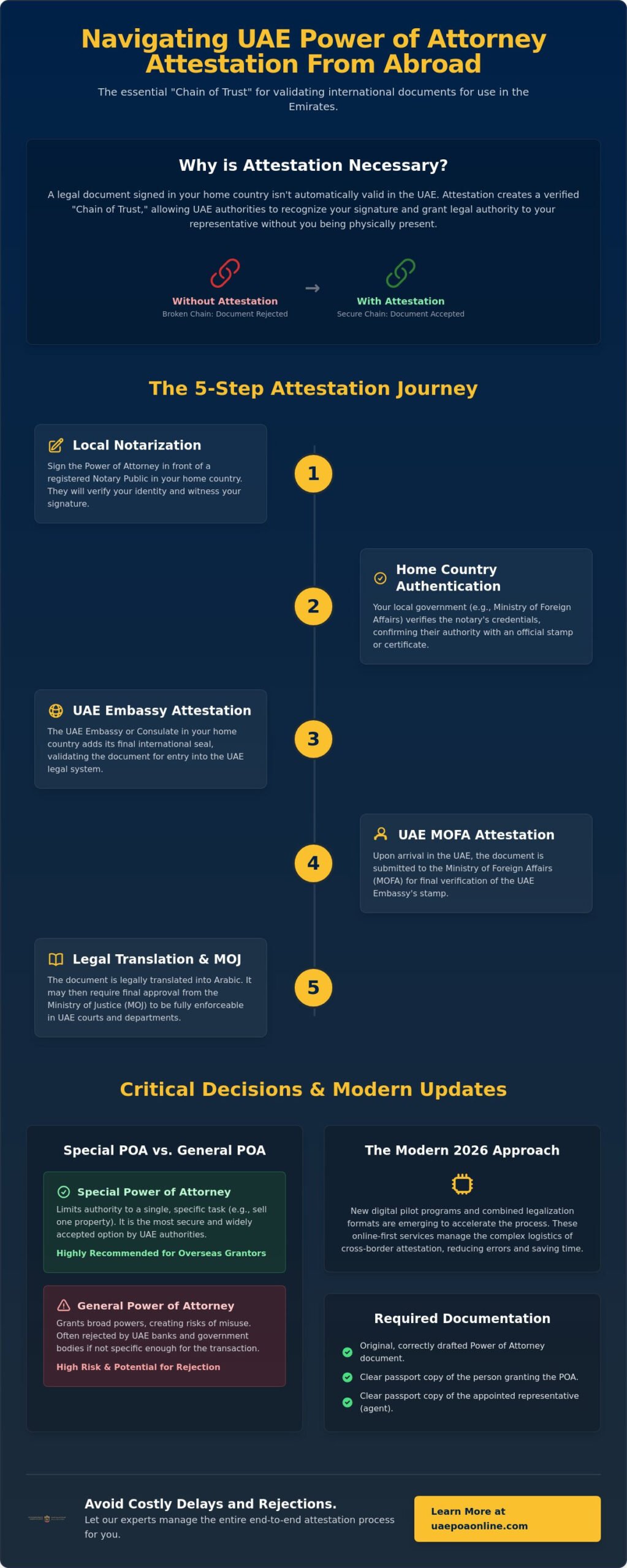
Securing legal authority from abroad requires a precise, sequential approach. If you miss a single stamp or complete a step out of order, the entire document can be rendered void by UAE authorities, leading to costly delays. This isn’t a single event but a cumulative chain of trust that validates your document across international borders. Each government body in the chain relies on the previous authority’s seal to confirm the document’s legitimacy.
- Step 1: Local Notarization. You must sign the document in the presence of a registered notary public in your current country. They verify your identity and witness your signature.
- Step 2: Home Country Authentication. Your document travels to your local Ministry of Foreign Affairs or equivalent state department. They confirm that the notary who witnessed your signature is officially registered and authorized to act.
- Step 3: UAE Embassy Attestation. This is the international bridge. The UAE Embassy or Consulate in your home country validates the seal of your local government.
- Step 4: UAE MOFA Attestation. Once the document physically arrives in the Emirates, it must be presented to the local UAE Ministry of Foreign Affairs for a final domestic validation.
- Step 5: Ministry of Justice (MOJ) Finalization. The document is translated into Arabic by a licensed legal translator and then stamped by the UAE Ministry of Justice to become fully actionable.
The Role of the UAE Embassy in Your Home Country
The UAE embassy attestation for power of attorney serves as the critical pivot point between your local laws and UAE regulations. The embassy’s primary function is to verify that the previous government seal from your home country’s foreign office is genuine. In 2026, many embassies have moved toward appointment-only systems or require the use of authorized attestation agents to manage the volume of requests. It’s vital to check the specific requirements of the consulate in your region, as processing timelines can vary from 48 hours to several weeks depending on current demand and the specific pilot programs for digital validation currently being tested.
Completing the Chain: MOFA and MOJ Inside the UAE
A common mistake many grantors make is assuming the process ends at the embassy. In reality, the document is not yet legally standing within the Emirates. Once the document is couriered to the UAE, it requires a domestic MOFA stamp to be recognized by local entities. Following this, a certified legal translation UAE into Arabic is mandatory. This translation must be performed by a translator licensed by the Ministry of Justice. The final MOJ stamp confirms that the translation is accurate and the document meets all local standards for property, business, or car transfers. If the logistics of physical appointments and international couriers seem daunting, you can manage the entire workflow through UAE POA Online to ensure every stamp is secured correctly.
Common Requirements and Documentation for Overseas Grantors
Precision in documentation is the only way to avoid the cycle of rejection and re-payment. Before you even approach a local notary, you must ensure your paperwork aligns with the strict standards set by the UAE Ministry of Foreign Affairs. Securing a UAE embassy attestation for power of attorney requires more than just a signature; it requires a verified identity trail that government officials can trust. The core requirements for individual grantors typically include:
- The original Power of Attorney document, drafted with specific legal clauses.
- High-resolution passport copies for both the grantor (you) and the appointed attorney.
- Proof of asset ownership, such as a Title Deed or Mulkiya, if the document grants authority over property or vehicles.
For corporate entities, the burden of proof is significantly higher. You’ll need to provide a business power of attorney UAE, which must be supported by the company’s Certificate of Incorporation and a Board Resolution authorizing the specific signature. These corporate documents often require their own separate attestation chain before the UAE embassy attestation for power of attorney can be finalized. This ensures that the person signing on behalf of the company has the legal right to do so under the laws of their home country.
Drafting Standards: Avoiding Rejection at the Embassy
Vague language is the primary cause of document rejection at the diplomatic level. Avoid broad phrases like “manage all my affairs” and instead use specific, actionable clauses that define the exact limits of the representative’s power. Bilingual drafting in English and Arabic is highly recommended. It significantly accelerates the process by allowing UAE officials to review the content immediately without waiting for secondary legal translations. Accuracy must be absolute from the start. Once a document has received its official stamps, any manual alteration or handwritten correction will immediately invalidate the entire instrument.
Identity Verification for Non-Residents
Verification methods depend heavily on your current residency status and history with the UAE. If you’ve previously held residency and maintain a valid Emirates ID, you can often utilize the UAE Pass for secure digital verification. This modern approach is becoming the standard for 2026, offering a faster alternative to traditional methods. Foreign investors who have never held residency must rely on physical passport verification through the embassy or an authorized agent. Accuracy is paramount. Ensure the attorney’s name and identification number in your document match their UAE-registered ID exactly to prevent identity mismatch errors at the final stage of the chain.
Digital vs. Physical Attestation: The Modern 2026 Approach
The landscape of international legal validation has undergone a significant transformation in 2026. While the traditional “paper and stamp” method remains the foundation for most overseas documents, digital alternatives are rapidly becoming the preferred choice for efficiency. Understanding the difference between these paths is vital to ensuring your UAE embassy attestation for power of attorney is completed without unnecessary delays or physical travel. The shift toward electronic systems doesn’t just save time; it adds a layer of cryptographic security that physical stamps alone cannot provide.
Electronic notarization is now a reality in many jurisdictions, allowing you to sign your POA via secure video link. However, a digital signature in your home country doesn’t always mean a fully digital path in the UAE. Most government departments in the Emirates still require a physical verification of the international chain unless the document originates from a system with integrated QR code verification. You must determine if your specific transaction, such as a high-value property sale, accepts a purely digital version or requires the traditional wet-ink document.
Choosing a DIY approach often means managing multiple international courier shipments and navigating the specific appointment systems of various consulates. Professional service providers eliminate this logistical burden by acting as a single point of contact. They manage the physical movement of your documents and ensure that the digital filings align perfectly with the physical stamps. This hybrid model combines the speed of digital tracking with the reliability of physical legal standing.
Using the MOFA Smart Channels
The UAE Ministry of Foreign Affairs (MOFA) official website and smart application now offer a streamlined portal for document tracking and fee payment. Since the April 2026 pilot launch, documents with modern verification features like QR codes or reference numbers can often be processed entirely online. You can upload digital copies, pay the required fees through secure government gateways, and receive a digitally signed attestation. This digital version is increasingly sufficient for many UAE government departments, though you should always verify the requirements of your specific end-user, such as a local bank.
The Courier-Based Attestation Model
For documents that require a physical UAE embassy attestation for power of attorney, authorized couriers provide a secure bridge. These specialized services handle the door-to-door transport of your sensitive legal papers between your home country and the UAE. Most providers offer real-time tracking and specialized handling to prevent loss. Typical turnaround times for this end-to-end physical process have been reduced to approximately 7 to 10 business days in 2026, depending on the speed of your local foreign office. You can start your online attestation today to have our team manage these complex logistics on your behalf.
Streamlining Your Overseas POA with UAE POA Online
Managing the intricate requirements of international legalisation doesn’t have to be a source of stress. While the previous sections detailed the technical hurdles of the five-step chain, UAE POA Online provides an end-to-end solution that handles every link on your behalf. We act as your local expert intermediary, ensuring that your UAE embassy attestation for power of attorney is executed with absolute precision. Our team understands that a single error in drafting or a missed stamp in your home country can lead to document rejection at the final UAE Ministry of Justice stage, costing you both time and significant re-attestation fees.
We manage the entire workflow, from the initial drafting of your Special POA or Business POA to the final MOJ notarization inside the Emirates. By coordinating directly with the UAE Ministry of Foreign Affairs (MOFA) and licensed legal translators, we ensure your document moves seamlessly through the system. You don’t need to worry about the logistics of international couriers or the nuances of local government appointments. Our process is designed to be a well-oiled machine that transforms a complex multi-country bureaucratic task into a straightforward digital experience.
Why Professional Drafting Matters for Overseas Clients
The success of your legal authority depends entirely on the quality of the initial document. Our expert drafting services pre-emptively meet the strict standards required by UAE banks, the Dubai Land Department, and the Ministry of Justice. We eliminate vague language that often causes delays in property sales or corporate governance deals. By providing a bilingual document from the start, we future-proof your POA for all UAE government entities. This unified approach includes certified legal translation as a standard part of the service, ensuring that the Arabic text perfectly mirrors the legal intent of the English original.
Get Started with Your Overseas POA Today
Securing legal standing in the UAE from abroad is a time-sensitive matter that requires professional integrity and technical expertise. We offer a simple online consultation process to define your specific needs, whether you require a Property POA for a real estate transaction or a Car POA for a vehicle transfer. Our pricing is transparent, covering everything from drafting and translation to attestation support. You can contact UAE POA Online to begin your attestation process and gain the peace of mind that your legal affairs are in expert hands.
Secure Your Legal Authority in the UAE Today
Navigating the international legalisation chain doesn’t have to be a barrier to your property or business goals. By understanding the five-step validation process and leveraging the latest 2026 digital updates, you can successfully grant legal power without leaving your home country. Success depends on precise drafting and maintaining the integrity of the attestation chain from your local notary to the final Ministry of Justice approval. A single oversight in the UAE embassy attestation for power of attorney can cause significant delays, so prioritizing accuracy from day one is essential.
You don’t have to manage these complex bureaucratic hurdles alone. Our team of certified UAE legal experts provides specialized support for Real Estate and Business POAs, ensuring your documents meet every local standard. We offer end-to-end MOFA and MOJ coordination to make the entire process seamless and secure. Take the first step toward a reliable legal solution and Draft and Attest Your UAE Power of Attorney Online. We’re here to ensure your legal authority is established with speed and professional integrity.
Frequently Asked Questions
Can I give power of attorney without visiting the UAE?
Yes, you can grant legal authority without traveling to the Emirates. You must sign the document before a notary in your current country and then complete the international attestation chain. This includes local government verification and the mandatory UAE embassy attestation for power of attorney before the document is sent to the UAE for final domestic approval and legal translation.
How long does UAE embassy attestation take for a POA?
The timeline for the embassy stage typically ranges from two to five business days. However, the entire end-to-end process, including local notarization and final UAE Ministry of Justice approval, usually takes between two and four weeks. Factors like courier speeds and specific regional consulate workloads in 2026 can influence the total duration of the process.
Do I need to translate my POA before or after embassy attestation?
Translation should be completed after the embassy attestation. The UAE Embassy validates the document in its original language to confirm the preceding government seals are genuine. Once it arrives in the UAE, a licensed legal translator must convert it to Arabic. This translation then receives a Ministry of Justice stamp to make it legally actionable for local government entities and banks.
What is the cost of attesting a power of attorney from outside the UAE?
Total costs vary significantly based on your home country’s notary fees and the document type. Government fees in the UAE distinguish between personal and commercial documents. While you’ll pay local fees for notarization and foreign office stamps, the final UAE-based attestation fees are determined by the Ministry of Foreign Affairs based on the document’s specific purpose and legal category.
Can a digital power of attorney be used for UAE property sales?
Yes, digital versions are increasingly accepted for real estate transactions. Following the April 2026 pilot launch for digital attestation, documents with verifiable QR codes or reference numbers can be validated online through government smart channels. However, some departments still require the physical document with original stamps, so it’s vital to confirm current requirements with the Dubai Land Department before proceeding.
What happens if my POA is rejected by the UAE Ministry of Foreign Affairs?
If your document is rejected, you must first identify the specific administrative or legal error. Common reasons include vague authorization clauses or a missing seal from your home country’s foreign ministry. Once the error is corrected, you’ll need to restart the UAE embassy attestation for power of attorney chain from the beginning to ensure every government body validates the updated and corrected version.
Is a lawyer required to draft a POA for use in the UAE?
A lawyer isn’t legally required, but professional drafting is highly recommended to avoid rejection. UAE authorities have strict standards for how specific powers are described. Using a specialist ensures your document includes the precise terminology required by the Ministry of Justice, saving you from the high costs and significant delays of re-attesting a rejected or improperly worded DIY document.
How long is an attested power of attorney valid in the UAE?
Most powers of attorney in the UAE are valid for two years from the date of the final Ministry of Justice stamp. However, certain authorities or banks may require a more recent document or a “Life and Liberty” certificate to prove the POA is still active. You can also specify a shorter expiration date or a task-based termination within the document itself.
Leave a Reply