

Did you know that under Federal Decree-Law No. 51 of 2024, your UAE-based assets could be transferred to a state-managed charitable endowment if you pass away without a registered will? It’s a sobering reality that many residents overlook until it’s too late. Most expats already feel a deep sense of anxiety regarding frozen bank accounts or the legal uncertainty of child guardianship. You want to protect your family’s future, but the confusion over which court jurisdiction to choose often leads to costly delays. Choosing to write a will in UAE is the only way to replace this stress with the certainty that your legacy is secure.
We understand that legal bureaucracy can feel overwhelming. This guide provides the clarity you need to navigate the 2026 legal landscape with absolute confidence. You’ll learn how to secure a legally binding document recognized by local courts while avoiding the default inheritance protocols that might contradict your wishes. We’ll preview the essential requirements for residents, the impact of the lowered age of majority to 18, and the streamlined steps to ensure your assets and loved ones remain protected under current UAE law.
Key Takeaways
- Identify how the latest 2026 legal updates, including the lowered age of majority, impact your capacity to execute a valid and enforceable document.
- Evaluate the specific advantages of DIFC, ADJD, and Notary Public jurisdictions to determine the most efficient registration path for your local assets.
- Discover why you must write a will in UAE rather than relying on a home country document to avoid frozen accounts and lengthy probate delays.
- Master a streamlined 5-step drafting framework that ensures your beneficiaries and guardianship wishes are recognized by UAE courts.
- Learn how professional drafting and legal translation services can simplify the registration process and provide absolute security for your family.
Why You Must Write a Will in the UAE as a Resident
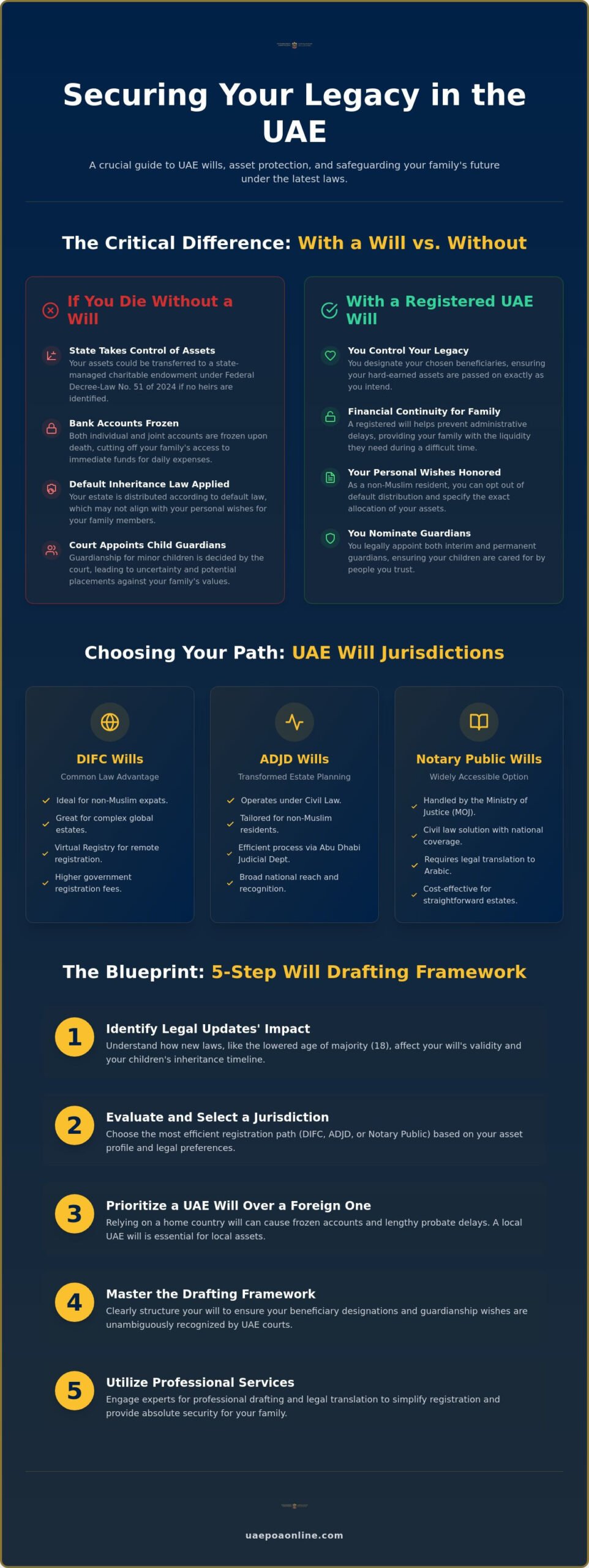
For most residents, the decision to write a will in UAE is often sidelined by the demands of daily life. However, failing to formalize your wishes creates significant legal risks that can impact your family within hours of your passing. Under Federal Decree-Law No. 51 of 2024, which became effective on January 1, 2026, assets belonging to individuals who die without a registered will and have no identifiable heirs are transferred to a state-managed charitable endowment. This “Law of the Land” ensures that no asset remains in limbo; however, it also means your hard-earned wealth might not reach the people you care about most.
One of the most immediate consequences of dying intestate is the freezing of bank accounts. UAE financial institutions typically freeze both individual and joint accounts upon learning of a death. This process remains in place until all liabilities are settled and the court issues a succession order. For a surviving spouse, this can result in a sudden loss of access to liquid cash for daily expenses, school fees, or mortgage payments. A registered will acts as a strategic shield against these administrative delays and provides the liquidity your family needs during a transition. Many expats are also surprised to discover how many dangerous myths about expat wills in the UAE can leave their families financially exposed at the worst possible moment.
Asset Distribution Under Shariah Law vs. Personal Choice
The UAE Personal Status Law serves as the default framework for estate distribution. While this system provides a clear structure, it may not reflect your specific intentions, especially regarding the proportions allocated to different family members. Non-Muslim residents have the legal right to opt-out of default Sharia-based distribution by registering a valid will under Federal Decree-Law No. 41 of 2022. This legislation provides the foundation for the UAE’s dual legal system, allowing expats to apply their personal preferences to their local assets. Without this proactive step, the court must follow the standard statutory allocations regardless of your verbal wishes.
Protecting Minor Children and Guardianship
For parents, the most distressing aspect of dying without a will is the uncertainty surrounding child guardianship. Choosing to write a will in UAE is the only way to legally nominate both interim and permanent guardians for your children. In the absence of a will, the UAE courts will intervene to appoint a guardian based on local legal principles. This often leads to unnecessary court involvement or guardianship placements that don’t align with your family’s specific values or cultural background.
It’s also essential to distinguish between physical custody and financial guardianship. A registered will allows you to clearly define who will care for your children daily and who will manage their inheritance. With the age of majority now lowered to 18 under Federal Decree-Law No. 25 of 2025, your children will gain full legal capacity sooner. This makes the precision of your guardianship and trust provisions more critical than ever before, ensuring that your children are supported by trusted individuals until they are ready to manage their own affairs.
Comparing UAE Will Jurisdictions: DIFC, ADJD, and Notary Public
Deciding where to register your document is a pivotal step when you write a will in UAE. The legal framework offers three distinct pathways, each tailored to different asset profiles and personal requirements. While the Dubai International Financial Centre (DIFC) provides a common law framework, the Abu Dhabi Judicial Department (ADJD) and the Ministry of Justice (MOJ) Notary Public offer civil law solutions with broad national reach. Selecting the right jurisdiction ensures your estate is managed according to your specific legal expectations and cultural needs.
DIFC Wills: The Common Law Advantage
The DIFC Wills Service Centre is a premier choice for non-Muslim expats who prefer a legal system similar to the UK, Australia, or Canada. It operates under common law principles, which provides a high degree of testamentary freedom. One significant benefit is the Virtual Registry. This allows you to complete the registration process remotely from anywhere in the world, making it ideal for non-resident investors. This jurisdiction is particularly effective for those with complex global estates or significant assets located within Dubai. While government registration fees for this service are higher than other options, the framework offers robust, internationally recognized protection for asset distribution.
ADJD and MOJ Notary: National Legal Options
The Abu Dhabi Judicial Department (ADJD) has transformed estate planning for non-Muslims across the Emirates. Following the implementation of Federal Decree-Law No. 41 of 2022, wills registered with the ADJD Non-Muslim Wills Registry now hold nationwide validity. This option is highly efficient and offers a fully digital registration process. For many residents, this has become the preferred route due to its streamlined nature and accessibility across all seven emirates. If your estate requires specific authorizations for business or property management, you might also consider the Online Power of Attorney UAE framework to complement your will through digital notarization.
The Ministry of Justice (MOJ) Notary Public remains the traditional route for Shariah-compliant wills or specific asset-based declarations. This path is often used by Muslim residents or those needing to formalize documents that require specific Arabic legal translation and attestation. Because the UAE’s legal environment is increasingly digital, most of these services can now be initiated through professional portals. If you’re ready to secure your assets, you can start your will preparation online to ensure every document meets the strict requirements of your chosen jurisdiction.
Common Misconceptions: Home Country Wills vs. UAE Wills
A frequent mistake among the expatriate community is assuming that a will drafted in their home country provides sufficient protection for their local assets. While international law might recognize the validity of a foreign document, the practical application within the Emirates is far from automatic. When you write a will in UAE, you’re creating a specialized legal instrument designed to interact directly with local authorities. Relying on an overseas document often forces your beneficiaries into a grueling administrative cycle that can last for months or even years.
The core issue lies in the “probate problem.” For a foreign will to be recognized, it must undergo a multi-layered attestation process. This typically involves verification by the Ministry of Foreign Affairs in your home country, the UAE Embassy abroad, and the Ministry of Foreign Affairs within the UAE. Once attested, the entire document requires certified legal translation into Arabic. These steps are not only expensive but also significantly delay the court’s ability to issue a succession order, leaving your family without access to vital resources during a critical time. Understanding the full scope of common expat will UAE myths that put family assets at risk can help you avoid these costly pitfalls before they arise.
Why Foreign Wills Cause Delays in UAE Courts
UAE courts require a local probate order to execute any distribution of assets. If you rely solely on a foreign will, the court must first verify that the document complies with both the laws of your home country and the public policy of the UAE. This creates a risk of conflicting clauses, especially regarding property rights or guardianship. Local registration is the only way to ensure immediate asset access and avoid the complications of international legal scrutiny.
The Benefits of a UAE-Specific Will
A locally registered will offers a “fast-track” for your estate. It’s directly recognized by local banks, the Dubai Land Department, and other government entities without the need for additional external verifications. This streamlined approach reduces legal fees for your beneficiaries and ensures that your specific intentions are carried out precisely as written.
Many residents choose a “Mirror Will” strategy. This involves maintaining your home country will for global assets while having a dedicated UAE document for your local interests. This dual-layered protection is particularly vital for entrepreneurs. If you hold corporate interests, you should also consider a Business Power of Attorney to ensure your company shares are managed effectively alongside your estate plan. By separating your local and global plans, you provide your family with a clear, efficient path to security that bypasses the hurdles of the international probate system.
The 5-Step Process to Writing Your Will in the UAE
Moving from the theoretical understanding of jurisdictions to the actual execution requires a methodical approach. When you decide to write a will in UAE, you’re engaging in a structured administrative sequence designed to ensure your document survives legal scrutiny. This process has become significantly more efficient in 2026, with digital integration allowing residents to complete most steps through secure online portals. Following these five steps will move your estate plan from a draft to a legally recognized shield for your family.
- Step 1: Asset and Beneficiary Mapping. Begin by identifying every asset you hold within the Emirates. This includes bank accounts, real estate, vehicle registrations, and business shares. You must also clearly identify your primary and contingent beneficiaries with their full legal names as they appear on their passports.
- Step 2: Drafting the Document. This is the most critical phase. Your will must use precise legal terminology that aligns with the requirements of your chosen jurisdiction. Vague language or contradictory clauses can lead to a will being contested or rejected during probate.
- Step 3: Certified Legal Translation. If you’re registering through the ADJD or a Ministry of Justice (MOJ) Notary, your document must be translated into Arabic. This must be performed by a translator certified by the UAE Ministry of Justice to be valid.
- Step 4: Notarization or Registration. Submit your documents to the relevant judicial body. This step finalizes the legal standing of the will. Depending on the jurisdiction, this may involve a virtual meeting or a physical appointment at a notary office.
- Step 5: Safekeeping and Informing Executors. Once registered, store your original document in a secure location. It’s vital to inform your appointed executors of the will’s existence and how they can access it when the time comes.
Drafting and Legal Translation Requirements
Generic templates often fail in UAE courts because they don’t account for the specific nuances of local property laws or the Personal Status Law. A professionally drafted will ensures that executor and guardian appointments are ironclad. For registrations involving the ADJD or MOJ, the Arabic translation isn’t just a courtesy; it’s a mandatory legal requirement. The court relies on the Arabic text as the primary source of truth, so the translation must be flawless and capture every legal nuance of the English original. Residents who want to complete this entire process remotely should explore a trusted online will service UAE that handles expert drafting, certified translation, and digital registration in one streamlined workflow.
Notarization and Final Execution
Digital notarization has revolutionized the final step of the process. Residents can now finalize their documents through secure video conferencing platforms, which has eliminated the need for lengthy physical queues at court buildings. During this phase, the presence of witnesses is mandatory to verify the identity of the testator. If you have assets that require management before the probate process concludes, a Special Power of Attorney UAE can provide your family with the immediate authority they need. To ensure your documents are prepared with absolute precision, you can register your will online today through our professional drafting service.
Professional Will Preparation Services with UAE POA Online
Choosing to write a will in UAE is a significant step toward family security, but the technical execution shouldn’t be a source of stress. The UAE’s legal landscape is sophisticated, and the 2026 standards require absolute precision to ensure a document is recognized across all jurisdictions. Our expert team simplifies this complex environment by acting as a reliable, tech-savvy intermediary. We’ve mastered the nuances of recent federal decrees, ensuring that every document we draft is fully compliant with the latest inheritance and personal status regulations.
The primary advantage of professional drafting lies in the elimination of errors that frequently invalidate “DIY” or template-based wills. A single mistranslation or a vague clause regarding asset distribution can lead to lengthy court disputes. We provide a streamlined approach that covers every requirement, from initial asset mapping to final notarization. By leveraging our deep understanding of regional administrative systems, we move your application through the necessary channels with speed and precision, valuing your time as much as your legal security.
Comprehensive Legal Documentation Support
An effective estate plan often requires more than just a single document. We offer an integrated approach that combines Wills with other essential instruments, such as a General or Property POA, to create a complete protection plan. This ensures that while your will handles your legacy, your current affairs remain protected during your lifetime. Our team provides expert assistance with MOJ Notary Services, handling the coordination required for official attestation and legal translation. For business owners who also need to notarize business documents in the UAE alongside their estate planning, our integrated support covers both personal and corporate documentation requirements under the latest 2026 MOJ framework.
Our process is transparent and methodical. We guide you through the requirements for certified legal translation, ensuring that the Arabic text reflects your intentions with 100% accuracy. Because we specialize in the digital notarization framework, we can often facilitate the final execution of your documents without the need for traditional, time-consuming office visits. This modern approach transforms a heavy bureaucratic task into a seamless, professional experience.
Secure Your Legacy Today
There is no substitute for the peace of mind that comes with professional legal oversight. When you work with us, you aren’t just getting a document; you’re securing a legally binding shield for your family’s future. We handle the technicalities so you can focus on what matters most, providing a supportive environment where your questions are answered with authority and clarity. Don’t leave your estate to the default provisions of the law when a professional solution is readily available.
This need for specialized protection extends beyond estate planning; for those requiring legal advocacy in other areas, such as personal injury law in the United States, the Oberg Law Office demonstrates how dedicated legal support can secure a family’s financial future after an unexpected event.
Our commitment to professional integrity and regional expertise makes us an indispensable partner for residents and expats alike. We understand the urgency of protecting your assets and the sensitivity of guardianship arrangements. If you’re ready to formalize your estate plan, start your UAE Will preparation with our experts today and ensure your legacy is handled with the precision it deserves.
Secure Your UAE Legacy Today
Securing your family’s future in the Emirates requires more than just good intentions. It demands proactive legal planning. We’ve explored how a locally registered document bypasses the probate problem and protects against the immediate freezing of bank accounts. By choosing the right jurisdiction and following a methodical drafting process, you replace legal uncertainty with absolute peace of mind. It’s clear that the decision to write a will in UAE is the most effective way to ensure your wishes are honored and your children’s guardianship is legally protected.
Our team of certified UAE legal experts is here to streamline this journey for you. We specialize in certified legal translation and Ministry of Justice (MOJ) notary coordination, ensuring every document meets the highest standards of validity. You don’t have to navigate these complexities alone. Protect your UAE assets and family; draft your registered will online today. Take the first step toward total family security and rest easy knowing your legacy is in expert hands.
Frequently Asked Questions
Can I write a will in the UAE online?
Yes, you can complete the entire process to write a will in UAE online through the DIFC or ADJD virtual registries. These platforms use secure video conferencing to verify identities and witness signatures remotely. This digital approach is ideal for busy residents or international investors who cannot attend physical court appointments.
Does a non-Muslim need a will in the UAE?
Yes, non-Muslims absolutely need a will to ensure their assets are distributed according to their personal wishes rather than default UAE laws. Without one, Federal Decree-Law No. 41 of 2022 and the 2024 updates might apply a standard distribution that doesn’t match your intentions. A registered document is the only way to opt out of these default frameworks and prevent assets from being transferred to state-managed endowments if no heirs are found.
What happens to my UAE bank account if I die without a will?
Your bank accounts, including joint ones, are typically frozen immediately by the bank upon notification of your death. This freeze remains until the UAE courts issue a formal succession order to distribute the funds. Having a registered will significantly speeds up this court process, allowing your family to regain access to liquid assets and settle urgent liabilities much sooner.
How much does it cost to register a will in the UAE?
Registration fees vary significantly depending on the jurisdiction you choose. The Abu Dhabi Judicial Department (ADJD) charges a government registration fee of AED 950 for a single will, while the DIFC Wills Service Centre fees start at approximately AED 10,000. You should also factor in costs for professional drafting and certified legal translation to ensure the document meets all validity requirements.
Can I appoint a guardian for my children in my UAE will?
Yes, you can and should appoint both interim and permanent guardians for your minor children in your will. This is the only legally recognized method in the UAE to ensure your children are cared for by people you trust. Since the age of majority was lowered to 18 in June 2026, guardianship provisions apply until the child reaches this new legal threshold and gains full capacity.
Is a will from my home country valid in the UAE?
A home country will is technically valid but is rarely sufficient for immediate asset transfer in the UAE. It requires a complex process of attestation, legal translation, and a local probate court order, which can take many months to resolve. We strongly recommend a local will to cover your UAE-based assets and avoid these costly administrative hurdles.
How long does the will registration process take?
The timeframe to write a will in UAE and have it registered typically ranges from a few days to a couple of weeks. Drafting the document with professional oversight is a quick process, while the registration appointment depends on the current availability of the DIFC or ADJD virtual registries. Most residents find the process surprisingly efficient once their documentation is properly prepared.
Who can be an executor of a will in the UAE?
Any mentally competent adult over the age of 18 can be appointed as an executor of your will. It’s common to choose a spouse, a close family member, or a professional firm to handle the administrative tasks of settling your estate. You should ensure your chosen executor is willing to act and understands their responsibilities under the specific requirements of UAE law.
Leave a Reply