

A single misplaced phrase or a non-certified translation can render your sworn statement completely void in a UAE court, regardless of how truthful your claims are. It’s common to feel overwhelmed by the strict requirements for Arabic legal terminology or the technical nuances of the Ministry of Justice digital portals. You want a document that stands up to scrutiny without the stress of potential rejection. Understanding how to make an affidavit in UAE shouldn’t feel like a bureaucratic maze, especially with the 2026 shift toward fully digital, “zero bureaucracy” notarization workflows that prioritize speed and transparency.
This guide provides the exact blueprint you need to navigate the latest legal procedures, ensuring your document is legally enforceable and compliant from the first draft. We’ll outline the precise documentation required, the standardized fee structures effective as of January 2026, and the essential steps for securing a certified translation that satisfies every regulatory standard. You’ll discover how to move from a draft to a notarized digital document quickly, giving you a clear path to a fast, digital-first experience that protects your legal interests.
Key Takeaways
- Master the digital-first workflow to understand exactly how to make an affidavit in UAE using the Ministry of Justice portal and your UAE PASS credentials.
- Secure document validity by utilizing MOJ-licensed legal translators for the mandatory Arabic or side-by-side bilingual formatting required for all official submissions.
- Prevent document rejection by eliminating vague legal phrasing and adhering to the specific 2026 drafting standards.
- Streamline your costs by understanding the updated 2026 fee schedule for electronic registration and signature verification.
- Select the appropriate affidavit category to ensure your sworn statement serves as legally enforceable evidence in judicial and administrative matters.
What is an Affidavit and When is it Required in the UAE?
An affidavit is a formal sworn statement of fact signed by a declarant, serving as a critical piece of evidence in administrative, judicial, and personal legal matters. To understand What is an Affidavit?, one must view it as a written version of an oath taken in court. In the local legal system, a UAE affidavit is a legally binding declaration of truth verified by a licensed notary. Without this official notarization, the document carries no legal weight within the country’s federal or local court systems. Learning how to make an affidavit in UAE is often the first step for expats and business owners who need to formalize specific facts for government entities.
The legal landscape in the UAE requires absolute precision. When you sign an affidavit, you are confirming that every statement within the document is true to the best of your knowledge. Because these documents are used as evidence, the UAE Ministry of Justice (MOJ) maintains strict standards for their drafting and execution. If a document contains vague language or lacks the necessary legal phrasing, it will likely be rejected during the digital notarization process. This is why many individuals choose to work with specialists who understand the intersection of local law and digital filing requirements.
Affidavit vs. Power of Attorney: Key Distinctions
While both documents require notarization, they serve entirely different purposes. An affidavit declares facts that you swear are true; in contrast, a Power of Attorney (POA) grants specific authority to another person to act on your behalf. If you are sponsoring a family member’s visa, you need an affidavit of support to confirm your income and relationship. However, if you want that person to sell a car for you, you need a Car POA. Understanding the difference between notarization vs attestation in UAE is also vital. Affidavits typically undergo a specific notarization process before any further attestation is required for international use. Misidentifying the document you need can lead to significant delays and unnecessary costs.
Common Uses for Affidavits in 2026
The UAE’s digital transformation has streamlined several processes, yet the requirement for verified declarations remains firm. In 2026, knowing how to make an affidavit in UAE is essential for several common scenarios. For visa and immigration applications, an Affidavit of Support is frequently required to sponsor dependents or students. In the real estate sector, these documents are used for property transactions, specifically for ownership declarations or confirming marital status during a purchase. Businesses also rely on them for corporate compliance. You may need to draft declarations for company formation or when opening corporate bank accounts to verify beneficial ownership or financial standing. Each of these cases requires a document that is not only accurate but formatted to meet the specific demands of the receiving authority.
Prerequisites: Preparing Your Affidavit for Notarization
Successful notarization begins long before you log into the official UAE government portal. In fact, most document rejections occur during the initial drafting phase because the text fails to meet the stringent 2026 federal notary standards. Precision is paramount. If your affidavit contains ambiguous terms or lacks the required legal structure, the system will flag it for correction, delaying your process by days or even weeks. Understanding how to make an affidavit in UAE requires a focus on rejection-proof preparation that aligns with the Ministry of Justice’s specific criteria.
A fundamental rule for all legal instruments in the Emirates is the language requirement. All affidavits submitted for notarization must be in Arabic. For expats and international business owners, the standard practice is to utilize a side-by-side English and Arabic format. This bilingual structure ensures total transparency, allowing the declarant to understand exactly what they’re swearing to while providing the notary with the mandatory Arabic text. You must also ensure all supporting evidence, such as bank statements or educational certificates, is valid and ready for digital upload in high-resolution PDF format.
The Necessity of Certified Legal Translation
You can’t use standard translation services for this process. The UAE Ministry of Justice only accepts translations performed by MOJ-licensed legal translators. These professionals carry a specific seal and certification that validates the document’s accuracy for court use. If you submit a document translated by an uncertified provider, your application will be cancelled immediately. Following a certified legal translation UAE compliance path is the only way to ensure your bilingual affidavit passes the first stage of review. If you’re unsure about the phrasing, our team provides expert drafting and translation coordination to streamline this step.
Identity Verification Requirements
Digital security is a cornerstone of the 2026 notarization workflow. For UAE residents, a valid Emirates ID is non-negotiable. You must also ensure your UAE PASS account is active and upgraded to the “Verified” status, as this serves as your digital signature during the finalization of the document. Non-residents aren’t excluded from the process but face different hurdles. They must provide a high-quality passport copy and may need to verify their entry stamp or visa status. Before you start, double-check that your identity documents haven’t expired, as the portal syncs directly with federal identity databases. Knowing how to make an affidavit in UAE effectively means having these digital credentials ready before you begin the upload process.
Types of Affidavits Handled by UAE Notaries
Affidavits in the Emirates aren’t one-size-fits-all documents. Understanding how to make an affidavit in UAE starts with identifying the correct legal category for your specific needs. Each type requires distinct legal phrasing and specific supporting documentation to be accepted by the notary public. The UAE Ministry of Justice affidavit process categorizes these instruments based on their intended use, ensuring each document meets the necessary evidentiary standards for local authorities. Choosing the wrong template or category is a frequent cause of rejection, so identifying your document’s primary function is a vital first step.
Most residents and business owners will encounter one of four primary affidavit types during their time in the country:
- Affidavit of Identity: This is used to confirm names, dates of birth, or parentage, often when there’s a discrepancy between different official documents.
- Affidavit of Support: This is a common requirement for sponsoring family members or students, where the declarant swears to provide financial maintenance for the dependent.
- Financial Affidavit: These are formal declarations of income, assets, or liabilities required by banks or courts during financial disputes or loan applications.
- No-Objection Affidavit: Frequently used in business or property-related authorizations, this document confirms that a party has no objection to a specific legal action or transaction.
Personal and Family Declarations
Personal affidavits often deal with sensitive family matters, such as declarations of marital status or kinship for inheritance purposes. These documents are essential for clarifying family trees or proving a relationship when original certificates are unavailable or require local verification. If your goal involves long-term estate planning or protecting your family’s future, you might also need to write a will in UAE alongside these declarations. Be aware that affidavits are also the standard tool for correcting names or minor clerical errors on official documents, providing a sworn basis for government departments to update their records.
Business and Corporate Affidavits
For commercial entities, knowing how to make an affidavit in UAE often involves swearing to company debt, liquidation status, or shareholder resolutions. Directors and shareholders must frequently provide these sworn statements to ensure MOJ compliance during company audits or structural changes. To ensure your corporate filings are handled correctly, you should review the guidelines on how to notarize business documents UAE. These affidavits serve as high-level evidence of a company’s standing and are often non-negotiable requirements for opening corporate bank accounts or securing government contracts in 2026.
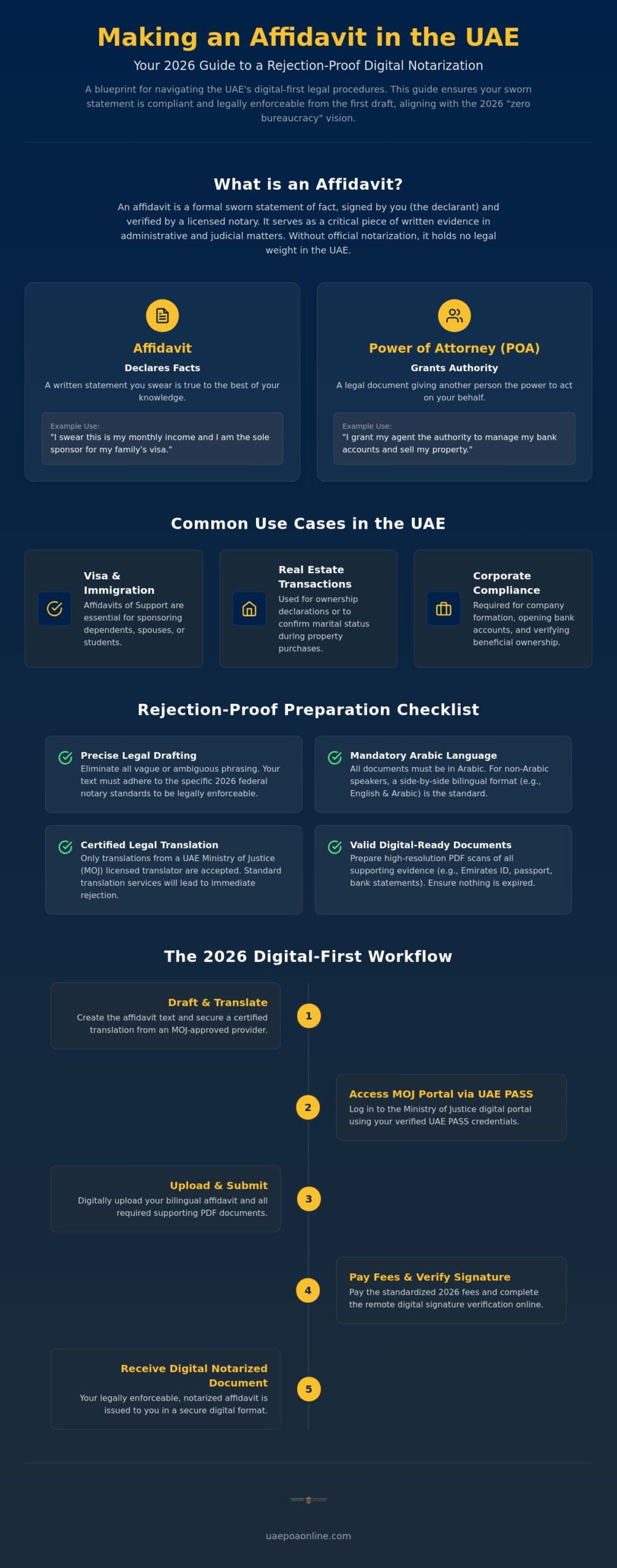
Step-by-Step Guide to Making an Affidavit Online
Transitioning from the preparation phase to the actual filing requires a methodical approach to the Ministry of Justice (MOJ) digital workflow. The process of how to make an affidavit in UAE has been redesigned to align with the country’s “zero bureaucracy” goals, allowing you to complete the entire notarization from your home or office. This digital-first strategy eliminates the need for physical appointments, provided your documentation is flawless and your digital identity is verified. To understand the full scope of how the e-notary UAE system has evolved into the primary legal standard, it helps to review the broader transformation of digital notarization services. Follow these five steps to secure your notarized statement:
- Step 1: Draft your affidavit and secure a certified legal translation from an MOJ-licensed professional to ensure the bilingual format is compliant.
- Step 2: Log in to the official Ministry of Justice (MOJ) portal using your UAE PASS credentials, ensuring your account is set to the “Verified” status.
- Step 3: Upload the bilingual document along with high-resolution PDF copies of your Emirates ID or passport.
- Step 4: Pay the required government fees, including the electronic registration and signature fees, through the portal’s integrated payment gateway.
- Step 5: Attend a brief virtual hearing with the notary public to verify your identity and confirm the facts stated in your document.
Navigating the MOJ Digital Portal
Efficiency within the portal depends on selecting the correct service category. You must look for the “Application of Affidavits and Authentication” section to begin your request. Technical delays are usually the result of file formatting issues; always ensure your uploads are in high-resolution PDF format and do not exceed the portal’s size limits. Before you begin, confirm that the mobile number linked to your UAE PASS is active. You’ll need to receive and enter multiple One-Time Passwords (OTPs) to authorize the data exchange between your digital ID and the legal system. If you find the technical requirements daunting, you can coordinate your digital notary submission with our expert team to avoid common upload errors.
The Virtual Verification Hearing
The virtual hearing is the final hurdle in learning how to make an affidavit in UAE. Once your application is reviewed and the fees are processed, a notary will initiate a video call through the portal or an authorized link. This session is brief but formal. You’ll be asked to present your original Emirates ID or passport to the camera for identity verification. The notary will then ask you to state your name and confirm that you understand the legal implications of the sworn statement you’re signing. Digital signing occurs immediately after the notary grants approval. You’ll receive a link to download the digitally notarized and sealed affidavit, which carries the same legal weight as a paper document with a physical stamp.
Common Mistakes and How to Avoid Rejection
Learning how to make an affidavit in UAE involves more than just following the steps on a portal; it requires dodging the subtle traps that lead to instant rejection. Even minor errors can trigger a cancellation, forcing you to restart the process and repay the electronic registration fees. Most failures in the 2026 digital system stem from preventable drafting oversights or technical mismatches that can be easily avoided with the right preparation.
Vague language is the primary reason for rejection. A notary can’t verify a statement that’s open to interpretation. If you simply state you “possess assets,” the description is too broad. You must list specific bank account numbers, plot details, or property title deed numbers exactly. Another critical error is the failure to use an MOJ-licensed translator. The digital portal validates translator credentials automatically. If your document lacks a certified seal from a licensed professional, the system cancels the application immediately before a notary even reviews it.
Technical compliance also involves your identity documents. Expired Emirates IDs or passports halt the verification stage because the portal syncs directly with federal databases. You must also ensure the Arabic and English texts in your bilingual document are identical in meaning. Discrepancies between the two versions make notaries question your intent, which almost always leads to a rejected signature. Ensuring both sides of the page convey the exact same legal facts is essential for a smooth approval.
Ensuring 2026 Legal Compliance
Your sworn statement must align with UAE public order and Sharia principles. Any document contradicting local legal codes will not be notarized. Use names and dates exactly as they appear on your official IDs to prevent database mismatches. If your goal is to authorize a third party to act on your behalf rather than just declaring a fact, you may need an online power of attorney UAE to ensure you have the correct legal instrument for representation.
Professional Review and Coordination
Consulting a specialist to review your draft before government submission is the most efficient way to secure a successful result. Expert coordination ensures your document is “rejection-proof” and processed on the first attempt. This approach allows you to manage the entire workflow digitally, even if you’re currently abroad. By letting a tech-savvy legal expert handle the nuances of how to make an affidavit in UAE, you move swiftly from inquiry to a legally enforceable document without the typical bureaucratic headaches.
Secure Your Legal Standing with Digital Precision
Navigating the 2026 legal landscape requires a commitment to accuracy and a firm grasp of the Emirates’ digital-first administrative systems. By prioritizing MOJ-compliant bilingual drafting and ensuring your UAE PASS credentials are verified, you can successfully bypass the common pitfalls that lead to document rejection. Mastering how to make an affidavit in UAE is no longer a matter of waiting in queues; it is about leveraging the right technology and legal expertise to create a document that stands up to the highest level of judicial scrutiny.
Don’t let technical complexities or translation nuances delay your personal or business milestones. Our team of certified MOJ notary experts provides a 100% digital workflow designed for speed and absolute reliability. With our 24-hour legal drafting turnaround, you can ensure your sworn statement is precise, valid, and ready for immediate notarization. Draft and notarize your UAE affidavit with UAE POA Online today and experience a streamlined process that respects your time. You’re now equipped with the knowledge to formalize your legal documents with total confidence.
Frequently Asked Questions
Can I make an affidavit in the UAE online while I am outside the country?
Yes, you can complete the entire process from abroad. The Ministry of Justice digital portal allows for remote submissions as long as you have an active UAE PASS account. You’ll need to attend a virtual hearing via a video call to verify your identity. This digital approach ensures that knowing how to make an affidavit in UAE is accessible to residents and non-residents regardless of their physical location.
What is the government fee for notarizing an affidavit in the UAE in 2026?
As of January 2, 2026, the electronic registration fee is AED 100 for each party’s details in the system. There’s also a signature fee of AED 100 for each signature on the legal instrument. For standard affidavits at a public notary, the notarization cost generally ranges between AED 100 and AED 200. These fees are standardized to ensure transparency across all digital and physical service points.
How long does the entire affidavit process take from drafting to signing?
The timeline is remarkably efficient in the 2026 digital workflow. Professional drafting typically takes 24 hours; meanwhile, the Ministry of Justice generally processes the digital application within three working days. Your total turnaround time depends largely on how quickly you book and attend your virtual hearing with the notary. Accurate documentation on the first attempt is the best way to ensure a fast result.
Do I need witnesses to sign my affidavit in the UAE?
Most standard affidavits don’t require external witnesses to be present. The notary public acts as the official witness to your declaration and identity verification during the virtual or physical hearing. Some specific document types or cases involving individuals with certain disabilities might require witnesses; however, for the vast majority of personal and business declarations, your verified UAE PASS signature is sufficient.
Is a digital signature legally valid for a UAE affidavit?
Yes, a digital signature is fully valid and carries the same legal weight as a physical one. The UAE legal system uses the UAE PASS infrastructure to provide a secure, encrypted method for signing documents. This process is the standard for the 2026 digital-first initiative. It ensures that your document is tamper-proof and easily verifiable by any government entity or bank within the Emirates.
What happens if my affidavit is rejected by the notary public?
If the notary rejects your document, the application is usually cancelled. You’ll receive a notification explaining the reason, such as incorrect legal phrasing or translation discrepancies. You’ll need to fix the errors and submit a new application. It’s important to remember that government registration fees are typically non-refundable, so you’ll have to pay them again for the new submission.
Does an affidavit made in the UAE need MOFA attestation for use abroad?
Yes, any document intended for use outside the UAE must be attested by the Ministry of Foreign Affairs (MOFA). Notarization only makes the document valid for use within the country. The MOFA attestation verifies the notary’s signature for international authorities. In 2026, the fee for personal document attestation is approximately AED 150 to AED 250, and the process is handled primarily through a digital portal.
Can I draft an affidavit in English only for use in the UAE?
No, you cannot use an English-only affidavit for official legal purposes. All documents must be in Arabic to be recognized by the courts and government departments. When learning how to make an affidavit in UAE, most expats choose a side-by-side bilingual format. This allows you to read the content in English while providing the mandatory Arabic text required for the notary to approve the document.
Leave a Reply