

In 2026, the traditional image of waiting in a government office for a physical stamp is officially a thing of the past. The e-notary UAE system has moved from a digital alternative to the primary legal standard, allowing you to formalize critical documents with total confidence from your laptop. You’ve likely felt the frustration of trying to distinguish between notarization and attestation, or perhaps you’re worried that a digital Power of Attorney won’t be accepted by your bank or local authorities. It’s a common concern when the stakes for your property or business are this high.
We understand that navigating the Ministry of Justice portals can feel overwhelming when you’re working against tight deadlines. This comprehensive guide will show you how the UAE has revolutionized legal documentation to make it faster and more secure than ever before. You’ll learn exactly how the MOJ e-notary system works, how to avoid document rejection, and the specific steps to secure a legally valid POA from anywhere on the globe. We’ll simplify the technicalities so you can move forward with your legal matters without the stress of travel or bureaucratic delays.
Key Takeaways
- Learn how digital QR-code verification has replaced physical stamps to ensure your documents are instantly verifiable and fraud-proof.
- Understand the critical role of UAE Pass and multi-factor authentication in securing your identity within the e-notary UAE system.
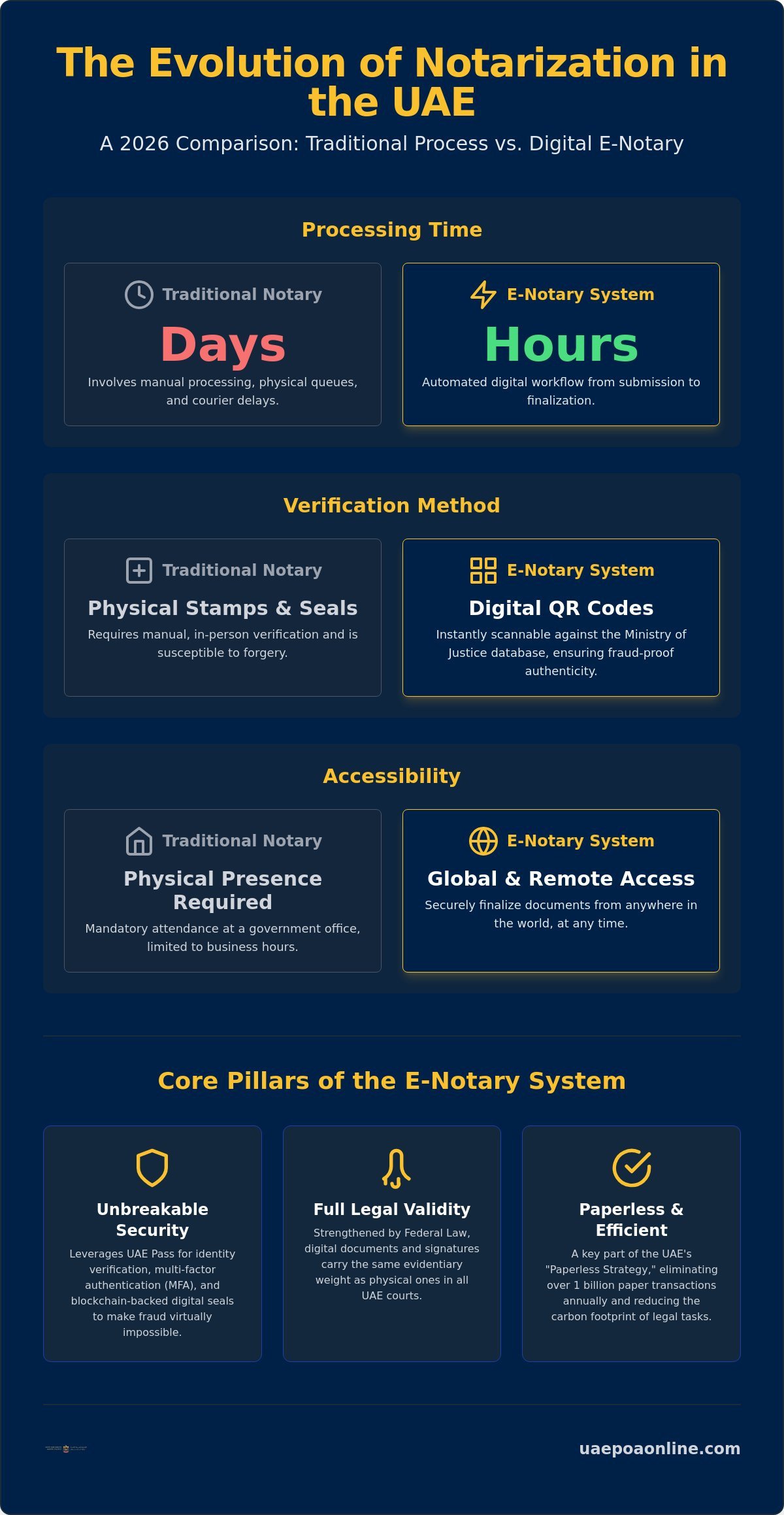
- Discover how the transition from traditional notarization to digital systems has reduced processing times from days to mere hours.
- Master the step-by-step requirements for remote notarization, including the mandatory role of certified legal translation for MOJ portal acceptance.
- Explore how AI integration and expanded digital services are making complex estate planning and Wills more accessible for residents and overseas investors.
The Rise of E-Notary UAE: Transforming Legal Documentation in 2026
The legal landscape in the Emirates has undergone a massive transformation. By 2026, the e-notary UAE system has evolved from an experimental digital tool into the definitive standard for legalizing documents. An e-notary is essentially the digital equivalent of the traditional public notary service, but it removes the need for physical presence and manual paperwork. Instead of the familiar wet-ink stamps and embossed seals, you’ll now find digital QR-code verification on every document. These codes allow any authority, bank, or government entity to instantly verify the document’s authenticity by scanning it against the Ministry of Justice (MOJ) database.
This transition is a cornerstone of the UAE’s “Paperless Strategy,” which aims to eliminate over a billion pieces of paper used in government transactions annually. The MOJ has successfully unified national standards, ensuring that whether you’re in Dubai, Abu Dhabi, or the Northern Emirates, the process and legal standing of your documents remain consistent. It’s a move that prioritizes your time and security, replacing slow, manual checks with high-speed encryption and a unified e-notary UAE portal.
Why the UAE Shifted to Digital Notarization
The shift wasn’t just about modernizing for the sake of technology; it was a strategic move to boost the efficiency of the federal judicial system. By automating the verification process, the courts have significantly reduced the administrative burden on public officials, allowing for faster turnaround times on complex filings. You no longer need to wait for hours in a lobby to secure a five-minute appointment.
There’s also a vital environmental component to this change. Reducing the carbon footprint of legal tasks is a priority, and moving to a digital-first model removes the need for millions of couriers and physical storage facilities. Perhaps most importantly, the system facilitates global investment. Overseas investors can now participate in the UAE market with ease, signing contracts and issuing Powers of Attorney without ever stepping onto a plane. This global accessibility is supported by the broader technological framework of eNotary services, which ensures that digital documentation meets international security standards.
Legal Validity of Electronic Notarization
You might wonder if a digital file holds the same weight as a paper document in a courtroom. The answer is a definitive yes. The legal framework is built upon Federal Law No. 11 of 2017, which was further strengthened by 2026 updates to reflect modern encryption standards. These laws ensure that digital documents are treated with the same evidentiary weight as physical ones in all UAE courts. This means your Property POA or Business POA is fully protected under federal law.
The system is designed to be airtight. Every document processed through the digital portal is backed by the state’s judicial authority and protected against tampering. In the UAE, a digital signature verified through the UAE Pass carries the same legal weight and enforceability as a handwritten signature on a physical document. This legal parity provides the certainty you need when managing high-value assets or corporate agreements.
How the UAE E-Notary System Works: Security and Technology
The e-notary UAE infrastructure is built on a foundation of “security by design,” ensuring that every digital interaction is as legally binding as a face-to-face meeting. It isn’t merely a video conference; it’s a sophisticated multi-layered protocol that combines identity verification, real-time visual confirmation, and immutable record-keeping. By utilizing the UAE Ministry of Justice E-Notary System, the government has created a environment where fraud is virtually impossible. Every document notarized through this portal receives a unique digital seal backed by blockchain technology. This ensures that once a document is signed and sealed, it cannot be altered without breaking the digital verification, providing a level of integrity that physical paper simply can’t match.
To prevent unauthorized access, the system employs mandatory multi-factor authentication (MFA). This means that even after you log in, every critical action—such as the final signature—requires a secondary confirmation, usually through a time-sensitive code or a biometric prompt on your mobile device. This rigorous approach alleviates the fear of document rejection by banks or authorities, as the digital trail is transparent and verifiable at every step.
Identity Verification via UAE Pass
The UAE Pass serves as the primary digital identity for all notarization tasks. It effectively replaces the need to present a physical Emirates ID to a notary public. When you initiate a request, the system pulls your verified biometric data directly from the national registry, confirming your identity with absolute certainty. For non-residents or overseas investors, the process has been streamlined to allow for temporary digital identity access. This enables you to participate in the legal system without a residency visa, provided you meet the specific security protocols for remote verification. This biometric handling ensures that only the authorized individual can execute a Power of Attorney or contract.
The Role of Certified Legal Translation
Arabic remains the official language of the UAE judicial system. Consequently, any document drafted in English or another language must undergo a certified legal translation UAE before it can be uploaded to the MOJ portal. This isn’t a standard translation; it must be performed by a translator whose seal is officially recognized by the Ministry of Justice. Modern digital translation platforms now integrate directly with e-notary systems, allowing for a seamless flow from drafting to notarization. Ensuring your translation is certified is a mandatory prerequisite that prevents delays or rejection during the final review.
Managing these technical requirements can be complex, especially when dealing with urgent legal matters. If you’re looking to streamline this process, working with a specialist like UAE POA Online can help you navigate the MOJ portal requirements with precision and speed.
Traditional Notary vs. E-Notary: A 2026 Comparison
Choosing between a traditional notary and the modern e-notary UAE system depends on your specific legal requirements, but the efficiency gap between the two is now undeniable. In the past, notarizing a document meant scheduling an appointment, traveling to a government office, and waiting for a physical stamp. This process typically spanned several days. Today, the digital route has condensed that timeline into mere hours. By utilizing the UAE Ministry of Justice E-Notary System, you can initiate, sign, and receive a fully legalized document without ever leaving your desk.
Security standards have also shifted. While traditional ink stamps and embossed seals were once the gold standard, they are vulnerable to physical damage or forgery. The e-notary system replaces these with QR-code verification and blockchain-backed seals. This allows any third party to verify the document’s validity instantly. For businesses, the cost-benefit analysis is clear: the digital system eliminates courier fees, travel expenses, and the hidden costs of administrative delays. It’s a more transparent, faster, and more secure way to handle corporate and personal legalities.
When to Choose a Traditional Notary Public
Despite the digital shift, physical presence is still necessary in a few specific scenarios. Some foreign embassies still require “wet-ink” signatures for documents intended for use outside the UAE, particularly in countries that haven’t yet adopted digital notarization standards. You might also need a traditional notary when dealing with original physical title deeds or contracts that pre-date the digital transition. Additionally, complex multi-party agreements where all signatories must be physically identified and witnessed simultaneously may still favor an in-person session to ensure every party fully understands the legal implications in real-time.
The Dominance of E-Notary for Power of Attorney
For most residents and investors, an online power of attorney UAE is now the default choice. Whether you’re selling a property, registering a vehicle, or managing business shares, the digital system provides unmatched speed. You don’t have to wait for a specific time slot at the courts. Instead, you can draft your document, secure your translation, and complete the video verification from any global location. By removing the need for physical travel and manual document handling, e-notarization has reduced POA processing time by 80% compared to traditional in-person appointments. This responsiveness is vital for urgent legal matters where every hour counts.
Navigating the E-Notary Process: A Step-by-Step Guide
The e-notary UAE system is designed for speed, but its efficiency depends on following a precise sequence of actions. Missing a single technical requirement can lead to delays or the need to restart the application. By following this structured path, you can ensure your document moves through the Ministry of Justice (MOJ) portal without friction. The process is entirely digital, meaning you can manage your legal affairs from your home or office, provided you have a stable internet connection and the necessary verified credentials.
- Step 1: Drafting. Work with a legal expert to draft your document. Precision is vital; vague language often leads to rejection by banks or land departments.
- Step 2: Translation. Secure a certified legal translation into Arabic. The MOJ only accepts documents translated by licensed professionals recognized by the ministry.
- Step 3: Submission. Upload your bilingual document to the relevant digital portal. You’ll need to provide party details and attach supporting identification.
- Step 4: The Signing Ceremony. Attend a brief virtual meeting with the notary. They’ll verify your identity and witness your digital signature via a secure video link.
- Step 5: Verification. Once approved, you’ll receive your digitally notarized document via email. It features a QR code for instant authentication by any authority.
Preparing Your Documents for Success
Rejection often stems from minor administrative errors rather than legal flaws. Ensure your scans are high-resolution and that your digital identity is fully updated in the UAE Pass app. When you notarize business documents UAE, you must also prove that the signatory has the authority to act on behalf of the company. This usually requires uploading the Memorandum of Association or a relevant Board Resolution. Precise wording in a Special POA is equally critical; if the powers aren’t explicitly stated, the document may be deemed insufficient for specific transactions like property sales or bank account closures.
E-Notary for Clients Outside the UAE
If you’re an overseas investor, remote notarization UAE services are your most efficient option. You don’t need to visit a UAE embassy or courier physical papers across borders. The virtual meeting takes place via secure platforms like Zoom or Botim, where the notary confirms your identity in real-time. For documents intended for use outside the UAE, you may still need to coordinate with the Ministry of Foreign Affairs (MOFA) for electronic attestation. This cross-border integration ensures that your e-notary UAE documents are recognized internationally, maintaining their legal integrity regardless of your physical location.
If you’re ready to begin your application, you can order your online POA drafting and coordination here to ensure every detail is handled by experts.
Future Trends: What to Expect from UAE Notary Services
The trajectory of the e-notary UAE system points toward a fully autonomous legal ecosystem. While the current focus is on accessibility, the next frontier involves the integration of Artificial Intelligence (AI) to handle initial document reviews. This shift ensures that compliance checking happens in real-time, long before a notary public even opens the file. We’re also seeing a push for increased interoperability. This means your UAE-issued digital documents will eventually be instantly verifiable by global legal networks without the need for traditional, slow-moving legalization chains. UAE POA Online remains at the forefront of these technological shifts, ensuring our clients benefit from the latest security and speed enhancements.
AI and Automated Legal Drafting
AI is already transforming how we handle a general power of attorney UAE. By using advanced algorithms to scan drafts against current Ministry of Justice (MOJ) standards, we can eliminate common clerical errors that previously caused delays. This doesn’t replace human oversight. Instead, it allows our legal experts to focus on the strategic wording of your document while automation handles the structural pre-checks. You’ll experience faster turnaround times through these automated MOJ portal pre-checks, which flag inconsistencies in seconds rather than days.
Securing Your Legacy with Digital Wills
Estate planning is the next major area to embrace full digitization. The trend to write a will in UAE has become significantly more streamlined through e-notarization, particularly for non-Muslim residents and expats. The ability to register a Will remotely through a secure video link removes the logistical hurdles that often lead people to delay this critical task. Digital registration ensures your legacy is protected within a system that’s both transparent and easily accessible to your beneficiaries, regardless of where they are in the world. This expansion of the e-notary UAE system provides peace of mind through a secure, tamper-proof digital record.
The legal world is moving fast, and having a partner who understands these digital transitions is essential. Our team manages the technical complexities of the MOJ portal so you don’t have to. We ensure your documents are drafted with precision and processed with the urgency your matters deserve. Start your e-notary process with UAE POA Online today and experience the future of legal documentation.
Secure Your Legal Future with Digital Precision
The transformation of the UAE’s legal landscape is complete. Digital notarization is no longer a secondary option; it’s the most secure and efficient way to protect your interests. By leveraging the e-notary UAE system, you eliminate the need for physical travel and reduce processing times from days to hours. You’ve seen how blockchain-backed seals and UAE Pass integration provide a level of security that traditional paper documents simply can’t match. Whether you’re managing property from abroad or finalizing a business contract locally, the process is now designed to work around your schedule.
Navigating these digital portals doesn’t have to be stressful. Our team provides comprehensive support, including mandatory certified legal translation and expert MOJ portal management. We specialize in a 100% remote process that caters specifically to overseas clients; we ensure your documents meet every regulatory standard without you ever needing to visit an office. Streamline your legal documentation with our expert e-notary coordination services. Embrace the speed and reliability of a modern judicial system today.
Frequently Asked Questions
What documents can be notarized through the UAE e-notary system?
You can notarize a wide range of legal documents through the e-notary UAE system, including General and Special Powers of Attorney, Memorandum of Association, and various declarations. It’s also the standard for commercial contracts and corporate resolutions. While most civil and commercial papers are eligible, certain documents involving real estate title transfers or specific family law matters might still require additional court-specific procedures depending on the emirate’s local regulations.
Do I need to be physically present in the UAE to use the e-notary service?
No, you don’t need to be physically present in the country to complete the notarization process. The system is specifically designed for global accessibility, allowing you to participate in a secure video conference with a notary from anywhere in the world. As long as you have the required digital identification and a stable internet connection, you can finalize your legal documentation without the need for international travel.
How long does the e-notary process take from start to finish?
The digital process is significantly faster than traditional methods, often taking just a few hours once your documents are drafted and translated. While the actual video ceremony lasts only a few minutes, the total turnaround time depends on the Ministry of Justice portal’s review speed. Most clients receive their digitally signed and QR-coded documents within one to two business days after their initial submission.
Is a digital signature from an e-notary accepted by UAE banks?
Yes, digital signatures and QR-code verified documents from an e-notary UAE are fully accepted by all UAE banks and government authorities. These documents carry the same legal weight as those with traditional physical stamps. Because the authenticity can be verified instantly via the Ministry of Justice database, banks often prefer this digital format for its enhanced security and superior fraud prevention features.
What is the difference between notarization and attestation in the UAE?
Notarization is the process where a notary public verifies the identity of the signatories and witnesses the signing of a document. Attestation, usually performed by the Ministry of Foreign Affairs (MOFA), is a separate step that verifies the authenticity of the seals and signatures on a document for use in different jurisdictions. You typically notarize a document first before seeking further attestation if it’s required for international use.
Can I notarize a document in English using the e-notary system?
You cannot notarize a document solely in English; it must be in Arabic or provided as a bilingual document. Every English legal text must undergo certified legal translation by a Ministry of Justice licensed translator before it’s uploaded to the system. This ensures the document is legally valid and understandable within the UAE’s official judicial framework, which operates primarily in Arabic.
What happens if my document is rejected by the e-notary portal?
If the portal rejects your document, the system provides a specific reason for the refusal, such as incorrect wording or missing identification. You’ll need to rectify the error, which might involve redrafting the text or providing updated high-resolution scans of your ID. Working with experts can prevent these setbacks by ensuring your application meets all technical and legal standards before the first submission is ever made.
Is the UAE Pass mandatory for all e-notary transactions?
Yes, the UAE Pass is the mandatory digital identity tool for residents and citizens using the e-notary UAE system. It provides the secure authentication required to sign documents digitally. For non-residents, there are specific procedures to gain temporary digital access for legal transactions. This integration ensures that every signature is biometric-verified, maintaining the highest levels of security and legal integrity for all parties involved.
Leave a Reply