

Why spend thousands on international flights and embassy appointments when your smartphone can finalize your legal affairs in minutes? It’s a common frustration for expats and overseas investors who believe that a physical presence is still required for high-stakes documentation. The reality is that remote notarization UAE has transformed into a permanent, blockchain-secured system that is often faster and more reliable than traditional manual methods.
We understand the anxiety of potentially having a document rejected by authorities or struggling with technical hurdles like the UAE Pass. You need a solution that is both legally airtight and efficient. This 2026 guide provides the exact step-by-step process to notarize your Power of Attorney from anywhere in the world. We’ll cover the latest Ministry of Justice digital protocols, the shift toward blockchain-verified originals, and how to navigate the required video calls to ensure your legal documents are processed with total precision.
Key Takeaways
- Understand how the MOJ digital system enables legally binding signatures via live video link, removing the need for costly and time-consuming embassy visits.
- Compare the digital and consular paths to see how you can reduce document processing times from several weeks to just a few business days.
- Follow a proven workflow for remote notarization UAE that includes professional drafting and mandatory certified legal translation into Arabic.
- Learn the essential identity verification standards and specific clauses required for your document to be accepted by UAE authorities for property or business.
- Find out how to handle technical hurdles like video call coordination and digital portal requirements for a seamless, stress-free experience from abroad.
What is Remote Notarization in the UAE?
Remote notarization in the UAE is a legally binding procedure that allows a Notary Public to witness and verify a principal’s signature through a secure, live video conference. For years, granting power of attorney from abroad required tedious visits to a UAE Embassy or Consulate, followed by physical courier services and manual attestations. Today, the Ministry of Justice (MOJ) has digitized this entire workflow. It creates a seamless bridge between the legal requirements of the Emirates and the needs of global citizens. This shift isn’t just a temporary measure. It’s a permanent evolution toward a more accessible legal system.
Under Federal Decree-Law No. 20/2022, digital notarial deeds are granted the same legal standing as traditional paper-based documents. This isn’t just a convenience; it’s a robust system backed by blockchain technology. When a document is notarized remotely, it’s issued with a unique QR code. This allows any authority, from the Dubai Land Department to local banks, to verify its authenticity instantly. This system serves overseas investors, expats, and business owners who need to manage their UAE-based interests without the logistical burden of international travel. Using remote notarization UAE services ensures that your legal instruments are handled with both speed and professional integrity.
The Legal Framework for Digital Signatures
The UAE has established a rigorous foundation for electronic legal acts through the Electronic Transactions and Trust Services Law. This framework ensures that your digital signature is as valid as a physical one. To maintain high security, the MOJ uses advanced identity verification protocols. A central component of this process is the UAE Pass app, which serves as a secure digital identity. For those asking What is Remote Notarization? in a global context, the UAE’s model stands out for its direct integration with government databases to confirm the principal’s identity in real-time.
Common Documents Notarized Remotely
Most legal instruments can now be handled through remote notarization UAE portals. This includes a Special Power of Attorney for specific tasks like selling a property in Dubai or transferring a vehicle registration. Business owners frequently use the system for corporate resolutions or authorizing local managers. Whether you need a General POA for broad representation or a targeted Property POA for a real estate transaction, the digital system accommodates these needs. It eliminates the fear of document rejection by ensuring every file meets the Ministry’s strict formatting and translation standards before the video call begins.
Digital vs. Consular Path: Which Should You Choose?
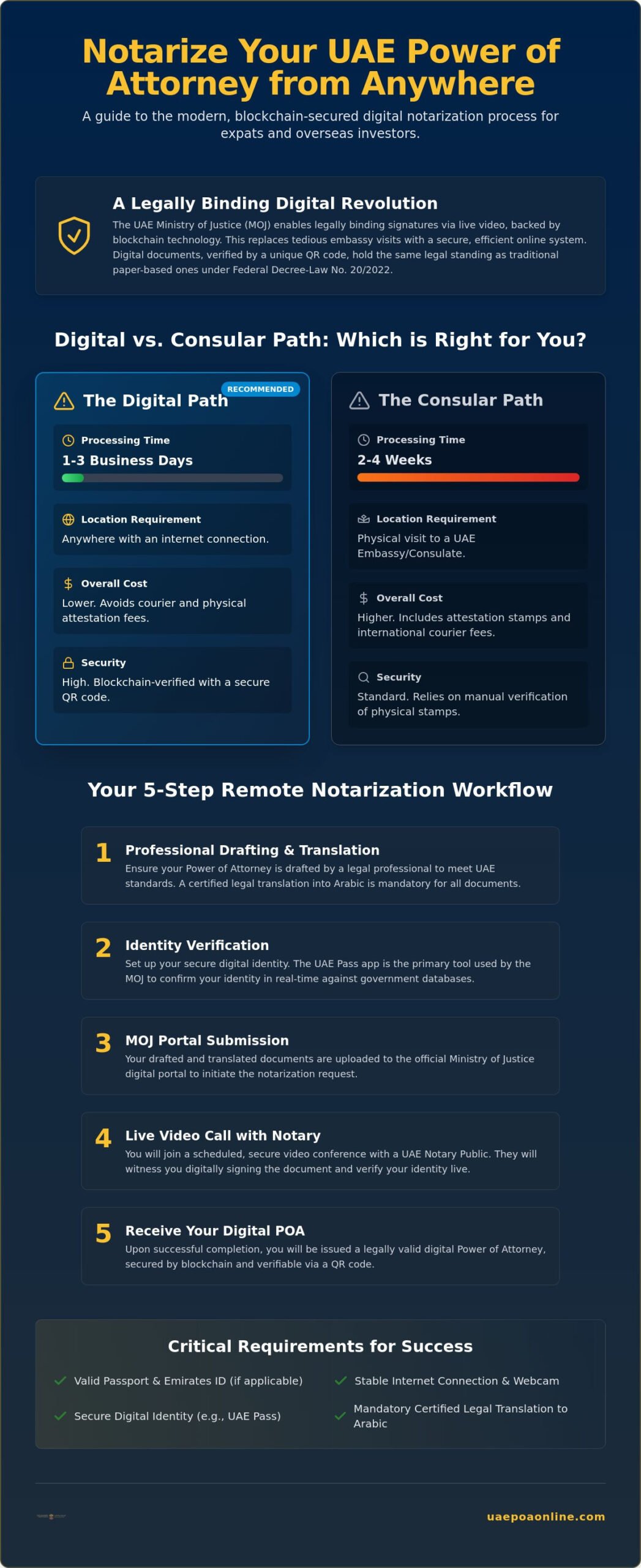
Choosing between the traditional consular route and modern remote notarization UAE systems depends on your urgency and location. Before the official government announcement regarding digital issuance, the consular path was the only option for those abroad. This older method involves visiting a UAE Embassy, obtaining stamps from the local Ministry of Foreign Affairs, and then couriering physical papers to the UAE for final MOFA attestation. It’s a multi-step process that often stretches across two to four weeks. The logistical burden of scheduling appointments and managing physical mail can be significant, especially during urgent legal matters.
In contrast, the digital path leverages the Ministry of Justice portal to finalize documents in just one to three business days. This speed is a game-changer for clients facing tight deadlines. You don’t need to worry about international courier fees or the risk of documents getting lost in transit. Cost considerations also favor the digital route. While notary fees are standardized, you avoid the high costs of physical attestation stamps and premium shipping services. Geographic flexibility is perhaps the greatest benefit. Whether you’re in a remote town far from a consulate or a major city, the requirements remain the same: a stable internet connection and valid identification. If you’re unsure which route fits your specific situation, our team at UAE POA Online can help you evaluate the most efficient path.
When the Consular Path is Still Necessary
While digital is faster, some legacy requirements still exist. Certain banks or specific government departments might occasionally insist on physical stamps for older file systems. Additionally, if a principal lacks a digital identity or faces challenges with digital identity verification due to specific nationality-based documentation rules, the traditional MOFA route remains a reliable fallback. This path ensures that even without a digital-first setup, your documents eventually gain the necessary legal weight through manual authentication. It provides a safety net for complex cases where modern tech hurdles might arise.
The Digital Advantage for Real Estate
Real estate transactions are highly time-sensitive. Overseas sellers often lose deals because of delays in document attestation. The digital system integrates directly with UAE land authorities, allowing for immediate verification. By using remote notarization UAE protocols, you eliminate the “dead time” spent waiting for mail. This direct coordination with the MOJ ensures that your Property POA is valid the moment the video call ends. It allows your representative to act on your behalf without a second’s delay, ensuring you never miss a market opportunity due to bureaucratic lag. For a deeper understanding of the specific legal requirements involved, our guide on POA for property management UAE covers the latest 2026 mandates, including validity limits and required wording for overseas authorizations.
Step-by-Step Guide to Remote Notarization via MOJ
Completing remote notarization UAE requires a methodical approach to ensure your documents are legally sound and technically compliant. The Ministry of Justice (MOJ) has designed a streamlined digital workflow, but precision at each stage is vital to avoid delays or rejection. By following these five steps, you can secure a valid Power of Attorney without leaving your home or office abroad.
- Step 1: Professional Drafting. Begin with the precise drafting of your special power of attorney UAE or other legal instrument. The document must explicitly state the powers granted and the specific assets involved to meet the standards of UAE banks and government departments.
- Step 2: Certified Legal Translation. Secure a certified legal translation into Arabic. This is a mandatory requirement for all documents processed through the MOJ. The final version must be bilingual, presenting the English and Arabic text side-by-side.
- Step 3: Portal Submission. Upload your documents to the MOJ digital portal. During this stage, you’ll provide your identity details and schedule a time for your live video call with a licensed Notary Public.
- Step 4: The Video Call Session. Join the video call at your scheduled time. The Notary Public will verify your identity, confirm your sound mind, and witness your digital signature in real-time.
- Step 5: Document Issuance. Once approved, you’ll receive a digitally signed and stamped PDF document. This file contains a unique QR code for instant blockchain verification by any third party in the UAE.
Technical Setup for the Video Call
The MOJ currently utilizes secure platforms like Botim or MS Teams for remote sessions. You’ll need a stable, high-speed internet connection to ensure the call doesn’t drop, as interruptions can lead to the session being voided. Before logging in, have your original passport and Emirates ID (if applicable) physically present. The Notary will ask you to show these documents to the camera, tilting them to reveal security features like holograms. This real-time verification is a critical part of the remote notarization UAE process.
The Role of Legal Translation
Legal translation in the UAE is a regulated profession. Your document must be translated by MOJ-certified experts who understand the nuances of local law. A minor error in a property plot number or a misspelled name can lead to an immediate rejection during the video call. Using a service that handles both drafting and certified translation ensures that your bilingual document is perfectly synchronized. This cohesion is essential for a smooth approval process, as the Notary will review both language versions simultaneously during your session.
Critical Requirements for UAE Power of Attorney from Abroad
Preparation is the most critical phase of remote notarization UAE. While the digital system is designed for speed, the Notary Public must adhere to strict regulatory standards before approving any document. This means your paperwork must be flawless before the video call even begins. For clients operating from abroad, this requires a deep understanding of how local authorities verify international documentation without a physical presence.
One of the primary requirements is a high-resolution, color scan of your original passport. Low-quality images or photos taken with a phone camera often lead to immediate delays. The Notary must be able to see all security features clearly. Additionally, if you are handling property transactions, your POA must include specific clauses that match the requirements of the Dubai Land Department or other relevant emirate authorities. Vague language regarding “property management” is rarely sufficient for a sale or purchase; you must specify plot numbers, title deed details, and the exact scope of authority. If you need assistance with these specific legal phrasings, you can start your document preparation today with our expert team.
Identity Verification for Non-Residents
Many overseas investors worry about the process if they don’t hold an active Emirates ID. The MOJ system is fully equipped to handle non-residents using international passport standards. The Notary will verify your identity by comparing your live video feed against the passport copy uploaded to the portal. Remote Identity Verification in 2026 utilizes multi-factor biometric matching against international passport databases to ensure the absolute integrity of digital signatures. It’s vital that your name matches exactly across your passport, the POA draft, and any supporting property or business documents to avoid verification failures.
Avoiding Common Rejection Reasons
Document rejection is usually the result of minor technical or linguistic oversights. Vague general power of attorney UAE documents are frequently flagged if they don’t explicitly authorize the representative to sign specific contracts or handle financial transfers. Other common issues include:
- Formatting Errors: Failing to use the specific digital templates required by the MOJ portal.
- Timing Hurdles: Not having all parties, including any required witnesses or co-signatories, ready and available for the live session.
- Translation Gaps: Using non-certified translators whose work doesn’t meet the Ministry’s bilingual standard.
The digital witness requirement is now handled through the Notary’s own verification of the live session recording. This replaces the need for physical witnesses to be present in the room with you. By ensuring your documentation is precise and your technical setup is ready, you can move through the remote notarization UAE process with absolute confidence.
Streamlining Your Remote Legal Documentation with UAE POA Online
Managing legal affairs across borders shouldn’t be a source of stress. UAE POA Online serves as your specialized intermediary, handling the technical and legal complexities of the Ministry of Justice interface so you don’t have to. We provide a comprehensive service that ensures every document meets the strict standards of remote notarization UAE protocols. From the initial drafting of your document to the final digital stamp, our team prioritizes speed and precision to protect your interests. We bridge the gap between your location and the UAE legal system, providing a secure path to formalize your documents without the need for travel.
Our approach is built on transparency and absolute competence. We understand that overseas clients often feel lost in the technicalities of digital portals and bilingual requirements. By offering a “done-for-you” experience, we alleviate the bureaucratic burden. Our experts coordinate every detail, ensuring that your legal needs are handled with the responsiveness and integrity you expect from a trusted specialist. Whether you are dealing with property, business, or personal matters, we provide the local insider knowledge required to navigate regional systems successfully.
Why Professional Coordination Matters
Navigating the MOJ portal can be complex for first-time users. The system requires specific file formats, precise bilingual layouts, and an intimate understanding of digital identity verification. We ensure your document is completely “notary-ready” before the video call starts. This preparation includes verifying that your ID scans are high-resolution and that your Arabic translation is flawless. By handling these details in advance, we significantly reduce the risk of multiple appointments and delays. Our goal is to make the process a well-oiled machine, moving you swiftly from inquiry to action.
Our Specialized Services for Overseas Clients
We recognize that different transactions require different levels of legal depth. Our team specializes in drafting business power of attorney UAE documents for international directors who need to manage corporate entities from afar. We also provide targeted assistance with property dispute POAs for non-resident owners, ensuring you have the legal standing to resolve local issues. Because we provide in-house certified legal translation, you don’t have to coordinate with multiple vendors. This integrated approach ensures 100% compliance with MOJ standards. You can get started with your remote notarization today and secure your legal representation with total confidence.
Secure Your UAE Legal Representation Today
The shift to digital legal services has removed the old barriers of distance and bureaucracy. By choosing remote notarization UAE, you bypass the weeks of waiting associated with embassy visits and physical courier services. Success in this digital environment requires more than just a video call; it demands precise drafting, certified translation, and a deep understanding of Ministry of Justice protocols. A well-prepared document can be finalized in just a few business days, providing you with a blockchain-verified Power of Attorney that is ready for immediate use.
Our team acts as your dedicated coordinator, ensuring every requirement is met before your session begins. With MOJ-certified legal experts and a focus on fast-tracked digital notarization coordination, we specialize in handling complex overseas property and business POAs. Don’t let distance delay your important transactions or property sales. Secure your Power of Attorney from abroad with UAE POA Online and experience a streamlined, professional process tailored to your specific needs. Your legal affairs in the Emirates are now just a secure video call away.
Frequently Asked Questions
Is a digital Power of Attorney valid for property sales in the UAE?
Yes, a digitally notarized Power of Attorney is fully valid for property sales across all seven emirates. The Ministry of Justice issues these documents with a unique QR code that allows the Dubai Land Department and local banks to verify the instrument instantly. This blockchain-backed security ensures that your representative can complete a sale or purchase without you being physically present in the country.
Do I need a UAE Pass account to notarize a document from abroad?
You don’t always need a UAE Pass account if you’re a non-resident. While residents use UAE Pass for seamless identity verification, the Ministry of Justice system allows foreign nationals to verify their identity using a valid international passport. This flexibility ensures that overseas investors can access remote notarization UAE services even if they’ve never lived in the Emirates or held a local ID card.
What video calling app does the UAE Notary Public use?
The UAE Notary Public currently uses secure platforms like Botim or MS Teams for all live sessions. You’ll receive a specific link or invitation once your document submission is approved and your appointment is scheduled. It’s essential to have the latest version of these apps installed on a device with a high-definition camera to ensure your identity documents are clearly visible during the call.
How long does the remote notarization process take?
The entire process typically takes between one and three business days from the moment you submit your drafted and translated documents. This timeframe includes the initial review by the Ministry of Justice, the live video call session, and the final issuance of your digital certificate. It’s significantly faster than the traditional consular route, which often takes several weeks to complete due to manual attestation steps.
Can I notarize a document remotely if I am not a UAE resident?
Yes, you can complete the process as a non-resident. The digital system is specifically designed to accommodate international investors and business owners who need to manage UAE interests from abroad. As long as you have a valid passport and a document that has been professionally drafted and translated into Arabic, you can access the remote notarization UAE portal to finalize your Power of Attorney.
What happens if my internet connection fails during the notary call?
If your internet connection fails, the Notary Public will usually void the session for security reasons. You’ll need to reschedule the appointment through the digital portal once your connection is stable. To avoid this, we recommend using a high-speed wired connection or a very strong Wi-Fi signal. The Notary must witness your signature and intent without any technical interruption to maintain the document’s legal integrity.
Is there an extra fee for remote notarization compared to in-person?
Notary fees are standardized across the Emirates by Cabinet Resolution No. 19 of 2024. While the base fee for the notarization itself remains consistent, choosing the remote path often results in lower overall costs. You avoid the high expenses of international courier services, UAE Embassy attestation fees in your home country, and the logistical costs associated with traveling to a physical government office.
Can I revoke a digitally notarized POA from outside the UAE?
You can absolutely revoke a digitally notarized Power of Attorney from outside the UAE. The revocation process is handled through the same Ministry of Justice portal used for the initial issuance. Once the revocation is processed, the blockchain registry is updated instantly. This ensures that the document is immediately flagged as invalid if anyone attempts to verify its QR code at a bank or government department.
Leave a Reply