

What if your high-stakes property deal or court submission fails not because of the law, but because of a single missing stamp? It’s a common fear for anyone dealing with the UAE’s strict administrative requirements. You’ve likely felt the stress of a looming deadline at the Ministry of Justice, only to find yourself confused by the specific sequence of attestation and translation. This uncertainty can lead to costly delays or outright document rejection when accuracy is most critical.
Securing a certified legal translation UAE shouldn’t be a source of anxiety. We’ve designed this 2026 reference guide to ensure your documents meet every standard set by Federal Decree-Law No. (22) of 2022 and the latest executive regulations. You’ll learn exactly how to navigate the mandatory MOJ stamp requirements, master the attestation sequence, and utilize digital verification to guarantee your documents are accepted by all government authorities and courts. This guide previews the essential steps to fast-track your legal instruments, providing you with a clear path to successful submission.
Key Takeaways
- Identify the legal weight of the Ministry of Justice (MOJ) stamp and why it is mandatory for all federal document submissions in 2026.
- Learn the correct sequence for document validation, ensuring you complete mandatory MOFA attestation before starting the translation process.
- Differentiate between standard and certified legal translation UAE to protect your interests through professional liability and legal precision.
- Discover how to integrate translation with online notary services to achieve a faster turnaround on complex documents like a business POA.
- Master the latest regulatory standards to ensure your legal instruments are accepted by UAE courts and government entities without the risk of rejection.
What is Certified Legal Translation in the UAE?
In the United Arab Emirates, translation is more than a linguistic conversion; it’s a formal legal procedure. A certified legal translation UAE refers to a document translated by a professional who holds an active license from the Ministry of Justice (MOJ). This isn’t a task for anyone who happens to be bilingual. It requires a specialist who has passed rigorous government examinations to act as an official intermediary between foreign languages and the state’s judicial system.
The “Certified” stamp carries immense legal weight. When an MOJ-licensed translator signs and stamps a document, they become the legal guarantor of its accuracy. This means they accept personal and professional liability for the content. If a discrepancy occurs between the original text and the Arabic version, the translator is held accountable under federal law. This level of accountability is why government entities, such as the Ministry of Interior or the Dubai Land Department, refuse to accept documents that lack this specific certification. Standard bilingual proficiency doesn’t offer the technical precision or the regulatory oversight required to protect the integrity of legal instruments.
The Legal Framework of Translation in 2026
The regulatory environment has evolved significantly following Federal Decree-Law No. (22) of 2022. This legislation establishes the MOJ as the sole authority for licensing and auditing translators. Because Arabic is the mandatory official language for all government business, any foreign document must be rendered into Arabic to be valid. In 2026, the validity of Certified translation in the UAE has been further modernized through the integration of digital signatures and electronic MOJ stamps. These digital markers allow authorities to instantly verify a translator’s credentials, reducing the risk of fraud and speeding up administrative approvals.
When is Certified Translation Mandatory?
You’ll need a certified translation whenever a document enters a formal government workflow. This is non-negotiable when submitting evidence or contracts to UAE Federal Courts, where every word must be precisely interpreted to avoid judicial errors. It’s also a critical step when processing an online power of attorney UAE. For non-Arabic speakers, the translation acts as the bridge that allows the Notary Public to verify your intent. Additionally, corporate governance tasks, such as company formation or amending Articles of Association, require certified versions of all founding documents to ensure compliance with the UAE Commercial Companies Law.
The Mandatory Role of Ministry of Justice (MOJ) Certification
Every page of a certified legal translation UAE must display a unique Ministry of Justice license number. This number isn’t just a bureaucratic detail; it’s your primary safeguard against document rejection. The MOJ acts as the central regulatory body, ensuring that every licensed translator possesses the technical expertise and ethical integrity required to handle sensitive legal instruments. Without this specific license number, a translation is merely a personal interpretation and carries no legal standing within the UAE’s federal system.
The Ministry maintains strict oversight to protect the public and the state’s judicial interests. They regularly audit translators to ensure compliance with Federal Decree-Law No. (22) of 2022. If you’re unsure about a provider’s status, you can verify their credentials through official government portals or by contacting the MOJ hotline at 800 333333. Using an uncertified translator often leads to immediate rejection by government bodies, which can result in missed court dates, failed property transfers, or the loss of significant filing fees. Ensuring your documents are handled by a verified professional is the only way to maintain your legal momentum.
The MOJ Exam and Licensing Process
Earning an MOJ license is a rigorous achievement. Candidates must hold relevant academic qualifications and demonstrate at least five years of practical experience before they are even eligible for the professional test. In 2026, the licensing standard has become even more robust, requiring translators to undergo continuing legal education to stay updated on shifting federal regulations. This ensures that a translator’s knowledge of the law is as current as their linguistic skills. Under UAE Federal Law, these professionals are held personally accountable for their work, meaning they face legal penalties for any intentional or negligent inaccuracies in their translations.
Recognizing the Official Seal and Signature
A valid translation features several distinct visual markers. While traditional physical stamps are still in use, the UAE has transitioned toward secure, QR-coded digital certifications. These codes allow any government official to scan the document and instantly confirm the translator’s identity and license validity. A valid document will always include the translator’s name, their MOJ registration number, and their official signature. The MOJ seal serves as the essential verification mark that allows a document to be recognized and accepted by judicial and administrative authorities across international borders. If you need assistance with complex documentation, you can consult with a specialist to ensure every stamp and signature meets current 2026 standards.
Certified vs. Standard Translation: Key Differences
Standard translation aims for general comprehension. It helps you understand the gist of a document or a conversation. In contrast, a certified legal translation UAE demands absolute linguistic and legal precision. While a standard translator might capture the essence of a contract, a certified professional ensures every term aligns perfectly with UAE federal terminology. This distinction is vital because UAE government entities, including the Dubai Land Department and the Ministry of Interior, exclusively accept documents bearing the official MOJ stamp.
Liability represents the most significant divide between these two services. If a standard translation contains an error, you bear the full weight of the consequences. However, UAE Ministry of Justice (MOJ) certified translators operate as sworn officers of the court. They carry legal responsibility for their work, offering a layer of security that standard services cannot match. Opting for a “cheap” translation might save money upfront, but it often leads to expensive legal delays, document rejections, and lost filing fees that far outweigh the initial savings.
Risk Management in Legal Documentation
Precision is the ultimate safeguard in legal proceedings. A single mistranslated term can invalidate a special power of attorney UAE, rendering your representative unable to act on your behalf at a critical moment. In the UAE, “sworn” status means the translator has taken a formal oath to provide faithful renderings of the source text. Common errors in standard translations often involve “false friends”—words that look similar in different languages but have vastly different legal implications. These errors can lead to unintended breaches of contract or the total loss of rights in foreign agreements.
Use Cases for Standard Translation
Standard translation still serves a purpose in your daily business operations. It’s suitable for tasks that don’t require government validation, such as:
- Internal business communications and non-binding memos.
- Marketing materials and general website localization.
- Preliminary reviews of foreign documents before deciding on further legal action.
Transition from standard to certified the moment a document moves toward a formal judicial or administrative process. If you’re preparing for a court hearing or a property transaction, the standard version must be replaced by a certified legal translation UAE to ensure its validity and acceptance by the presiding authorities.
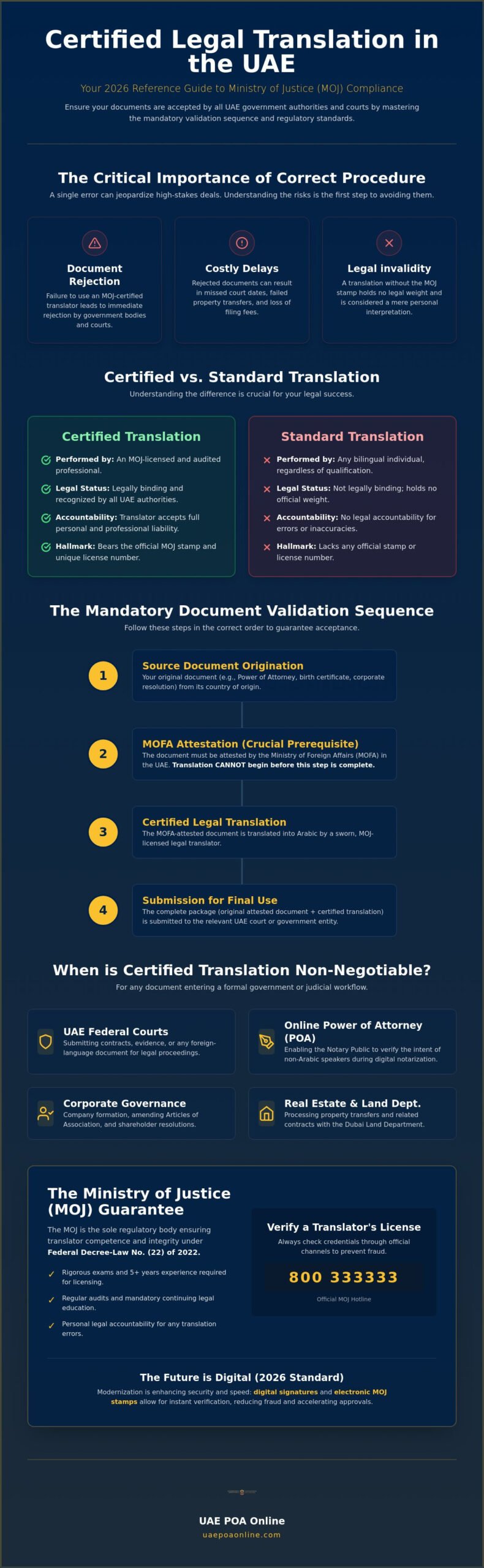
How to Obtain Certified Legal Translations for UAE Authorities
Securing a certified legal translation UAE involves a precise sequence of steps designed to ensure your documents survive the scrutiny of federal authorities. The process has evolved into a digital-first experience, but the underlying legal requirements remain strict. Skipping a single step in this workflow often leads to rejection at the final stage of notarization or court submission, regardless of the translation’s linguistic quality.
Your journey begins with document preparation. Before a translator can apply their official seal, the original document must be legally recognized by the state. Once attestation is complete, you’ll need to select a translation partner that holds an active Ministry of Justice license. In 2026, most reputable providers offer a secure digital portal for document submission. This allows for an immediate review of the text’s complexity and a clear timeline for delivery. During the drafting phase, you must verify that all names, dates, and technical terms match your official identity documents, such as your passport or Emirates ID. Even a minor spelling discrepancy can render the entire translation void in the eyes of a Notary Public.
The Attestation-Translation Sequence
The order of operations is critical. For foreign documents, the translation must usually follow the Ministry of Foreign Affairs (MOFA) attestation. If you’re handling a multi-country document chain, each preceding authority must stamp the document before it reaches the UAE. This ensures the translator is working from a verified, authentic source. In 2026, foreign documents must bear a valid Ministry of Foreign Affairs attestation stamp before a certified translator can legally apply the official MOJ seal. This “Attestation-First” rule prevents the certification of fraudulent or unverified papers. Understanding the precise distinction between these two procedures is essential; our complete guide on notarization vs attestation in UAE explains exactly which step applies to your specific document type.
Digital Workflow and Turnaround Times
The 2026 digital notary system has accelerated translation processing by allowing for real-time verification of MOJ credentials. Standard legal translations typically take 24 to 48 hours, while urgent requests for court or property transactions can often be completed within the same business day. Throughout this process, data privacy is paramount. Modern providers use end-to-end encryption to protect your sensitive legal instruments during the digital transfer. When the work is finished, you’ll receive a final document featuring either a physical stamp or a secure, QR-coded digital signature that is instantly verifiable by any government entity. To begin your submission, you can start your legal translation process today with a specialist who understands these digital requirements.
Integrating Translation with Online Notary and POA Services
Efficiency in the UAE’s 2026 legal ecosystem is defined by how well you can consolidate complex tasks. Managing drafting, certified legal translation UAE, and notarization as separate projects often leads to linguistic drift, where the intent of the English original doesn’t perfectly match the Arabic legal version. Using a single, integrated provider eliminates this risk. It ensures that the legal specialist drafting your document is the same one overseeing its translation, creating a seamless bridge between your intent and the state’s requirements.
This integration is particularly vital for corporate documentation. A business power of attorney UAE requires specific bilingual formatting to satisfy both internal corporate governance and external judicial standards. Similarly, the role of legal translation is central to writing a will in UAE for non-Muslim expats. In these cases, the translation isn’t just a courtesy; it’s the primary document the court will reference during probate or dispute resolution. Any inconsistency between the two languages can lead to prolonged litigation or the total invalidation of your wishes.
Bilingual Document Drafting
UAE Notaries strongly prefer the “Side-by-Side” format. This layout presents the English and Arabic text in parallel columns, allowing the Notary Public to verify that both versions are identical in meaning. Navigating complex legal terminology in this format requires a deep understanding of Sharia-influenced civil law and common law concepts. When you draft with a bilingual focus from the start, you reduce friction in the MOJ Notary approval process. This proactive approach ensures that technical terms, such as “indemnification” or “fiduciary duty,” are rendered into Arabic equivalents that carry the exact same weight in a UAE court.
Streamlining the Notarization Process
The transition from a finished draft to a notarized document is where most delays occur. UAE POA Online coordinates the certified legal translation UAE directly with MOJ Notary services, ensuring that the final translation stamp is applied only after a final expert legal review. This double-check prevents common clerical errors that trigger rejections in the digital notary system. Before you submit your document, use this final checklist to ensure it is ready:
- Verify that the Arabic text is in a clear, standard font accepted by the MOJ system.
- Ensure all passport numbers and names match the original identity documents precisely.
- Confirm the presence of a valid, QR-coded MOJ translator stamp.
- Check that the document is formatted for the specific requirements of either the Dubai Courts or the Federal Ministry of Justice.
By following this integrated workflow, you transform a potentially stressful bureaucratic hurdle into a predictable, well-oiled process. If you need to notarize business documents UAE alongside your translation requirements, understanding the full MOJ digital notarization framework will help you coordinate both processes efficiently. This modern approach protects your legal rights while respecting the urgency of your business or personal transactions.
Secure Your Document Validity with Expert Certification
Navigating the UAE’s administrative landscape in 2026 requires more than just bilingual skills; it demands a precise alignment with Ministry of Justice standards. You’ve learned that a certified legal translation UAE is the essential bridge that ensures your foreign documents are recognized by federal courts and government authorities. By mastering the attestation-first sequence and utilizing integrated bilingual drafting, you protect your interests from the risks of rejection and legal delays. Our MOJ-approved documentation experts specialize in bilingual POA and Will drafting, offering a secure 2026 digital processing experience that prioritizes both speed and precision. We act as your trusted specialist, handling the technicalities of regional systems so you can move forward with total confidence.
Get Started with Certified Legal Translation and Notary Services to ensure your legal instruments are submission-ready and fully compliant. Let’s simplify your documentation process today.
Frequently Asked Questions
Does the UAE Ministry of Justice accept translations from outside the country?
No, the UAE Ministry of Justice requires translations to be performed by translators specifically licensed and registered within the UAE. While you might possess a translation from abroad, it won’t carry the mandatory MOJ stamp required for local court or ministry acceptance. To use a foreign translation, it must typically undergo a complex attestation process at the UAE Embassy in the source country and the Ministry of Foreign Affairs locally before being re-certified.
How long is a certified legal translation valid in the UAE?
A certified legal translation remains valid as long as the original document it represents is still legally active. For instance, a translated birth certificate doesn’t expire, but a translated Power of Attorney might lose its validity if the original document has a specific expiry date or is revoked. It’s best to check with the specific authority requesting the document, as some entities prefer translations issued within the last six months for active transactions.
Can I get a certified translation for a document that isn’t attested?
You can technically translate any document, but a certified legal translation UAE won’t be accepted by government authorities if the original lacks the required attestations. Most MOJ-licensed translators will insist on seeing the Ministry of Foreign Affairs (MOFA) stamp on your original document before certifying the translation. This ensures the chain of legality is unbroken and prevents the rejection of your paperwork at the final submission stage.
What is the difference between a certified translator and a sworn translator in the UAE?
There is no practical difference between a certified translator and a sworn translator within the UAE’s legal system. Both terms refer to a professional who has taken an official oath before the Ministry of Justice and holds a valid license to practice. These individuals are legally authorized to stamp and sign documents, accepting full liability for the accuracy of the translated content as per Federal Decree-Law No. (22) of 2022.
Do I need to translate my passport for UAE legal transactions?
Yes, you frequently need to translate your passport if you’re submitting it to a UAE court or a government body that operates exclusively in Arabic. While many entities accept English passports for basic services, official legal instruments like a Power of Attorney or a Will often require an MOJ-certified Arabic version. This ensures all personal data, including your name and nationality, is officially recorded in the state’s primary language.
Can a certified translation be provided for any language into Arabic?
Certified translations can be provided for any language into Arabic, provided the translator is specifically licensed by the Ministry of Justice for that language pair. The MOJ maintains a registry of experts covering dozens of global languages. If your document is in a rare language, you may need to utilize a “relay” translation, where the document is first translated into English and then into Arabic by licensed professionals.
What happens if there is a mistake in my certified translation?
If a mistake occurs in your certified translation, the licensed translator is held legally and professionally liable under UAE law. You should immediately contact the service provider to issue a corrected version with the official stamp. Because MOJ-certified translators are sworn officers, they’re required to maintain high accuracy standards, and significant errors can lead to the suspension or even the cancellation of their professional license.
How much does certified legal translation cost in the UAE in 2026?
The cost of a certified legal translation UAE depends on the document’s complexity, the language pair, and the total word count. Technical legal instruments or rare languages typically command different rates than standard certificates. While the Ministry of Justice sets registration fees for translators, service providers set their own market rates based on turnaround times and the level of legal expertise required for your specific document type.
Leave a Reply