
A single technical oversight in your digital filing can now result in the immediate rejection of your legal documents by the Dubai Land Department or the Ministry of Justice. You likely feel the pressure of ensuring every clause is perfect, especially when the stakes involve high-value assets or urgent business decisions. It’s exhausting to navigate evolving digital protocols while worrying that your document might be too broad or, conversely, too restrictive for its intended purpose.
This guide provides the clarity you need to avoid the most common power of attorney mistakes UAE residents and non-residents face today. We will break down the essential 2026 checklist for a successful notarization, covering the latest e-verification standards and the strict regulations regarding property sale proceeds. By following these steps, you can secure a valid, notarized document that provides total peace of mind and moves through the system without delay. We’ll explore the critical requirements of Federal Decree-Law No. 20 of 2022 and how to ensure your agent’s authority is recognized by all relevant authorities.
Key Takeaways
- Identify how vague drafting and the absence of specific clauses like the ‘Right to Substitute’ can cause your document to fail at the Dubai Land Department.
- Avoid the most frequent power of attorney mistakes UAE users make when navigating the Ministry of Justice digital portals and e-notarization systems.
- Master the essential attestation chain for documents signed abroad to ensure they are legally recognized and accepted by UAE authorities.
- Understand the ‘Amendment Fallacy’ and why you must often revoke and redraft a document rather than attempting to fix a notarized error.
- Ensure your document meets strict bilingual standards by using certified legal translation services instead of unreliable automated tools.
The Consequences of Power of Attorney Mistakes in the UAE
Under the UAE Civil Transactions Law, specifically Federal Law No. 5 of 1985, a Power of Attorney (POA) is a binding legal contract that grants an agent the authority to act on behalf of a principal. While most people understand what a power of attorney is in a general sense, the UAE legal system applies specific, rigid requirements that differ significantly from other jurisdictions. A single error in drafting or execution can render the entire document useless for its intended purpose, creating a cascade of administrative hurdles.
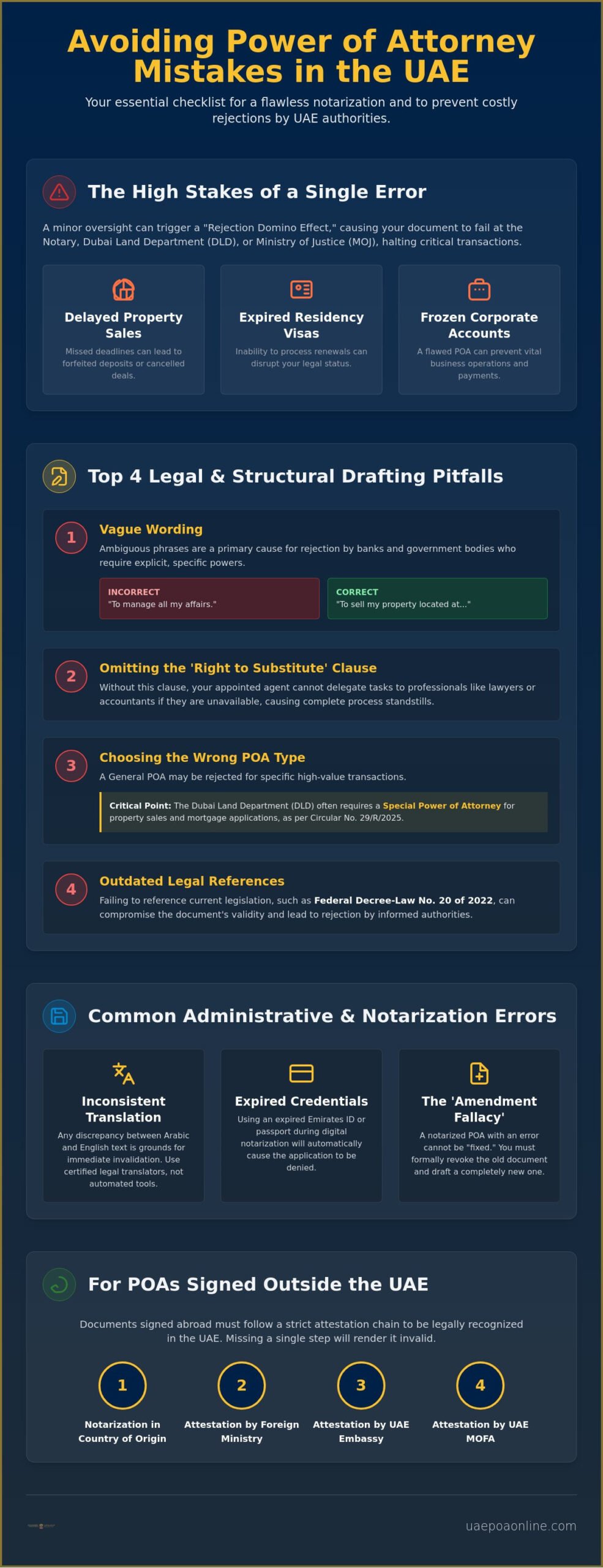
The most frustrating aspect of power of attorney mistakes UAE residents encounter is the “Rejection Domino Effect.” A document might appear valid on the surface, but a minor error in the drafting stage causes it to be flagged during the notarization process. Even if it clears the Notary, it may fail at the final step when presented to the Dubai Land Department (DLD) or the RTA. This failure stops transactions in their tracks, leading to delayed property sales, expired residency visas, or even frozen corporate bank accounts at critical moments.
The temporal and financial risks of these errors are significant. If a POA is rejected during a property transfer, you could miss contractual deadlines, resulting in the loss of a security deposit or the cancellation of a deal. For business owners, a flawed POA might prevent the renewal of essential trade licenses or the processing of employee salaries. Relying on internet downloads is one of the most common power of attorney mistakes UAE applicants make. These templates often lack the precise, localized terminology needed to satisfy UAE banks or government offices, which leads to costly delays and the need for a complete redraft. Many power of attorney expat UAE holders also mistakenly treat this document as something only needed when leaving the country, when in fact it is a critical tool for managing assets and emergencies at any time.
Why UAE Authorities Reject POA Documents
Rejection often stems from non-compliance with the latest Ministry of Justice (MOJ) digital circulars or simple administrative oversights. Common triggers include:
- Inconsistent Translation: Discrepancies between the Arabic and English text can lead to immediate invalidation by the authorities.
- Expired Credentials: Using an expired Emirates ID or passport during the digital notarization process will cause the application to be denied.
- Outdated Clauses: Failing to account for current regulatory updates regarding digital verification and e-notarization standards.
General vs. Special POA: The Risk of Incorrect Selection
Choosing the wrong document type is a frequent pitfall that leads to rejection at the point of use. While a General POA offers broad authority, many UAE entities, especially the DLD under Circular No. 29/R/2025, now apply much stricter standards. They often demand a Special Power of Attorney UAE for specific high-value transactions like property sales or mortgage applications. Over-authorization in a general document can also be dangerous, as it grants an agent more power than necessary, creating potential for misuse or legal disputes later.
Legal and Structural Mistakes: The Checklist of Drafting Pitfalls
Drafting a Power of Attorney requires more than just filling in blanks; it demands a deep understanding of local judicial standards to avoid power of attorney mistakes UAE authorities frequently flag. Many applicants make the error of using vague wording. Phrases like “manage all my affairs” are often rejected by banks and government departments because they lack the specific context required to verify the agent’s intent. Precision is your best defense against administrative delays.
A common oversight involves legal and structural mistakes such as omitting the “Right to Substitute” clause. Without this provision, your agent cannot delegate tasks to a professional, such as a lawyer or an accountant, if they are personally unavailable. This can bring your legal processes to a complete standstill. Additionally, failing to include an expiry date can be risky. While some POAs are intended to be long-term, many institutions prefer documents issued within the last two years, particularly for property matters. Ensuring your document references current legislation, such as Federal Decree-Law No. 20 of 2022, is essential for maintaining its validity.
Identification errors also cause significant friction. Your agent’s name must match their passport or Emirates ID exactly, including all middle names. A single character difference can lead to immediate rejection during digital verification. If you are unsure about the specific wording required for your situation, you can consult a specialist to review your draft before notarization.
Real Estate POA Checklist: Avoiding Property Rejections
Property transactions in the UAE are heavily regulated. To avoid rejection at the Dubai Land Department, your POA must include the exact Title Deed number and Plot number of the property in question. Simply referring to “my villa in Dubai” is insufficient. You must also explicitly grant the power to “sign at the Dubai Land Department” and handle all specific transfer procedures. Crucially, under DLD Circular No. 29/R/2025, a POA for sale must clarify that sale proceeds will be deposited into the owner’s UAE bank account, as agents are generally restricted from receiving these funds directly.
Business POA Pitfalls for Corporate Governance
When drafting a business power of attorney UAE, the document must align perfectly with your company’s Memorandum of Association (MOA). If the MOA does not authorize the principal to delegate certain powers, the POA will be legally void. Banking powers are another area of concern. Financial institutions require highly detailed clauses that specify which accounts can be accessed and what limits apply. Authorizing share transfers without a supporting board resolution is another frequent error that can lead to corporate governance disputes.
Administrative and Notarization Errors: Why Your Document Might Be Rejected
The transition to a digital-first legal system has streamlined the notarization process, but it has also introduced a new category of technical power of attorney mistakes UAE applicants often overlook. Even a perfectly drafted document will be rejected if the administrative filing does not meet the strict criteria of the UAE Ministry of Justice digital POA service. These errors are frequently found in the digital portal submission itself, where incorrect data entry or poor document formatting can trigger an automated rejection before a human notary even reviews the file.
Formatting is a common stumbling block. The MOJ requires specific margins and font sizes to ensure the document fits official templates. If your document is cluttered or uses non-standard formatting, it will likely be sent back for revision. Signature discrepancies are another high-risk area. In the current digital landscape, your digital signature must align precisely with the record on your passport or Emirates ID. If the system detects a mismatch during the verification phase, the process halts immediately.
Administrative precision is non-negotiable. Beyond the document itself, you must ensure all parties have an active UAE Pass with a high level of authentication. Without this, you won’t be able to access the necessary e-services to finalize the notarization. Small details, like ensuring your contact information matches your official government records, make the difference between a five-minute approval and a week-long delay.
The Role of Certified Legal Translation
Under UAE law, all legal documents must be in Arabic or a bilingual format where Arabic is the primary language. Relying on automated tools like Google Translate is one of the most dangerous power of attorney mistakes UAE users make. Technical legal terms have specific meanings in the UAE Civil Transactions Law; a slight mistranslation can fundamentally change your agent’s powers. To be valid, your translation must be completed by an MOJ-certified translator who can stamp the document, verifying its accuracy for government use.
Digital Notarization vs. Physical Presence
The online power of attorney UAE system allows for remote execution, but it requires meticulous attention to detail. Applicants often struggle with uploading the correct supporting documents, such as property title deeds or corporate MOAs, in the required high-resolution PDF format. Selecting the wrong ‘Type of Transaction’ in the e-notary menu is another frequent error that leads to the payment of incorrect fees and subsequent rejection. Finally, the ‘Video Verification’ step is mandatory. You must be prepared to present your original physical ID to the camera and answer the notary’s questions clearly to confirm your identity and intent. Failing this final check means you must restart the entire application from the beginning.
The Overseas Factor: Mistakes Made When Signing Outside the UAE
Signing a Power of Attorney while you’re outside the UAE adds layers of complexity that often lead to total document rejection. One of the most frequent power of attorney mistakes UAE non-residents make is assuming their local legal standards apply here. To be successful, you must follow a rigid five-step attestation chain that begins with a document drafted specifically for UAE authorities. If your POA doesn’t meet local requirements from day one, you’ll waste time and money on a document that will eventually be rejected. To avoid power of attorney mistakes UAE authorities flag, ensure your drafting is handled by experts before you visit your local notary.
The process follows a methodical sequence that cannot be bypassed. First, you must have the document notarized by a notary public in your current country. This is the ‘First Link’ where many fail by using incorrect templates. After notarization, the document moves to the Ministry of Foreign Affairs (or equivalent) in your home country for authentication. From there, it must be attested by the UAE Embassy or Consulate in that country, which carries a fee of AED 150. Once the document arrives in the UAE, it requires a final attestation from the UAE Ministry of Foreign Affairs (MOFA), which also costs AED 150. This entire cycle usually takes between one to three weeks to complete depending on the country of origin. Expats navigating this process for the first time should also review the common myths about power of attorney expat UAE residents believe, as misconceptions about Apostille validity and document recognition frequently derail the attestation chain at this stage.
The ‘Apostille’ Misconception
Many international residents believe an Apostille stamp makes their document globally valid. This is a critical error because the UAE is not a member of the Hague Apostille Convention. Assuming a home-country notary or an Apostille is sufficient for UAE use is a mistake that breaks the chain of attestation. Without the specific UAE Embassy and MOFA stamps, your document holds no legal weight within the Emirates. Don’t let your agent get stuck at a government counter because of a missing link in this chain.
Translation Timing Errors
Timing your legal translation is just as important as the drafting itself. A common mistake is translating the document into Arabic before receiving the final UAE MOFA stamp. The legal translation must include and account for every stamp and seal collected throughout the international attestation process. If you translate too early, the translation won’t reflect the final UAE authorizations, leading to immediate rejection by the Notary Public. It’s always safer to use UAE-based translators who understand Ministry of Justice compliance once all international stamps are secured.
If you’re currently abroad and need to ensure your document is bulletproof, you can get professional assistance with your international POA to avoid these costly delays.
How to Rectify POA Errors and Ensure Legal Compliance
Discovering an error in your document after it has been notarized is a stressful experience. Many people fall victim to the ‘Amendment Fallacy,’ believing they can simply update a clause or correct a typo through a minor addendum. In the UAE legal system, a notarized Power of Attorney is a final, sealed document. If you identify power of attorney mistakes UAE authorities will not accept, you cannot ‘fix’ the existing file. Instead, you must undergo the entire process again, which includes drafting a new document, paying all relevant fees, and completing the notarization cycle from the beginning.
The most efficient way to handle a flawed document is to perform a professional audit before you commit to the final signature. Before paying for notarization, conduct a ‘Test Run’ by sharing your draft with the specific end-user, such as your bank manager or a Dubai Land Department officer. These officials can often spot missing technical language or specific plot number errors that might lead to a later rejection. Taking this proactive step ensures that your final document is accepted on the first attempt, saving you both time and the cost of repetitive administrative fees.
Revoking a Faulty Power of Attorney
If your current document is overly broad or contains significant errors, revocation is your first priority. Under current Ministry of Justice protocols, you can execute a Deed of Revocation digitally. This process immediately updates a secure blockchain registry, ensuring that the agent’s authority is cancelled across government systems. You must formally notify the agent of this revocation to prevent any unauthorized use of the document. Failure to notify the agent or relevant third parties can lead to complex legal disputes regarding actions taken after you intended to cancel the powers.
Why Professional Drafting is an Investment, Not a Cost
Expert drafting is the only way to truly insulate yourself from the ‘Double Notarization’ fee that results from fixing errors. A specialist ensures that your document adheres to Federal Decree-Law No. 20 of 2022 and matches the specific requirements of UAE financial institutions. For long-term security, many expats are also integrating Wills for UAE residents into their legal planning. While a POA manages your affairs during your lifetime, a Will ensures continuity and protection for your assets and family beyond that period. Combining these documents creates a comprehensive legal shield that standard internet templates simply cannot provide.
Don’t risk a rejection at a critical moment. Contact UAE POA Online for a professional document audit today to ensure your legal paperwork is bulletproof and fully compliant with the latest 2026 regulations.
Secure Your Legal Interests with Confidence
Navigating the UAE’s digital legal system requires a combination of technical precision and current regulatory knowledge. By following a structured checklist, you protect yourself against the most frequent power of attorney mistakes UAE residents encounter, from vague phrasing in real estate clauses to broken attestation chains for documents signed abroad. A valid Power of Attorney is a vital tool for your personal and professional security; it’s essential to get it right the first time. Relying on outdated templates or non-certified translations often leads to costly delays and total document rejection at government counters.
Our platform provides a streamlined path to legal compliance through a secure digital portal accessible 24/7. We connect you with MOJ-certified legal experts who ensure every document meets the highest standards of the Dubai Land Department and the Ministry of Justice. With a 100% acceptance rate for notarized documents, we take the stress out of the notarization process so you can focus on your goals. Get Your Error-Free UAE Power of Attorney Online Now. You deserve the peace of mind that comes with professional, reliable legal support.
Frequently Asked Questions
Can I use a Power of Attorney from my home country in the UAE?
Yes, but it requires a complete attestation chain to be legally recognized. You must have the document notarized in your home country, authenticated by your local Ministry of Foreign Affairs, and attested by the UAE Embassy abroad. Once it arrives in the Emirates, it needs a final stamp from the UAE Ministry of Foreign Affairs and a certified legal translation into Arabic.
What is the most common reason for a POA being rejected at the Dubai Land Department?
The most frequent reason for rejection is vague wording or missing property identifiers. The Dubai Land Department requires the exact Title Deed and Plot numbers to be explicitly stated. Rejections also occur if the document fails to grant the specific power to sign at the department or if it lacks the mandatory clauses required by recent 2025 circulars.
Does a UAE Power of Attorney expire automatically?
A standard UAE Power of Attorney doesn’t expire automatically unless an expiry date is written into the document. However, many government departments and banks apply their own internal validity rules. For example, the Dubai Land Department typically limits the validity of foreign-issued POAs to two years, and most banks prefer documents issued within the last twenty four months.
Can I revoke a Power of Attorney if I think my agent made a mistake?
Yes, you can revoke your agent’s authority at any time by executing a Deed of Revocation. This process is handled digitally through the Ministry of Justice or Dubai Courts portals. Once you notarize the revocation, the change is updated in the official registry, which immediately cancels the agent’s legal right to act on your behalf across the UAE.
Is a digital signature valid for a UAE Power of Attorney in 2026?
Yes, digital signatures verified through the UAE Pass system are fully valid and widely used in 2026. The Ministry of Justice has integrated digital signatures into its e-notary portal, allowing for remote document execution. This method provides a secure, blockchain-verified record that is accepted by all major government entities, including the RTA and the Land Department.
Do I need a lawyer to draft my Power of Attorney in the UAE?
While you aren’t legally required to use a lawyer, professional drafting is essential to avoid power of attorney mistakes UAE authorities frequently flag. Experts ensure your document complies with Federal Decree-Law No. 20 of 2022 and includes the precise technical language required by local banks. This proactive step prevents the frustration of document rejection and the cost of repeat notarization.
What happens if there is a mistake in the Arabic translation of my POA?
Any error in the Arabic translation will lead to an immediate rejection because Arabic is the official legal language of the UAE. The Arabic text always takes precedence over the English version in court or at government counters. If the translation doesn’t perfectly mirror the legal intent of the original draft, the document will be rendered useless for its intended purpose.
How much does it cost to fix an error in a notarized Power of Attorney?
You cannot technically fix an error in a notarized document; you must draft and notarize a new one from scratch. This means you’ll have to pay the drafting fees, legal translation costs, and government notarization fees again. Avoiding power of attorney mistakes UAE applicants often make during the initial drafting stage is the only way to save yourself from these redundant administrative expenses.
Leave a Reply