

Accepting the role of a representative under a Power of Attorney isn’t just a gesture of trust; it’s a binding legal commitment that carries significant personal liability under the new UAE Civil Transactions Law. If you’ve been appointed, you’re likely feeling the weight of this responsibility and wondering about the specific duties of a power of attorney agent UAE. With the 2026 legal framework now in full effect, the boundary between simple assistance and legal negligence has never been sharper.
It’s natural to feel concerned about the strict Ministry of Justice requirements and the potential for personal liability. You want to support the principal effectively without accidentally overstepping your legal bounds. This guide clarifies your position by detailing your fiduciary responsibilities, the limitations on general authority, and the latest digital compliance standards. We’ll examine the specific implications of Federal Decree-Law No. 25 of 2025 to ensure you can execute your role with absolute confidence and professional integrity.
Key Takeaways
- Define the legal relationship between the Muwakkil (Principal) and Wakiil (Agent) within the UAE’s specialized legal framework.
- Understand the core duties of a power of attorney agent UAE, specifically the mandates for loyalty and strict obedience to the principal’s instructions.
- Navigate the updated fiduciary obligations under the UAE Civil Transactions Law to ensure all actions remain legally compliant in 2026.
- Identify high-risk pitfalls, including personal liability for exceeding granted authority or failing to meet standard care requirements.
- Learn how precise, MOJ-compliant drafting protects both parties from disputes and ensures a seamless digital notarization experience.
What is a Legal Representative in the UAE?
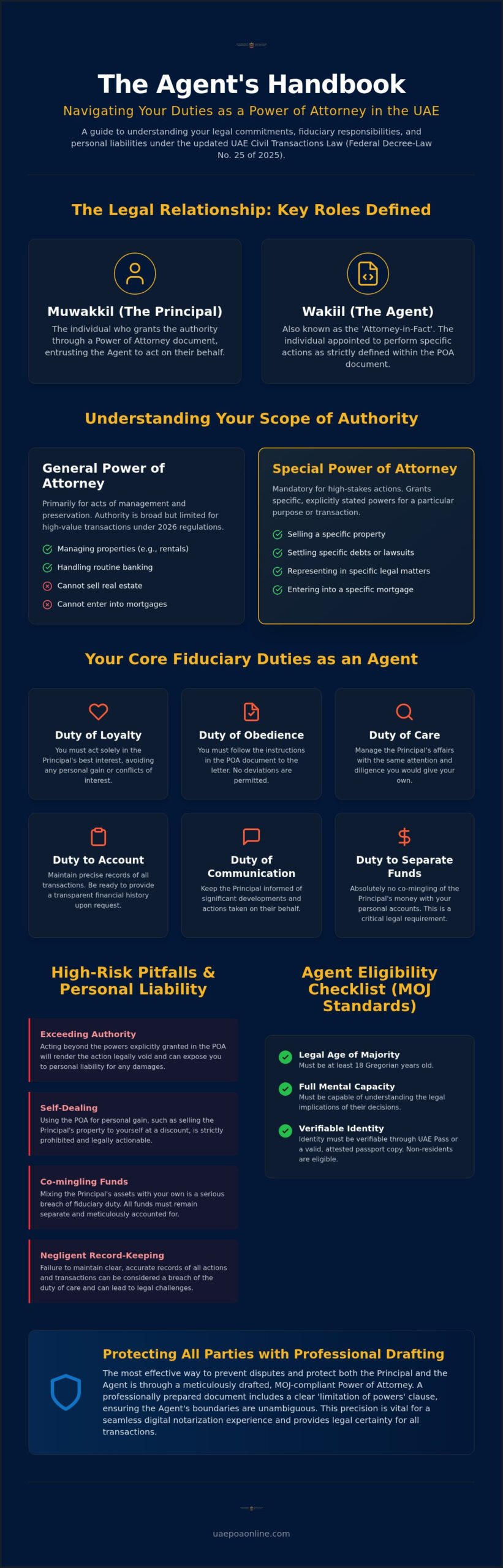
In the UAE legal system, an agent acts as an ‘Attorney-in-Fact,’ meaning they possess the legal standing to perform specific actions on behalf of another person. This relationship is defined by two specific roles: the Muwakkil (the Principal who grants the authority) and the Wakiil (the Agent who receives it). It’s vital to distinguish between the two; while the Agent is the person performing the tasks, the Power of attorney itself is the formal legal document that serves as their mandate. Without this physical or digital document, the agent has no standing before government entities, banks, or the Dubai Land Department.
Becoming a legal representative UAE means you are strictly confined to the instructions written in the notarized text. The UAE Civil Transactions Law, specifically Federal Decree-Law No. 25 of 2025, ensures that an agent cannot assume powers that aren’t explicitly stated. If a document authorizes you to manage a property but doesn’t mention selling it, any attempt to sign a sales agreement will be legally void. This highlights why understanding the duties of a power of attorney agent UAE starts with a meticulous review of the document’s language before notarization occurs.
The Scope of Authority
The extent of an agent’s power depends heavily on whether they hold a General or Special POA. Under the 2026 regulations, a General POA is largely restricted to acts of management and preservation. For high-stakes actions like selling real estate, entering into mortgages, or settling debts, a Special POA is now mandatory. Scope of authority is the legal boundary of an agent’s actions. To prevent future disputes, modern UAE documents often include a ‘limitation of powers’ clause. This ensures the agent knows exactly where their permission ends, protecting both the agent from personal liability and the principal from unauthorized acts.
Eligibility for Agents in the UAE
The Ministry of Justice (MOJ) enforces clear standards for who can serve as an agent and fulfill the duties of a power of attorney agent UAE. Following the 2026 legal updates, the age of legal majority in the UAE is 18 Gregorian years. An agent must also possess full mental capacity to understand the legal implications of their decisions. Non-residents can act as agents within the UAE, provided they can verify their identity through the MOJ’s digital systems or possess a valid, attested passport copy. The MOJ now utilizes the UAE Pass system to verify identities instantly, ensuring that the person acting as the Wakiil is exactly who they claim to be during the notarization process.
Core Legal Duties of a Power of Attorney Agent
The role of an agent carries specific legal weight under UAE law. Once you accept the appointment, you’re bound by a set of fiduciary obligations designed to protect the principal’s assets and intentions. Primary among these is the duty of loyalty, which requires you to act solely in the principal’s best interest at all times. This isn’t a suggestion; it’s a foundational legal requirement. You must also exercise the duty of obedience, meaning you follow the instructions in the document to the letter. Any deviation, even if well-intentioned, can lead to legal challenges.
A high standard of diligence is expected through the duty of care. You’re required to manage the principal’s affairs with the same level of attention you’d give your own. This includes a strict duty to account for every action taken. You must maintain precise records of all transactions, receipts, and legal filings. If the principal or a court asks for a report, you must be ready to provide a transparent history of your actions. Transparency is further reinforced by the duty of communication, ensuring the principal remains informed of significant developments as they occur.
Financial and Property Management Duties
Managing assets in the UAE involves navigating strict regulatory environments, particularly with the Dubai Land Department (DLD) and local banks. One of the most critical duties of a power of attorney agent UAE is the absolute separation of funds. You must never co-mingle the principal’s money with your personal bank accounts. For property transactions, you’re responsible for ensuring all sale proceeds are paid directly to the owner named on the title deed, as mandated by DLD Circular No. 29/R/2025. Failure to follow these specific administrative steps can result in the transaction being blocked or legal penalties being applied.
Conflicts of Interest
UAE law is clear: an agent cannot use their position for personal gain. This prohibition on self-dealing means you cannot sell the principal’s property to yourself or a family member at a discount. Because misuse of the POA is an extremely serious offence, any potential conflict must be disclosed immediately. If your interests clash with the principal’s, you must prioritize their needs or step aside from that specific transaction. Professional drafting can help define these boundaries early; you might consider consulting a specialist for a Property POA to ensure all conflict-of-interest protections are in place before you begin your duties of a power of attorney agent UAE.
Fiduciary Obligations Under the UAE Civil Transactions Law
The legal framework for agency in the Emirates has undergone a significant transformation with the enactment of Federal Decree-Law No. 25 of 2025. This new Civil Transactions Law, which came into force on June 1, 2026, replaced the long-standing Federal Law No. 5 of 1985. While the foundational concept of Wakala (Agency) remains, the updated statutes place a sharper focus on the duties of a power of attorney agent UAE. An agent is no longer just a facilitator; they’re a fiduciary with a strict responsibility to complete every task they accepted during the notarization process. If you’ve accepted a mandate, you’re legally bound to see it through to completion unless the document is revoked or you’re formally released from your role.
Delegation is another area where the law is uncompromising. An agent generally cannot appoint a sub-agent to handle their responsibilities unless the original Power of Attorney explicitly grants the “right of substitution.” Without this specific clause, any actions taken by a third party on your behalf are legally invalid and could expose you to personal liability. Your legal responsibility ends only when the specified task is finished, the principal revokes the authority through the Ministry of Justice portal, or in the event of the death or legal incapacity of either party. Understanding these duties of a power of attorney agent UAE ensures you don’t inadvertently remain liable for an expired or completed mandate.
Article-Based Obligations
The 2026 Civil Transactions Law emphasizes the doctrine of “good faith” in every contractual relationship. This means an agent must act with honesty and integrity, prioritizing the principal’s welfare over any personal or external interests. UAE courts consistently prioritize the principal’s protection in agency disputes. If a court finds that an agent acted in bad faith or failed to protect the Muwakkil’s assets, the legal consequences can be severe. This judicial lean toward principal protection makes it vital for agents to document every decision and ensure their actions align perfectly with the written mandate.
Notarization and the MOJ Framework
The integrity of your authority starts with the notarization process. Utilizing MOJ notary services UAE provides a digital audit trail that validates your identity and the principal’s intent. Because Arabic is the official language of the UAE legal system, every POA must be bilingual or accompanied by a certified legal translation. This isn’t just a formality; it’s a safeguard. A bilingual document ensures you fully comprehend your legal obligations in English while remaining compliant with the Arabic requirements of UAE government departments and banks. Clear translation eliminates the risk of “lost in translation” errors that often lead to agent overreach or unintended negligence.
Common Pitfalls and Liability for Agents
Accepting the duties of a power of attorney agent UAE involves more than just signing documents. It carries the risk of personal liability if you fail to meet the standards set by the 2026 Civil Transactions Law. If you mismanage assets or commit a ‘gross error’ that leads to financial loss for the principal, you can be held personally responsible in a UAE court. Negligence, such as failing to renew a property lease or missing a critical tax deadline, often results in the principal seeking damages. One of the most frequent risks involves power of attorney mistakes UAE agents make by assuming their authority is broader than the specific text allows. Beyond civil lawsuits, the UAE Penal Code mandates strict criminal penalties for fraud or embezzlement, including heavy fines and potential imprisonment for agents who intentionally misuse their position.
Exceeding Authority
Performing ‘ultra vires’ acts, or actions beyond your legal power, is a common trap for agents. Since the June 2026 legal update, a General Power of Attorney no longer permits the sale of real estate or the signing of mortgages. If you attempt these actions without a Special POA, third parties like banks or the Dubai Land Department will reject the transaction immediately. These entities now use blockchain-verified QR codes to check the scope of your authority in real-time. If you sign a contract without proper authorization, the principal can choose to reject the act, which leaves you personally liable for any damages or contractual obligations to the third party.
Mitigating Risk for Agents
You can protect yourself by maintaining a meticulous record of every action taken. Keep a digital and physical paper trail of all notarized copies, transaction receipts, and correspondence with the principal. Always seek professional legal advice if a specific instruction in the POA is vague or if you’re unsure about the limits of your mandate. It’s also vital to understand the boundaries of your role; for example, managing an estate after a principal passes away requires an expat will UAE, as a POA legally expires upon the principal’s death. To avoid these common pitfalls and ensure your authority is clearly defined, secure a professionally drafted POA that protects both you and the principal.
Securing Your Interests with Professional POA Drafting
Understanding the legal landscape is only the first step. To ensure the duties of a power of attorney agent UAE are executed without friction, the underlying document must be flawless. Generic templates found online often lack the specific legal triggers required by the Ministry of Justice or the Dubai Land Department. A poorly drafted document creates ambiguity, which is the primary cause of rejected transactions and agent liability. When powers aren’t explicitly defined, the Wakiil is left in a vulnerable position, unable to act decisively while remaining exposed to claims of overreach.
Professional drafting bridges the gap between intent and legal execution. By using online power of attorney UAE services, you gain access to documents specifically calibrated for the 2026 legal framework. These services ensure that every clause aligns with the new Civil Transactions Law, protecting the principal’s assets while providing the agent with a clear, defensible mandate. Transitioning from a theoretical understanding of duties to a formalized, notarized document requires a methodical approach that prioritizes speed and precision.
Why Professional Drafting Matters
A tailored document acts as a shield for the representative. It defines the exact ‘scope of authority’ required for modern compliance, ensuring that the duties of a power of attorney agent UAE are manageable and clearly bounded. This specificity is essential for high-value transactions where the risk of ‘gross error’ is highest. Professional drafting provides several key advantages:
- Eliminates Ambiguity: Precise language ensures banks and government entities recognize the agent’s authority instantly.
- Regulatory Compliance: Documents are drafted to meet the latest 2026 MOJ standards, including blockchain-ready formatting.
- Tailored Authority: Whether you need a Property POA, Car POA, or Business POA, the document is customized to the specific transaction.
How UAE POA Online Simplifies the Process
Navigating the notarization and translation workflow doesn’t have to be a bureaucratic burden. UAE POA Online offers a streamlined digital experience that handles everything from initial drafting to final MOJ coordination. For those managing international interests, our specialized support for power of attorney expat UAE needs ensures that all documents meet both local requirements and international attestation standards. We provide certified legal translations to ensure all parties fully understand their obligations before the digital seal is applied. Don’t leave your legal standing to chance. Draft your Ministry of Justice-compliant POA today and secure your interests with absolute confidence.
Mastering Your Role as a Trusted Representative
Navigating the duties of a power of attorney agent UAE requires a precise understanding of the 2026 legal landscape. You’ve learned that acting as a Wakiil involves strict fiduciary obligations, from the duty of loyalty to the necessity of keeping accurate financial records. With the recent updates to the Civil Transactions Law, the distinction between management and disposal of assets is sharper than ever. Protecting yourself from personal liability starts with a document that leaves no room for interpretation.
We specialize in Ministry of Justice (MOJ) compliant drafting that clearly defines your authority, preventing the common pitfalls of agent overreach. Our services include certified legal translation and expertise in remote notarization, making it easy for expats to formalize their legal needs from anywhere in the world. By choosing a structured and professional path, you ensure that your actions remain legally sound and fully transparent.
Take the next step in your legal journey with total peace of mind. Secure your legal interests with a professionally drafted UAE POA and fulfill your responsibilities with the support of local experts. You’re now equipped to handle your mandate with the integrity and precision the UAE legal system demands.
Frequently Asked Questions
Can a Power of Attorney agent sign on behalf of themselves?
No, an agent cannot sign on behalf of themselves in transactions involving the principal’s assets unless the document explicitly grants this power. This practice is known as self-dealing and is strictly regulated under the UAE Civil Transactions Law to prevent conflicts of interest. Without specific “self-contracting” authorization, such actions are legally void and can lead to personal liability for the agent.
What happens if a POA agent dies in the UAE?
The Power of Attorney automatically terminates upon the death of the agent. Because the legal relationship is based on personal trust between the Muwakkil and the Wakiil, the authority does not pass to the agent’s heirs. The principal must then draft and notarize a new document to appoint a replacement representative to manage their affairs.
Is an agent responsible for the principal’s debts in the UAE?
An agent isn’t personally responsible for the principal’s debts, provided they acted within their authorized powers. The financial obligations remain with the principal as the contracting party. However, if the agent exceeds their authority or commits a “gross error” in managing finances, they could be held liable for resulting damages or losses incurred by the principal or third parties.
Can a principal sue an agent for a bad investment decision?
Yes, a principal can sue if the investment decision resulted from negligence or a breach of the duties of a power of attorney agent UAE. While agents aren’t liable for general market fluctuations, they’re responsible for exercising a high standard of care. If the agent failed to perform due diligence or ignored the principal’s specific instructions, they may be liable for the loss.
How do I prove I am the legal representative of someone in the UAE?
You prove your status by presenting the original notarized Power of Attorney document, either in physical form or via a digital QR code. Government entities and banks in the UAE now use the Ministry of Justice’s blockchain registry to verify the document’s validity instantly. You’ll also need to provide your original Emirates ID or passport for identity verification during the process.
Can a POA agent sell property to themselves?
An agent is legally prohibited from selling the principal’s property to themselves unless the POA contains a specific clause allowing “self-dealing.” Under UAE law, the agent must act in the principal’s best interest. Selling assets to oneself is viewed as a conflict of interest and is often rejected by the Dubai Land Department during the transfer process to prevent fraud.
Does a Power of Attorney remain valid after the principal’s death?
No, a Power of Attorney becomes legally void immediately upon the death of the principal. Once the principal passes away, the agent’s authority ceases, and the management of assets shifts to the executors named in a Will or the legal heirs under UAE inheritance laws. Continuing to act under a POA after the principal’s death is a serious legal violation.
Can I appoint two agents with different duties in one POA?
Yes, you can appoint multiple agents within a single document and assign them distinct duties of a power of attorney agent UAE. You must specify whether they’re to act “jointly,” meaning they must sign together, or “severally,” allowing them to act independently. This is a common practice for complex estates where one agent handles property while another manages business interests.
Leave a Reply