

Most expats treat a UAE Power of Attorney as an “exit document” for when they leave the country. However, waiting until you’re at the airport is the fastest way to have your local assets frozen during an emergency. It’s a common mistake that leaves families stuck in bureaucratic limbo when they need access to bank accounts or property management. Securing a power of attorney expat UAE residents can trust isn’t just about preparing for a departure. It’s about maintaining total control over your life and investments while you’re here.
We understand that the thought of handling MOJ notary services or legal translations feels overwhelming. You likely worry that a foreign document won’t be recognized or that the process will take weeks of office visits. This guide will clarify exactly how the system works under the 2026 regulations. We’ll debunk seven dangerous myths that could compromise your legal standing and show you how to secure a bulletproof POA through modern digital channels. You’ll learn about the latest Dubai Land Department rules, updated notary fees, and the specific steps required to keep your business and property interests seamless.
Key Takeaways
- Recognize that a Power of Attorney is a vital tool for managing daily life and medical emergencies, not just a document for when you permanently leave the UAE.
- Understand the 2026 digital shift that allows you to secure a power of attorney expat UAE residents can finalize through remote video notarization and paperless platforms.
- Learn why foreign documents aren’t automatically valid and the specific multi-step attestation process required by the Ministry of Foreign Affairs.
- Differentiate between General and Special POAs to avoid common rejections by local banks and government entities during critical transactions.
- Clarify the legal boundary between a POA and a Will to ensure your legacy is protected, as a Power of Attorney expires immediately upon the grantor’s death.
The “I Only Need a POA if I Leave the UAE” Myth
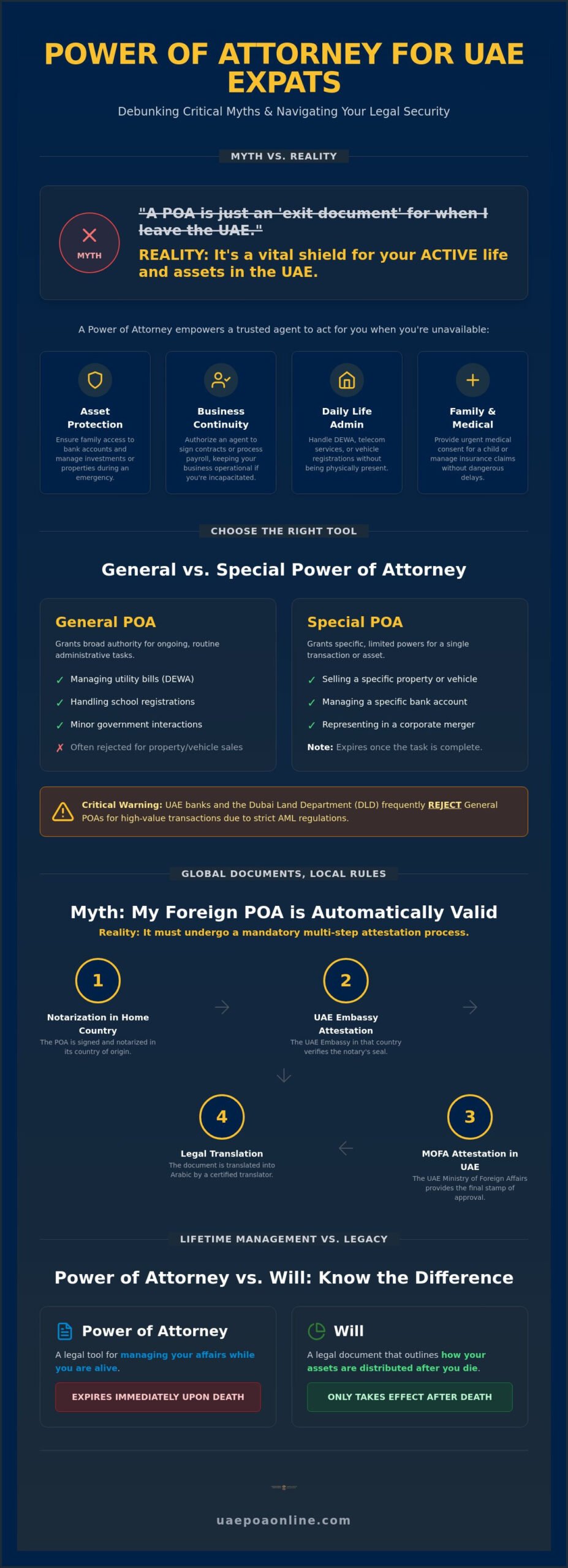
Many residents believe they only need a legal representative when they’re planning a permanent move or an extended vacation. This assumption is a significant risk to your daily security. A Power of Attorney (POA) is actually a proactive shield for your current life in the Emirates. It’s a legal bridge that allows a trusted person to act on your behalf when you’re physically unable to, whether due to a sudden illness or a simple scheduling conflict.
Active residents use a power of attorney expat UAE document to handle essential but time-consuming tasks. Think about your DEWA account, telecommunications services, or even renewing your vehicle registration. If you’re stuck in a meeting or feeling under the weather, a designated agent can step in. Without this document, your spouse or partner might find themselves locked out of basic household management tasks that are registered solely in your name. It’s about maintaining a well-oiled machine for your household, even when you aren’t personally available.
Asset Protection for Active Residents
Managing your wealth shouldn’t stop because you’re unavailable. A POA ensures your family has immediate access to bank accounts if you’re hospitalized. It also allows your representative to manage local stock portfolios or attend owners’ association meetings for your real estate investments. For small business owners, this document is vital for business continuity. It allows an agent to sign contracts or process payroll if the primary license holder is incapacitated. Don’t leave your commercial interests to chance; professional drafting ensures your business stays operational 24/7.
Emergency Guardianship and Family Matters
Family dynamics in the UAE often involve one parent traveling for work. If a child needs urgent medical care or a school requires an immediate signature, a POA prevents dangerous delays. It streamlines insurance claims and medical authorizations, ensuring your family’s health isn’t compromised by red tape. Beyond emergencies, it’s a practical tool for navigating family-related legalities like marriage or inheritance registration. Using a power of attorney expat UAE residents can rely on means your family is protected during every stage of life, not just during an exit.
Waiting for a crisis to occur is a common pitfall. By formalizing your legal representation now, you eliminate the stress of bureaucratic hurdles during high-pressure moments. It provides peace of mind, knowing that your local utility accounts, investments, and family needs are handled with absolute precision.
Myth: One General POA Grants Unlimited Power Forever
Assuming that a single document provides your agent with total authority for an indefinite period is a dangerous legal oversight. In reality, the UAE legal system distinguishes sharply between broad administrative rights and specific transactional powers. Banks, the Dubai Land Department (DLD), and other government entities frequently reject General POAs if they don’t contain precise, pre-approved language for the task at hand. This is particularly true for high-value transactions where “over-authorizing” can lead to security risks or immediate rejection by officials who require an expert overview of POA laws to ensure compliance.
When you set up a power of attorney expat UAE residents often find that “general” doesn’t mean “universal.” For instance, since June 2025, DLD regulations mandate that property sale proceeds must be transferred directly to the seller’s bank account. Even with a General POA, your agent cannot bypass these strict Anti-Money Laundering (AML) protocols. Relying on an outdated or overly broad document can stall your business or property deals at the final hour. To avoid these hurdles, many expats choose to draft a Special POA that targets specific assets with surgical precision.
General vs. Special POA: When to Use Which
A general power of attorney UAE works best for daily administrative tasks, such as managing utility bills, handling school registrations, or representing you in minor government interactions. However, for selling a car or a villa, a Special POA is mandatory. These documents are limited to a single transaction and expire once that task is finished. A hybrid approach is often the most efficient strategy. You can maintain a General POA for routine life while issuing a Special POA for specific, high-stakes events like a property sale or a corporate merger.
Expiration and Revocation Realities
The belief that a POA lasts forever is false. In Dubai, a POA used for selling property is typically valid for only two years. If you’re purchasing property, the validity extends to five years. In Abu Dhabi, most POAs are limited to a three-year term. These time limits are designed to protect you from long-term unauthorized use of your signature. If your circumstances change, you don’t have to wait for the document to expire. You can formally revoke a POA through a notary public at any time, ensuring that your legal representative’s authority ends exactly when you decide. Keeping your power of attorney expat UAE documentation updated with the 2026 Ministry of Justice standards is the only way to ensure your agent’s power remains valid and recognized.
Myth: Foreign POAs are Automatically Valid in the UAE
Expats often arrive in the UAE with a Power of Attorney signed and notarized in their home country, expecting it to function immediately. This is a significant legal hurdle. A foreign document is never “plug-and-play” in the Emirates. To be recognized by local banks, the Dubai Land Department, or the courts, your document must pass through a multi-step legalization chain. This process is designed to verify the document’s authenticity at every level of government, from your home country to the UAE Ministry of Foreign Affairs (MOFA).
For anyone navigating the requirements for a power of attorney expat UAE officials will honor, the complexity of this chain is often a surprise. It begins with notarization in your country of origin. Next, you must secure an attestation from that country’s Ministry of Foreign Affairs, followed by a stamp from the UAE Embassy located there. Once the document arrives in the UAE, it requires a final attestation from the local MOFA. Only after these steps are complete can you proceed to the mandatory Arabic translation.
The Legal Translation and Attestation Chain
Every foreign legal instrument must be translated into Arabic by a certified legal translator licensed by the UAE Ministry of Justice. This isn’t a standard translation; it’s a specific legal formatting that ensures your document complies with local terminology. If the translation is inaccurate or the attestation chain is broken, UAE entities will reject the document instantly. This process frequently takes weeks and costs significantly more in administrative fees and international couriers than drafting a fresh local document. Using a locally drafted version eliminates these cross-border headaches entirely.
Why Local Drafting is the Gold Standard
Drafting your document locally is the most efficient way to ensure its validity. Local templates are designed to meet the exact requirements of UAE authorities, reducing the risk of rejection. The government has made this easier than ever through the UAE Ministry of Justice digital POA service, which allows for remote issuance and digital notarization.
By choosing a local power of attorney expat UAE residents can avoid the high costs of cross-border legalization. You also ensure that your agent has the specific powers recognized by local institutions like the Dubai Courts. To ensure your document is bulletproof, review our guide on power of attorney mistakes UAE expats should avoid. A locally drafted POA is recognized immediately across all seven emirates, providing a seamless experience for property management, banking, and business operations.
Myth: Creating a POA Requires Weeks of In-Person Visits
The belief that legalizing documents requires endless queues at government offices is a relic of the past. By 2026, the UAE has fully transitioned to a digital-first legal infrastructure, making the “Paperless Notary” the standard for all residents. The Ministry of Justice (MOJ) has overhauled the national notarization process, allowing you to handle the entire lifecycle of your document from a laptop or smartphone. This shift eliminates the need for multiple physical appointments and long travel times to government centers. You can now move from the initial drafting phase to a finalized, legally binding document with remarkable speed.
Securing a power of attorney expat UAE residents can rely on is no longer a bureaucratic marathon. The system leverages advanced identity verification and encrypted digital signatures to maintain absolute legal integrity while prioritizing your time. In this modernized environment, the transition from a drafted text to a notarized instrument often happens within a single business day, provided your documentation is in order. This efficiency is vital for expats who need to respond quickly to property deals or family emergencies without the luxury of waiting weeks for administrative processing.
The Online Notarization Process
The journey begins when you submit your online power of attorney UAE application for official review. After your draft is checked for legal compliance and correct Arabic translation, a notary public conducts a brief verification via video conference. This call serves as the final identity check where you confirm your intent to grant specific powers. Once the notary approves the transaction, you receive a digitally signed document. This file includes a secure QR code that any bank or government department can scan to verify its validity in real-time. It’s a faster, more secure way to manage your affairs compared to traditional paper-based methods.
UAE Pass: Your Digital Key
The backbone of this seamless experience is the UAE Pass. Every expat must have a verified, “upgraded” UAE Pass account to participate in remote legal transactions. This digital identity platform uses biometric data to replace traditional wet-ink signatures, offering a level of security that physical documents cannot match. It ensures that your power of attorney expat UAE issuance is authorized only by you, preventing identity fraud. If you face common digital submission errors, ensure your Emirates ID is linked and your app is updated to the latest version. This digital key is essential for anyone looking to manage their legal documents with professional precision and speed.
Don’t let outdated myths about bureaucratic delays hold you back. You can get started with your digital POA drafting right now and experience the efficiency of the UAE’s modern legal system firsthand.
Securing Your Expat Legacy: Wills vs. POAs
A Power of Attorney is a tool for the living. One of the most dangerous misconceptions among international residents is the belief that their agent can continue managing their affairs after they pass away. Under UAE law, the authority granted by a power of attorney expat UAE document ceases the exact moment the principal dies. This means your agent cannot sell property, pay final bills, or distribute assets once a death certificate is issued. Without a registered Will, your local bank accounts and property titles are immediately frozen, regardless of what your POA says. Understanding this boundary is the only way to ensure your family’s financial security isn’t compromised during a crisis.
A comprehensive strategy treats the POA and the Will as two halves of a single protective shield. While the POA manages your “active” life, the Will secures your legacy. Expats often assume their home country’s Will is sufficient, but local UAE assets require specific registration to avoid complex legal hurdles. By securing a power of attorney expat UAE residents can trust for their daily needs and pairing it with a locally registered Will, you create a 360-degree safety net that covers every possible scenario, from temporary medical incapacity to permanent estate distribution.
Why a POA Cannot Replace a Will
The immediate cessation of POA powers upon death is a non-negotiable legal reality in the Emirates. If you don’t have a registered Will, the courts will distribute your UAE-based assets according to Sharia principles. This distribution might not align with your personal wishes or the inheritance laws of your home country. To prevent your family from entering a lengthy and expensive legal battle, you must write a will in UAE that explicitly outlines your inheritance plan. While your POA handles your signature while you are alive, your Will speaks for you when you’re gone.
Comprehensive Estate Planning for Expats
A truly robust strategy combines personal and professional documentation. You should integrate your business power of attorney UAE with your broader estate plan to ensure your company remains stable during any transition. It’s often wise to appoint separate agents: one for complex financial and business matters, and another for the physical guardianship of minors. This separation of duties ensures that every aspect of your legacy is managed by the person best suited for the task. Before finalizing your appointments, it’s equally important to understand the duties of a power of attorney agent UAE law imposes, so your chosen representatives are fully aware of their fiduciary responsibilities and personal liability under the 2026 framework. Consulting with a specialist can help you unify these documents into a single, bulletproof strategy.
Don’t leave your family’s future to chance by relying on a single document. Take the time to audit your current legal standing and ensure that your Power of Attorney and your Will are both updated to meet 2026 standards. This proactive approach eliminates the stress of bureaucratic hurdles and provides the ultimate peace of mind for you and your loved ones.
Take Control of Your Legal Protection in the UAE
The legal landscape in the Emirates has moved into a digital-first era. You don’t have to navigate complex bureaucratic hurdles or wait weeks for document verification anymore. By understanding the distinction between General and Special POAs and the necessity of local drafting, you ensure your assets remain accessible and your family stays protected. A power of attorney expat UAE residents rely on is now a streamlined, secure instrument that supports your active life and long-term investments.
We provide specialized expat support and 100% digital MOJ coordination to make this process seamless. Our documents are drafted by certified UAE legal experts to ensure they meet the highest standards of compliance and local terminology. Draft your legally compliant UAE Power of Attorney online today and secure your future with absolute precision. Your peace of mind is our priority. Take the first step toward a bulletproof legal strategy today and experience a truly modern approach to legal documentation.
Frequently Asked Questions
Can an expat give power of attorney to someone outside the UAE?
You can appoint an agent who lives outside the UAE to manage your international interests. This is a practical solution for handling family assets or business matters in your home country. You’ll need to have the document attested by the UAE Ministry of Foreign Affairs and the embassy of the recipient’s country. This ensures the document is legally recognized in that specific jurisdiction for your agent to act.
Is an online Power of Attorney legally binding for property sales in the UAE?
Yes, digitally notarized POAs are fully recognized by the Dubai Land Department for all real estate transactions. These digital documents include a secure QR code that allows banks and government officials to verify the agent’s authority in real-time. This 2026 paperless standard has made the power of attorney expat UAE residents use more secure and much faster than traditional paper versions.
How much does it cost to notarize a Power of Attorney for an expat in 2026?
Standard fees for notarization in the UAE typically range from AED 200 to AED 1,000 depending on the complexity. In Dubai, private notaries charge AED 100 for the electronic registration of party details and AED 100 for each signature on the document. These standardized rates ensure transparency and protect consumers from unexpected costs when formalizing their legal documents through official channels.
Does a UAE Power of Attorney need to be in Arabic?
Arabic is the mandatory legal language for all documents submitted to UAE government entities. Most expats prefer a bilingual format where the English and Arabic text appear side-by-side. You must use a certified legal translator to ensure the Arabic version is 100% accurate. Any errors in translation can lead to immediate rejection by local banks or the Dubai Courts.
Can I revoke my Power of Attorney if I move away from the UAE?
Revoking a POA is possible at any time, even after you’ve left the country. You can process the revocation through a UAE Embassy abroad or via the Ministry of Justice digital portal if your UAE Pass is active. It’s vital to formally cancel the document to ensure your former agent’s authority is removed from the national registry and cannot be used for unauthorized transactions.
Do I need a lawyer to draft my Power of Attorney, or can I use a template?
While templates exist, professional drafting is the best way to ensure your document is accepted by local institutions. UAE banks and government departments are notoriously strict about specific legal terminology. A professionally prepared power of attorney expat UAE document avoids the common phrasing errors that lead to delays. Experts ensure the text covers your exact needs while remaining compliant with 2026 regulations.
What happens if I don’t have a Power of Attorney and I am involved in an accident?
Your local assets will likely be frozen if you’re incapacitated without a designated representative. Family members often find themselves unable to access bank accounts, pay school fees, or sign insurance and medical authorizations. This creates significant stress during an already difficult time. A valid POA acts as a safety net, allowing your chosen agent to manage your daily life and finances without interruption.
Can a non-resident expat issue a Power of Attorney for UAE assets?
Yes, non-residents can grant a POA to manage their UAE investments or property from abroad. You’ll typically need to sign the document at the UAE Embassy in your current country of residence. Once that document is attested by the Ministry of Foreign Affairs within the UAE, it becomes a valid legal instrument that your local agent can use for your banking or property affairs. If you’ve recently been appointed as an agent yourself, reviewing the full scope of duties of a power of attorney agent UAE regulations outline will help you execute your responsibilities with confidence and avoid personal liability.
Leave a Reply