

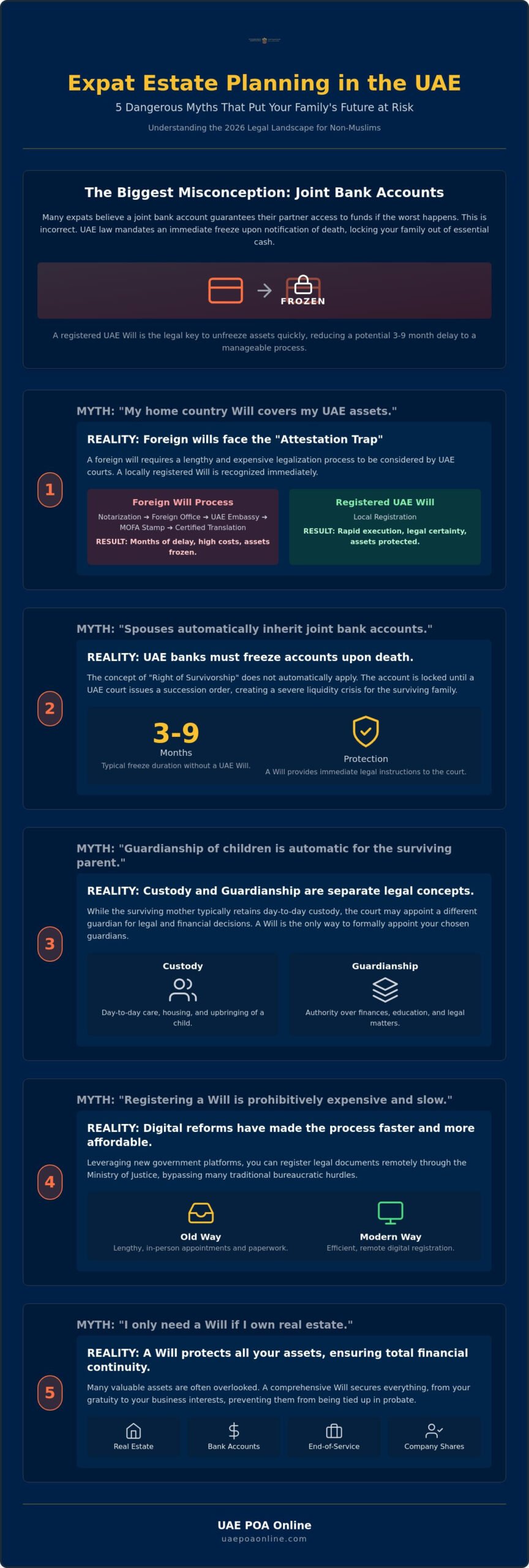
Your joint bank account in Dubai isn’t the safety net you think it is. Many residents believe that if the worst happens, their partner will have immediate access to shared funds, but the reality under local law is far more rigid. Without a registered expat will UAE, bank accounts are typically frozen the moment a death is reported, leaving survivors without immediate cash for daily expenses. It’s a high-stakes situation that catches even the most prepared families off guard.
We understand that estate planning often feels like an overwhelming bureaucratic hurdle. You want to protect your children and assets without getting lost in complex legalities. This guide reveals how to gain absolute legal certainty and avoid the risks of intestacy under the laws that took effect on January 1, 2026. We’ll debunk five dangerous myths regarding Sharia law and guardianship, then provide a streamlined, digital path to securing your family’s future with total confidence.
Key Takeaways
- Prevent the “immediate freeze” of joint bank accounts by understanding how local probate laws affect non-Muslim residents in 2026.
- Secure your children’s future by clarifying the legal distinction between custody and guardianship within an expat will UAE.
- Bypass the expensive “attestation trap” of foreign documents with a locally registered will that ensures rapid asset distribution for your survivors.
- Leverage recent digital reforms to register your legal documents remotely through the Ministry of Justice for a faster, more affordable experience.
- Protect often-overlooked assets like end-of-service benefits and company shares to ensure total business and financial continuity for your family.
Myth 1: “My Home Country Will Covers My UAE Assets”
Assuming your home country will is enough to protect your Dubai villa or Abu Dhabi bank account is a high-stakes gamble. While a foreign will might eventually be recognized, it isn’t the “plug-and-play” solution many believe it to be. An expat will UAE is a locally registered legal document specifically designed to be recognized by UAE authorities. It bypasses the complex, multi-step hurdles that often block foreign documents during the probate process.
The primary obstacle is the “Attestation Trap.” For a foreign will to have any standing in a local court, it must undergo a grueling legalization process. This involves notarization in your home country, stamps from your national Foreign Office, attestation at the UAE Embassy abroad, and a final stamp from the UAE Ministry of Foreign Affairs (MOFA). This process is expensive and can take months. During this time, your assets remain frozen and your family is left in legal limbo. Understanding the UAE Legal System Overview is vital, as it highlights how civil law requirements differ from common law jurisdictions.
Federal Decree-Law No. 41 of 2024, which became effective on January 1, 2026, serves as the default “Law of the Land” for non-Muslims. While this law improved inheritance rights, it doesn’t eliminate the need for local documentation. Without a registered expat will UAE, the court will apply the default 50/50 split between a spouse and children, which may not align with your specific wishes or your home country’s laws.
Why UAE Courts May Reject Overseas Wills
Procedural delays are the most common reason for rejection. Every foreign document must have an MOJ-certified legal translation into Arabic; without it, the court won’t even review the file. Jurisdictional conflicts also play a major role. UAE civil law doesn’t recognize certain common law frameworks, such as the right of survivorship for property. Validating a foreign grant of probate in local courts is a massive financial burden that often requires specialized legal teams, costing families far more than the price of a local will.
The 2026 Legal Standard for Expat Inheritance
The 2026 regulations allow you to specify that your national law should apply to your estate, but there’s a catch. You must formalize this choice through a local registration. When you write a will in UAE, you provide a clear instruction that the courts can follow immediately. You also get to choose your jurisdiction, such as the Abu Dhabi Judicial Department (ADJD) for affordability or the DIFC for common-law-style protection. This choice is the only way to guarantee your national laws are respected without a protracted court battle.
Myth 2: “Spouses Automatically Inherit Joint Bank Accounts”
One of the most distressing surprises for grieving families in the Emirates is the sudden loss of access to cash. In many Western jurisdictions, “Right of Survivorship” ensures that a joint account remains fully accessible to the surviving partner. This is not the case here. Upon the death of an account holder, UAE banks are legally required to freeze all accounts, including joint ones, once they are notified of the passing. This administrative lock remains in place until a court issues a formal succession order.
The UAE Civil Personal Status Law provides the framework for asset distribution, but it does not bypass the freezing process. Without a registered expat will UAE, the surviving spouse may find themselves unable to pay for immediate needs like rent, utility bills, or school fees. This legal “lockdown” is designed to protect the rights of all potential heirs, but it creates a significant liquidity crisis for the immediate family at the worst possible time.
A registered will acts as the essential legal key to unfreeze these assets. It provides the court with clear, notarized instructions on how the funds should be distributed. While the freeze is mandatory, having a local will drastically shortens the time it takes for a judge to release the funds, turning a months-long struggle into a manageable administrative process. Using a trusted online will service UAE is the most efficient way to ensure your document meets all local requirements and is ready to be acted upon immediately.
What Happens to Your Cash Without a Will?
When an account is frozen, the court initiates a mandatory inventory of all liquid assets. This includes checking for outstanding debts, credit card balances, and personal loans. Without a local will, this inventory and the subsequent distribution process typically take between three and nine months to complete. If you die without a will, your family’s daily survival depends entirely on the speed of a court system that is legally bound to follow a rigid, slow-moving default distribution path.
Protecting Shared Assets and Properties
The risk extends beyond cash to physical assets like the family home. While a general power of attorney UAE is invaluable for managing affairs while you are alive, it expires immediately upon death. It cannot be used to transfer property shares or manage bank accounts during probate. To ensure your share of a property passes directly to your spouse rather than being split among extended relatives, a will is a structural necessity.
For those managing high-value real estate, a property power of attorney UAE can help a representative manage the maintenance or leasing of a villa during the living years, but only a will secures the title deed for the next generation. Securing these assets doesn’t have to be a burden; you can draft your legal documents online to ensure your family maintains the lifestyle you’ve worked hard to build.
Myth 3: “Guardianship of Children is Automatic for the Surviving Parent”
Protecting your children is likely your highest priority, yet many parents operate under a dangerous misunderstanding of local family law. In the UAE, the legal roles of “custodian” and “guardian” are distinct. While a surviving mother is typically granted custody, which involves the physical day-to-day care of the children, she does not automatically become the legal guardian. The guardian is the person responsible for managing the children’s assets, education, and legal affairs. Without an expat will UAE, the court may look to default rules that often prioritize the paternal grandfather or the closest male relative on the father’s side for this role.
This legal gap creates a period of high uncertainty. If both parents pass away and no legal document exists, the state must intervene. In the critical first 48 hours following an incident, children may be placed into temporary care because no one has the immediate legal authority to take them. A registered will is the only way to ensure your children remain with people you trust from the very first moment. It provides a clear, notarized instruction that the courts can act upon immediately to keep your family together.
The Role of the UAE Courts in Child Protection
The courts always prioritize the “best interests of the child,” but without written evidence of your wishes, they have no roadmap to follow. A notarized guardianship clause in a registered will carries significant legal weight. It provides the judge with a documented instruction that overrides default familial hierarchies. By registering your document, you ensure that your chosen guardians are vetted and recognized by the Ministry of Justice long before they are ever needed.
Interim Guardianship: A Critical Safety Net
Most expatriate families have their primary support network living thousands of miles away. If your permanent guardians reside overseas, they cannot reach the UAE instantly to assume their duties. This is why nominating “interim” guardians, such as trusted friends or colleagues living locally, is essential. These individuals act as a bridge, providing immediate care until your permanent guardians arrive. You can manage these complex requirements and ensure your online power of attorney UAE supports your guardianship wishes. This dual-layered approach ensures your family is never left at the mercy of bureaucratic delays during a crisis.
Myth 4: “Registering a Will is Prohibitively Expensive and Slow”
Many residents postpone estate planning because they remember the days of physical court visits and endless bureaucratic queues. By 2026, the UAE has fully embraced a digital-first approach to legal documentation. You can now finalize an expat will UAE through 100% remote notarization, often involving a simple video conference with a government notary. This digital revolution has stripped away the time-consuming hurdles of the past, making the process both fast and accessible from your home or office.
Professional drafting is the most effective way to ensure your document isn’t rejected at the notary stage. While some online templates promise a 30-minute fix, they often lack the technical precision required by local authorities. A rejected document leads to re-filing fees and unnecessary stress. Choosing a “Mirror Will” is a strategic way for couples to save on registration costs. Mirror wills are nearly identical documents that name each other as primary beneficiaries, streamlining the notarization process and reducing the overall financial burden for the family.
Comparing UAE Will Jurisdictions
Your choice of jurisdiction depends on your asset portfolio and preferred legal framework. The Abu Dhabi Judicial Department (ADJD) offers a highly affordable, streamlined online process that is recognized across all Emirates. For those with complex international assets or a preference for common-law principles, the DIFC Wills Service Centre remains a premium option. Most registrations in 2026 are completed within a few days of drafting. Understanding MOJ notary services UAE is essential for ensuring your business interests are correctly integrated into your estate plan.
The True Cost of Intestacy
The real expense lies not in creating a will, but in dying without one. Intestacy triggers a cascade of hidden costs, including mandatory certified legal translations for every heir’s birth and marriage certificates. You may also face significant court fees and higher property transfer taxes that a well-structured will could have mitigated. A single, one-time investment in a professional will costs significantly less than the legal fees required to settle a contested estate in the UAE courts. To secure your assets today, you can register your will online with our expert team to ensure total compliance.
Myth 5: “I Only Need a Will if I Own Real Estate”
Many residents believe that if they don’t own a villa in the Springs or an apartment in Downtown, they can skip the estate planning process. This assumption is a significant financial risk. An expat will UAE is the only instrument that covers every facet of your life in the Emirates, including your liquid assets and personal belongings. Even if you rent your home, you likely have thousands of dirhams tied up in bank accounts, vehicles, and end-of-service benefits that require legal protection.
Your End-of-Service Benefits (EOSB) are often the largest single payout your family will receive. Without a will, your final salary and gratuity can be held by your employer or the bank to settle outstanding debts, leaving your survivors without their primary financial cushion. Vehicles are another critical point of failure. Once a death is reported, a car’s registration cannot be renewed, and it cannot be sold or legally driven until the probate court issues a transfer certificate. A registered will ensures these assets move to your loved ones without months of administrative gridlock.
The modern 2026 approach to estate planning involves a dual strategy. You need a business power of attorney UAE for “living protection” to manage your affairs if you become incapacitated, paired with a will for “after-life protection.” Together, these documents form a comprehensive shield around your legacy.
Wills for Business Owners and Entrepreneurs
For business owners, the stakes are even higher. If a sole shareholder passes away without a will, the company’s trade license and corporate bank accounts are typically frozen. This stops payroll, halts operations, and can lead to the cancellation of employee visas. By designating a legal representative in your will, you ensure the business remains a “going concern” during the probate period. Entrepreneurs can even use remote notarization UAE to coordinate these protections with partners who may be located overseas.
Next Steps: Securing Your Legacy Online
Securing your family’s future doesn’t require weeks of legal consultations. You can start the drafting process with UAE POA Online today through our streamlined digital platform. To begin, you’ll need to gather a small checklist of documents:
- A clear copy of your Passport and Emirates ID.
- A basic list of your UAE assets (Bank accounts, vehicles, company shares).
- The names and passport copies of your chosen executors and guardians.
Don’t leave your family’s stability to the default application of local laws. Take control of your assets and provide your survivors with the legal certainty they deserve. Contact us today to formalize your expat will UAE and ensure your legacy is protected for years to come.
Take Control of Your Estate Today
The legal landscape of 2026 provides residents with unprecedented clarity, but these protections only benefit those who take proactive steps. Relying on common myths about automatic guardianship or joint account survivorship puts your family at risk of significant financial and emotional distress. An expat will UAE is no longer a luxury; it’s a fundamental requirement for anyone living, working, or investing in the Emirates. By formalizing your wishes now, you prevent the immediate freezing of bank accounts and ensure your children remain in the care of those you trust most.
Our team simplifies this entire process through expert UAE legal consultants and certified legal translation services. We manage every detail of your MOJ notary coordination so you can focus on your family’s well-being. Secure your assets today with our professional UAE Will drafting services. Don’t leave your legacy to chance when a streamlined, digital solution is within reach. You’ve worked hard to build a life here; let’s make sure it stays protected.
Frequently Asked Questions
Does a non-Muslim expat will in the UAE follow Sharia law?
No, non-Muslim wills don’t follow Sharia law by default under the 2026 legal framework. Federal Decree-Law No. 41 of 2024 governs these estates, ensuring a 50/50 split between a spouse and children if no will exists. However, an expat will UAE is the only way to opt out of these defaults and apply your home country’s laws to your assets.
Can I register my UAE will online from my home country?
Yes, you can register your document from anywhere in the world using digital platforms. The Abu Dhabi Judicial Department (ADJD) provides a completely online service that includes a video conference with a notary for final verification. This eliminates the need for physical travel or in-person appearances at a local court, making the process efficient for global residents. An online will service UAE can guide you through the ADJD and DIFC registration requirements step by step, ensuring your document is correctly prepared before submission.
What happens to my UAE bank account if I die without a will?
Your bank account is frozen the moment the bank receives notification of your passing. This administrative lock applies even to joint accounts where the surviving spouse is a co-owner. Without a will, the process to release these funds can take months. Under Law No. 51 of 2024, assets with no identifiable legal heirs are eventually transferred to a state-managed charitable endowment.
How much does it cost to register an expat will in the UAE in 2026?
Registration fees vary significantly depending on the jurisdiction you choose. As of July 2026, the ADJD charges AED 950 for a single will and AED 1,900 for mirror wills. The DIFC Wills Service Centre remains the premium option, with mirror full wills costing AED 15,000 and specific financial asset wills starting at AED 5,000 for a single applicant.
Do I need a separate will for every Emirate where I own property?
No, you only need one registered document to cover your assets across the entire country. An expat will UAE registered in either Abu Dhabi or Dubai is legally recognized in all seven Emirates. This single document protects your real estate, bank accounts, and personal belongings regardless of the specific Emirate where they are located.
Can I change or revoke my UAE will after it has been notarized?
Yes, you retain full control to change or revoke your will at any time as your circumstances evolve. If you have a new child or purchase additional property, you can draft an updated version. The new document must undergo the same notarization process to officially revoke the previous version stored in the government registry.
Is a DIFC will better than an ADJD will for expats?
The best choice depends entirely on your asset structure and budget. ADJD is the most cost-effective option for most residents and offers a seamless digital experience. DIFC is often preferred by those with complex international business interests or those who want their estate governed strictly by common law principles rather than the UAE’s civil law framework.
How long does the probate process take in the UAE with a registered will?
Probate typically takes a few weeks to a few months when a registered will is present. This is much faster than the nine-month average for estates without a will. Having a notarized document allows the court to issue a succession order quickly, providing your family with immediate access to essential funds and property titles.
Leave a Reply