
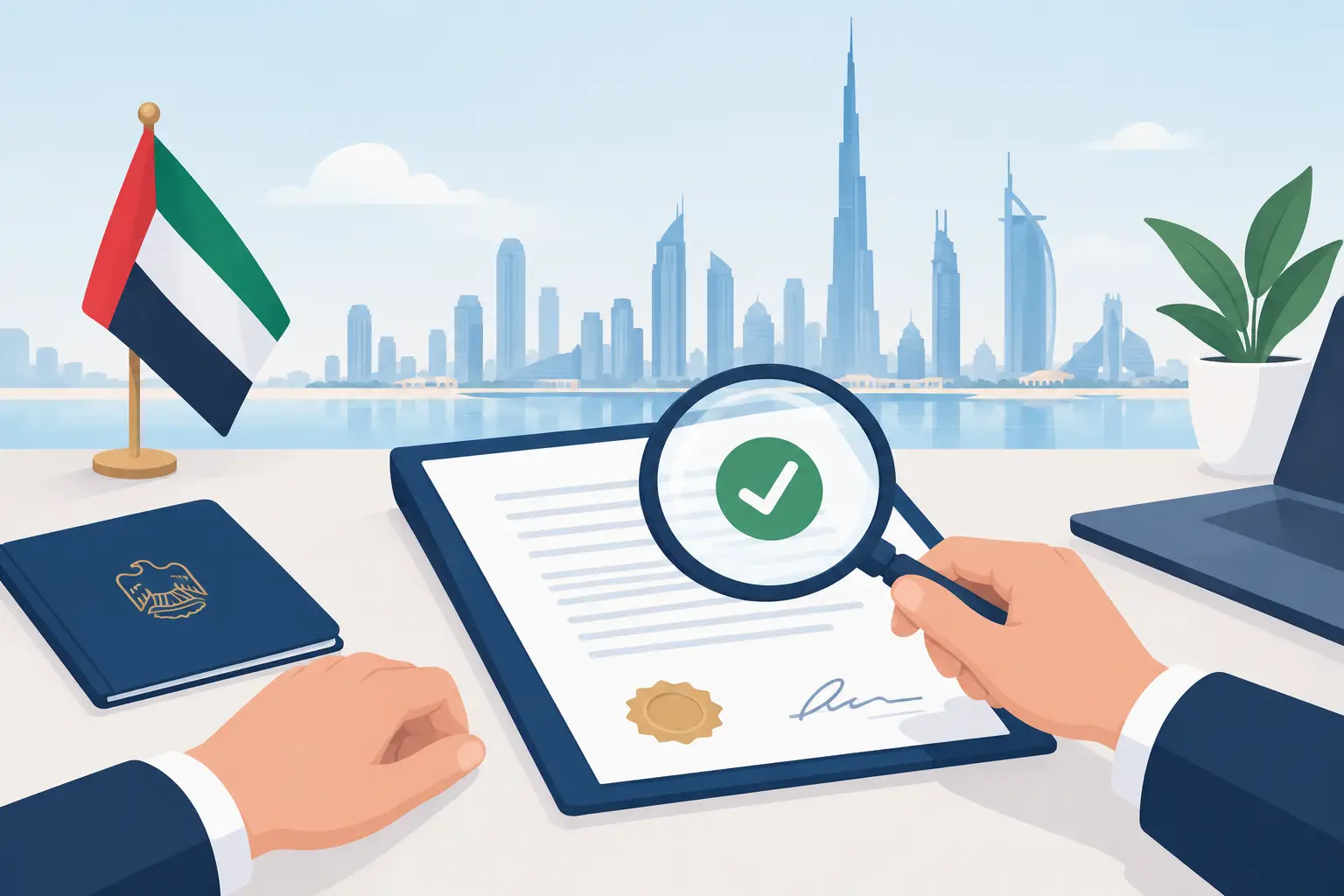
A Power of Attorney can be drafted perfectly and still be delayed if the identity documents, supporting papers, or signing method do not meet the notary’s requirements. For UAE residents, overseas property owners, business partners, and families, document verification is the stage that turns a prepared document into one that can move forward confidently for notarization and legal use.
The purpose is not to create unnecessary paperwork. It is to confirm that the person granting authority is correctly identified, has the authority to grant it, understands the document, and is using supporting records that are valid and consistent. When this is handled early, a remote POA process is faster, clearer, and far less likely to face rejection.
What Document Verification Means for a UAE POA
For a UAE Power of Attorney, document verification is the review of the personal, corporate, property, vehicle, or other supporting records needed for the specific authority being granted. The documents must match the POA details and satisfy the requirements of the relevant UAE notary, court, land department, bank, free zone, or other receiving authority.
A General POA and a Special POA do not always require the same supporting documents. A Property POA, for example, may need property information that is not relevant to a Car POA. A Business POA may require company records and proof of signatory authority in addition to the principal’s identification.
This is why a one-size-fits-all checklist can create problems. The correct documents depend on what the attorney-in-fact will do, where the POA will be used, the principal’s residency status, and whether the principal is signing inside or outside the UAE.
Why Verification Matters Before Notarization
Notarization confirms the execution of a legal instrument. It does not correct conflicting names, expired identification, incomplete company records, or overly broad instructions that a receiving authority may not accept. Verification before submission identifies these issues while they can still be resolved quickly.
The most common delays are often small but significant. A passport name may be spelled differently from the title deed. An Emirates ID may be expired. A company trade license may show an outdated manager. A POA may refer to a property using a description that does not match the official record. These differences can lead to additional questions, revisions, or a rejected appointment.
For clients abroad, the stakes are higher. If documents require legalization, certified legal translation, or a specific form of authentication, discovering that requirement after signing may add days or weeks. A careful review protects the timeline before the process begins.
Identity and Capacity Checks
The principal’s identity is central to every Power of Attorney. Typically, verification involves reviewing a valid passport and, where applicable, a UAE Emirates ID, visa page, or UAE Pass details. The name, nationality, document number, and expiry date should be clear and consistent with the POA draft.
The review also considers capacity and intent. The person granting authority must be able to understand the document and voluntarily approve its terms. Remote notarization does not remove this requirement. It makes accurate preparation even more important because the notary may confirm identity and consent through an online process.
If a signer does not understand the language of the POA, a certified legal translation or interpretation arrangement may be required. This is not a formality. It helps ensure that the signer is approving the authority knowingly and that the document can be legally recognized.
Matching the POA to the Underlying Transaction
A POA should be precise enough for the task at hand. Document verification checks whether the authority being granted reflects the actual transaction and the requirements of the organization that will rely on it.
For a property transaction, this can mean confirming the property reference, owner details, and the intended powers to sell, lease, manage, collect rent, or complete transfer formalities. For a vehicle matter, the document may need accurate vehicle details and authority for transfer, registration, or collection. For banking or financial matters, the receiving institution may have its own wording and compliance requirements.
Broad wording can be useful in a General POA, but it is not always the best choice. A narrowly drafted Special POA can provide stronger control when a client only needs representation for one property sale, one car transfer, or one business action. The right approach depends on the transaction, risk level, and how long the authority needs to remain in place.
Documents Commonly Reviewed
The required records vary, but a verification review commonly begins with the principal’s valid identification and the proposed attorney-in-fact’s identification details. From there, the supporting documents follow the purpose of the POA.
For personal matters, this may include a passport, Emirates ID, visa information, marriage certificate, birth certificate, or other evidence relevant to the authority requested. For property matters, it may include a title deed, property reference, tenancy information, or developer records. For a car POA, vehicle registration details may be relevant.
Business POAs require particular care. The reviewer may need to check the trade license, memorandum or constitutional documents, board resolution where applicable, and records showing who is authorized to grant the POA on the company’s behalf. Mainland companies, free zone entities, and foreign companies can each have different documentation paths.
Documents issued outside the UAE may need attestation, legalization, or certified Arabic translation before they can be accepted for their intended use. The exact route depends on the country of issue, the document type, and the authority that will receive it. Assuming that a scanned foreign document will be accepted without further formalities is a frequent and costly mistake.
A Practical Document Verification Process
The fastest process starts before the first draft is finalized. Share clear, current copies of all identification and transaction documents, then confirm the purpose of the POA in plain language. State exactly what the representative needs to do and where they will use the document.
A proper review then checks the following points:
- Whether identity documents are valid, readable, and consistent with the principal’s legal name.
- Whether the attorney-in-fact’s details are complete and accurately entered.
- Whether the proposed powers are specific enough for the intended transaction.
- Whether property, vehicle, company, or financial details match the relevant official records.
- Whether translation, attestation, legalization, or additional corporate approval is required.
Once the documents are cleared, the POA can be drafted in a form suitable for the applicable notary process. If revisions are needed, they should be made before the signing appointment rather than after notarization. That is usually the difference between a controlled timeline and an urgent correction.
Remote Verification for Clients Outside the UAE
Being outside the UAE does not automatically prevent a client from arranging a legally valid UAE POA. However, the process must be planned around the client’s location, identification documents, and the intended use of the final POA.
Some clients may be able to complete online or remote notary steps, subject to the applicable requirements. Others may need to sign before a local notary in their country and complete consular legalization or further UAE authentication. There is no single answer for every jurisdiction, so the correct path should be confirmed before documents are signed.
Time-sensitive matters deserve an early review. If a property completion, business filing, court matter, or vehicle transfer has a fixed date, provide the deadline at the start. This allows the legal team to identify the fastest compliant route instead of relying on assumptions about processing times.
Mistakes That Can Delay a POA
The most avoidable mistake is sending incomplete or expired identification. The next is using names or document details that do not precisely match official records. Even a missing middle name, an old passport number, or a transliteration difference between English and Arabic can require clarification.
Another issue is granting powers that do not match the transaction. A POA for property management may not be sufficient for a sale. A company manager’s personal authority may not prove that they can bind the company. A document can be validly notarized yet still be insufficient for the party receiving it.
Finally, do not sign a document before confirming whether translation or legalization is needed. Re-signing from abroad can be inconvenient, especially when deadlines are close.
Get the Details Right Before You Sign
Document verification is where speed and legal compliance meet. It gives you a clear view of what is needed, what may cause a delay, and whether the POA is structured for the action you actually need completed.
UAE POA Online helps clients prepare, review, notarize, legalize, and translate POA documents remotely, with attention to UAE notary and court requirements. Whether you need urgent representation for a property, vehicle, business, or personal matter, the strongest next step is simple: verify every document before the signing process begins.
Leave a Reply