

A single missing clause or a mistranslated word can render your Power of Attorney completely useless at the very moment you need it most. It’s a frustrating reality that many face when their documents are rejected by banks or government departments due to minor technicalities. Understanding the specific power of attorney requirements UAE mandates for 2026 is the only way to ensure your legal affairs remain uninterrupted and your interests stay protected.
You likely want a process that’s fast, digital, and above all, legally sound. We understand the stress of managing these requirements, especially if you’re handling notarization from abroad or feel overwhelmed by mandatory Arabic translation rules. This guide provides a comprehensive, step-by-step checklist of every document and legal clause required to create a valid POA. We preview the streamlined e-notarization path, explain the latest validity periods for different Emirates, and provide the certainty that your document will be accepted by every authority in the UAE.
Key Takeaways
- Understand the fundamental legal criteria under UAE Federal Law, including the mandatory age and mental capacity requirements for a valid principal.
- Identify the specific identification documents required for residents and non-residents to ensure your application proceeds without administrative delays.
- Learn how to navigate the power of attorney requirements UAE enforces regarding bilingual formatting and mandatory legal translation from MOJ-approved experts.
- Select the most efficient notarization path for your situation, whether through streamlined digital portals or flexible private notary services.
- Discover how professional drafting eliminates the risk of document rejection by ensuring every essential legal clause is present and correctly phrased.
What Makes a Power of Attorney Legally Valid in the UAE?
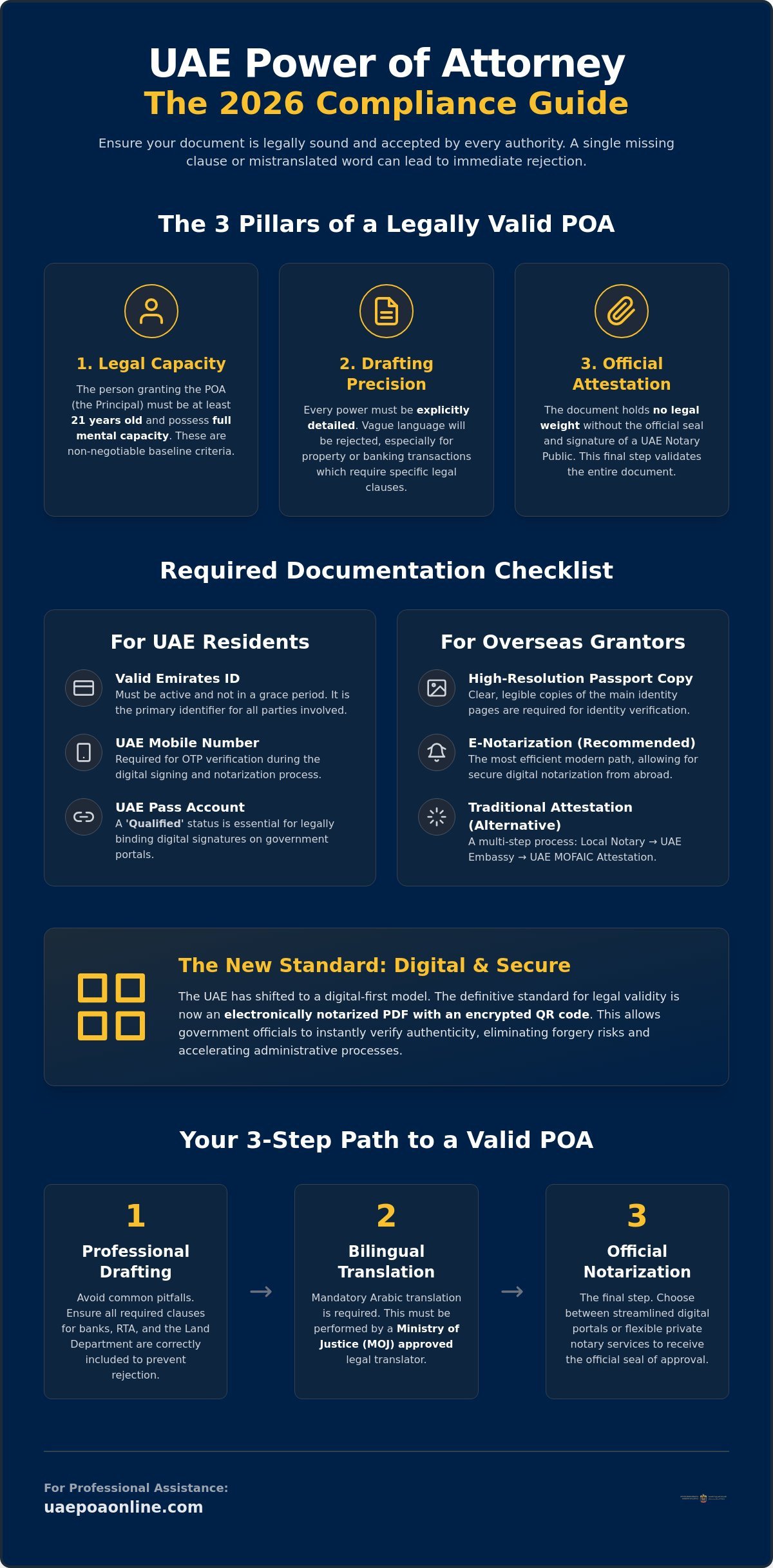
A Power of Attorney (POA) is a legal instrument that empowers a chosen representative to manage your affairs, whether personal or professional. Under UAE Federal Law, this document is more than a simple letter of intent; it’s a binding contract that must adhere to strict regulatory standards. To fulfill the power of attorney requirements UAE authorities demand, the principal must be at least 21 years of age and possess full mental capacity. If these baseline criteria aren’t met, the document is void from the outset. This protects both the grantor and the institutions that rely on the document’s integrity.
The Ministry of Justice (MOJ) maintains comprehensive oversight of the notarization process to prevent fraud and ensure legal compliance. Many people mistakenly believe they can download a generic template and modify it themselves. This approach often leads to immediate rejection. UAE government departments, such as the Dubai Land Department (DLD) or the RTA, require specific, non-negotiable legal clauses to authorize certain actions. A generic document lacks the localized precision needed to pass these rigorous checks; it won’t include the specific terminology required for local banking or property transfers.
The Three Pillars of UAE POA Compliance
Compliance rests on three essential factors. First is legal capacity. Both the grantor and the agent must meet eligibility standards, including age and residency status where applicable. Second is drafting precision. Every power you wish to grant must be explicitly detailed. Vague language won’t suffice for high-stakes transactions, and meeting the power of attorney requirements UAE law specifies means listing every authority from signing contracts to managing bank accounts. Finally, official attestation by a Notary Public serves as the ultimate validation. Without this official seal, the document holds no legal weight in the Emirates.
Digital vs. Physical Validity in 2026
The legal landscape has shifted toward a digital-first model. While physical papers still exist, authorities now prioritize digital documents equipped with encrypted QR codes. This technology allows government officers to verify document authenticity instantly through secure portals. It eliminates the risk of forgery and speeds up administrative tasks. Currently, an electronically notarized POA issued as a PDF with a QR code is the definitive standard for legal validity across all Emirates.
Checklist 1: Identification and Personal Documentation
Preparation is the key to a seamless notarization. Without a complete set of verified identification documents, even the most expertly drafted document will fail at the first stage of government review. The 2026 power of attorney requirements UAE authorities enforce are designed to be rigorous, ensuring that every party involved is exactly who they claim to be. This protects you from unauthorized representation and ensures that banks or land departments can trust the document implicitly.
For individuals, the primary requirement is a valid Emirates ID for all UAE residents, including both the grantor and the agent. If you’re representing a business, the documentation becomes more complex. You’ll need to provide a current Trade License and the Memorandum of Association (MOA). These documents prove that the person granting the power has the legal authority to bind the company. Navigating the legal requirements for a POA ensures that your identity is verified according to international and local standards, preventing administrative delays.
Requirements for UAE Residents
Residents must ensure their Emirates ID is active and not in a renewal grace period, as the digital systems used by notaries link directly to the Federal Authority for Identity and Citizenship. A linked UAE mobile number is essential; it’s used for OTP verification during the signing process. Most notarizations now utilize UAE Pass integration, which requires a “Qualified” account status to facilitate legally binding digital signatures. If you haven’t upgraded your UAE Pass at a physical kiosk, you should do so before starting your application.
Requirements for Overseas Grantors
If you’re outside the Emirates, you don’t necessarily need an Emirates ID, but you’ll need high-resolution copies of your original passport. The traditional route involves a multi-step attestation process: notarization in your home country, followed by legalization at the UAE Embassy and finally the Ministry of Foreign Affairs (MOFAIC). However, this is no longer the only option. For those currently out of the country, the most efficient path is using an online power of attorney UAE service to bypass physical embassy visits through remote video notarization.
Regardless of your location, you must provide the agent’s full legal name as it appears on their ID, along with their current contact details. Accuracy here is vital. A single typo in a passport number can lead to a rejection by the notary. If you’re unsure about your specific document status, our team at UAE POA Online can review your files before you submit them to the authorities.
Checklist 2: Drafting and Linguistic Requirements
Drafting a document that satisfies the power of attorney requirements UAE mandates involves a high level of linguistic and legal precision. It’s not enough to simply state your intentions in English. The UAE legal system requires a specific side-by-side bilingual format where Arabic and English text appear together. While the English portion helps you understand the contents, the Arabic text is the legally binding version used by courts and government officials. This means your translation must be flawless; a single mistranslated legal term can change the entire scope of the authority you’re granting.
Meeting the power of attorney requirements UAE officials look for means you can’t rely on standard translation services. The law requires a Certified Legal Translation performed by a translator approved by the Ministry of Justice (MOJ). These specialists understand the exact terminology required to make a document enforceable across all Emirates. Beyond the language, the drafting must clearly define the scope of authority. You must decide between granting “General” powers for broad management or “Special” powers for a specific task. To protect your interests, we always recommend including a “No Self-Dealing” clause. This prevents your agent from using the POA to transfer assets to themselves, adding a vital layer of security to your legal arrangements.
Essential Clauses for Every UAE POA
Every robust POA must explicitly list the authority to sign documents, represent the principal before authorities, and receive or pay funds. Without these specific verbs, the document might be deemed insufficient for financial transactions. It’s also critical to include a clear duration or a revocation clause. This ensures your agent’s authority doesn’t continue indefinitely if your circumstances change. If you need to terminate an existing authorization, understanding how to cancel power of attorney in Dubai is just as important as knowing how to create one. If you’re looking to handle a specific asset like a car or a house, you should refer to our guide on the special power of attorney UAE to see the exact wording required for those high-value transactions.
Department-Specific Requirements
One of the most common reasons for document rejection is the use of a “General” POA for specific government tasks. For example, the Dubai Land Department (DLD) frequently rejects broad documents that don’t explicitly mention the power to “sell” or “transfer” a specific property plot. Similarly, UAE banks often require very specific language regarding account management, including the power to open, close, or withdraw funds. If your document doesn’t mirror the exact internal requirements of these departments, it will be rejected, regardless of its notarization status. Precision in the drafting stage saves weeks of administrative delays later.
Checklist 3: Notarization and Attestation Paths
Selecting the correct notarization path is the final hurdle in meeting the power of attorney requirements UAE mandates for legal validity. You have two primary options: public notaries affiliated with the courts or licensed private notaries. While public notaries are the traditional choice, private notaries often provide faster, more flexible services for those with complex requirements. Regardless of the path you choose, the goal is the same: a document that carries the official seal of the state. This ensures your document adheres to the power of attorney requirements UAE authorities expect when you present it at a bank or government office.
Government fees are paid directly through the Ministry of Justice (MOJ) or the local judicial portal, such as the Dubai Courts website. These fees vary depending on the Emirate and the specific type of document being notarized. Identity verification is the most critical part of this stage. It usually involves a live video call or a physical appearance where the notary public cross-references your identification documents with your live presence. This ensures that the signature is voluntary and that the principal fully understands the powers they’re delegating. Once verified, the notary issues a final document featuring a digital tracking number, ensuring it can’t be tampered with.
The Digital Notarization Process
The digital path is now the standard for modern legal transactions in the Emirates. You start by uploading your bilingual draft to the MOJ portal or the relevant local authority’s system. Once the documents are screened, you’ll schedule a virtual meeting with a Notary Public. During this video call, you’ll provide your consent and sign the document electronically using your UAE Pass. After the notary approves the transaction, you receive the e-notarized document via email or an SMS link. This PDF contains a QR code, allowing any government department to verify its authenticity in seconds.
Notarization for Property and Business
Corporate and real estate transactions demand a higher level of precision during the attestation phase. There are additional verification steps for a business power of attorney UAE, such as proving the signatory’s authority through a valid Trade License or Board Resolution. Property-related POAs also face stricter scrutiny; notaries often require a Title Deed to confirm the grantor actually owns the asset being managed. The average timeline for completing a remote e-notarization for a POA, from document drafting to final issuance, is between 3 to 7 business days. If you want to avoid the complexities of portal navigation, you can manage your notarization through UAE POA Online for a guaranteed, error-free result.
Streamlining Your UAE POA with Professional Support
Navigating the complex power of attorney requirements UAE authorities enforce in 2026 requires more than just a basic understanding of the law. It demands a level of precision that only professional support can provide. By choosing an expert service, you eliminate the risk of drafting errors that frequently lead to rejection by banks or government entities. We ensure your document is legally fortified from the start, using MOJ-certified legal translators who understand the exact terminology needed for a document to be enforceable. These specialists ensure that the Arabic text, which is the definitive version used by local officials, perfectly mirrors your intentions without any ambiguity.
You don’t have to spend hours navigating government portals or scheduling appointments at a physical office. We coordinate the entire notarization process on your behalf, providing a seamless digital experience from the initial draft to the final e-notarized PDF. This comprehensive approach ensures your document meets the rigorous special power of attorney standards required for specific, high-value transactions. By centralizing the drafting, translation, and attestation, we remove the friction often associated with regional bureaucracy, giving you a document that is ready for immediate use.
Why DIY Drafting is Risky in the UAE
Attempting to draft your own POA is a gamble that rarely pays off. Most rejections occur because of vague language or the omission of specific powers that a particular department, like the Dubai Land Department, requires for property transfers. If your document is rejected, the consequences are both financial and administrative. You’ll face the high cost of re-translating and re-notarizing a corrected version, not to mention the potential for missed deadlines in your business or personal affairs. Professional drafting ensures acceptance at major financial institutions and government offices on the first attempt, protecting your interests and your schedule.
Get Started with UAE POA Online
We’ve developed a “Fast Documentation” process specifically for clients with urgent legal requirements. If you’re in a situation where every hour counts, our fast POA service UAE can offer a 24-hour turnaround for drafting and submission. This rapid service doesn’t compromise on quality; it simply leverages our deep understanding of the power of attorney requirements UAE law mandates to expedite the process. For complex property authorizations or corporate governance needs, we recommend requesting a detailed consultation. Our team acts as your trusted specialist, ensuring that your legal representative has the exact authority they need to act on your behalf.
Secure Your Legal Interests for 2026
Securing a valid document doesn’t have to be a bureaucratic struggle. You’ve now seen how success depends on precise bilingual drafting and choosing the correct digital notarization path. Meeting the power of attorney requirements UAE law mandates is about more than just paperwork; it’s about ensuring your representative has the exact authority needed to act when you cannot. Whether you’re managing real estate in Dubai or authorized business signatures in Abu Dhabi, precision is your best defense against administrative rejection.
Our team provides the expertise you need to navigate these systems with speed. We offer 100% digital notarization support and utilize MOJ-certified legal translators to guarantee your document’s acceptance. With our deep expertise in property and business authorizations, we handle the technical complexities so you don’t have to. You can Draft Your Valid UAE POA Online Today and experience a streamlined, professional process. Take the first step toward total legal peace of mind and protect your future interests with confidence.
Frequently Asked Questions
What are the main power of attorney requirements in the UAE for expats?
Expats must provide a valid passport and, if residing in the country, their original Emirates ID. The primary power of attorney requirements UAE law enforces for expats include bilingual drafting in Arabic and English and mandatory notarization. You must also be at least 21 years old and possess full mental capacity. Ensuring your agent’s details are perfectly aligned with their identification is vital for avoiding delays at government offices.
Can I issue a power of attorney if I am outside the UAE?
You can issue a POA while outside the UAE using the e-notarization system. This process involves a remote video call with a notary public and typically takes between 3 to 7 business days. Alternatively, you can use the traditional attestation route through the UAE Embassy in your current country and the Ministry of Foreign Affairs (MOFAIC). The digital path is significantly faster and eliminates the need for physical travel.
How long is a power of attorney valid in the UAE?
Validity periods vary based on the Emirate and the specific purpose of the document. In Dubai, a POA used for property sales is typically valid for two years. Abu Dhabi generally limits the validity of most POAs to three years. General documents may remain valid indefinitely unless a specific expiry date is mentioned or the grantor formally revokes the authority through a notary.
Do I need a lawyer to draft my power of attorney in the UAE?
You aren’t legally required to hire a lawyer, but professional drafting is essential to meet the power of attorney requirements UAE departments demand. Generic templates often lack the specific clauses required by banks or the Land Department, leading to immediate rejection. Professional services ensure your document is translated by MOJ-certified experts and contains the protective clauses necessary to safeguard your assets.
What is the difference between a General and a Special POA in the UAE?
A General POA grants broad authority to manage business affairs, personal legal matters, and bank accounts. In contrast, a Special POA is restricted to a single transaction or asset, such as selling a specific vehicle or property. Special POAs are often mandatory for high-value transactions because they provide a clearer, more secure scope of authority that government departments prefer for verification.
Is an online power of attorney equally valid as a physical one?
An online POA is 100% as valid as a physical one and is often preferred by authorities in 2026. Digital documents issued via the Ministry of Justice portal include a secure QR code for instant verification. This allows banks and government officers to confirm the document’s authenticity in real-time, reducing the risk of fraud and speeding up your administrative tasks across all Emirates.
Can a power of attorney be used for selling property in the UAE?
Yes, a POA can be used for selling property, provided it’s a Special POA that explicitly describes the asset. It must include the property’s title deed details and clearly state the power to sell, transfer, and receive funds. Without this specific language, the Dubai Land Department or other regional authorities will reject the representative’s authority to complete the transaction on your behalf.
How much does it cost to notarize a POA in the UAE?
Government notarization fees vary by Emirate and the type of document. For instance, public notary cancellation fees in Dubai range from AED 300 to AED 500, while in other Emirates like Sharjah or Ajman, fees can start as low as AED 50 per signature for certain services. Total costs for comprehensive e-notarization services typically reflect the complexity of the drafting and the translation requirements involved. If your circumstances change and you need to terminate an existing authorization, our detailed guide on how to cancel power of attorney in Dubai walks you through every step of the revocation process.
Leave a Reply