
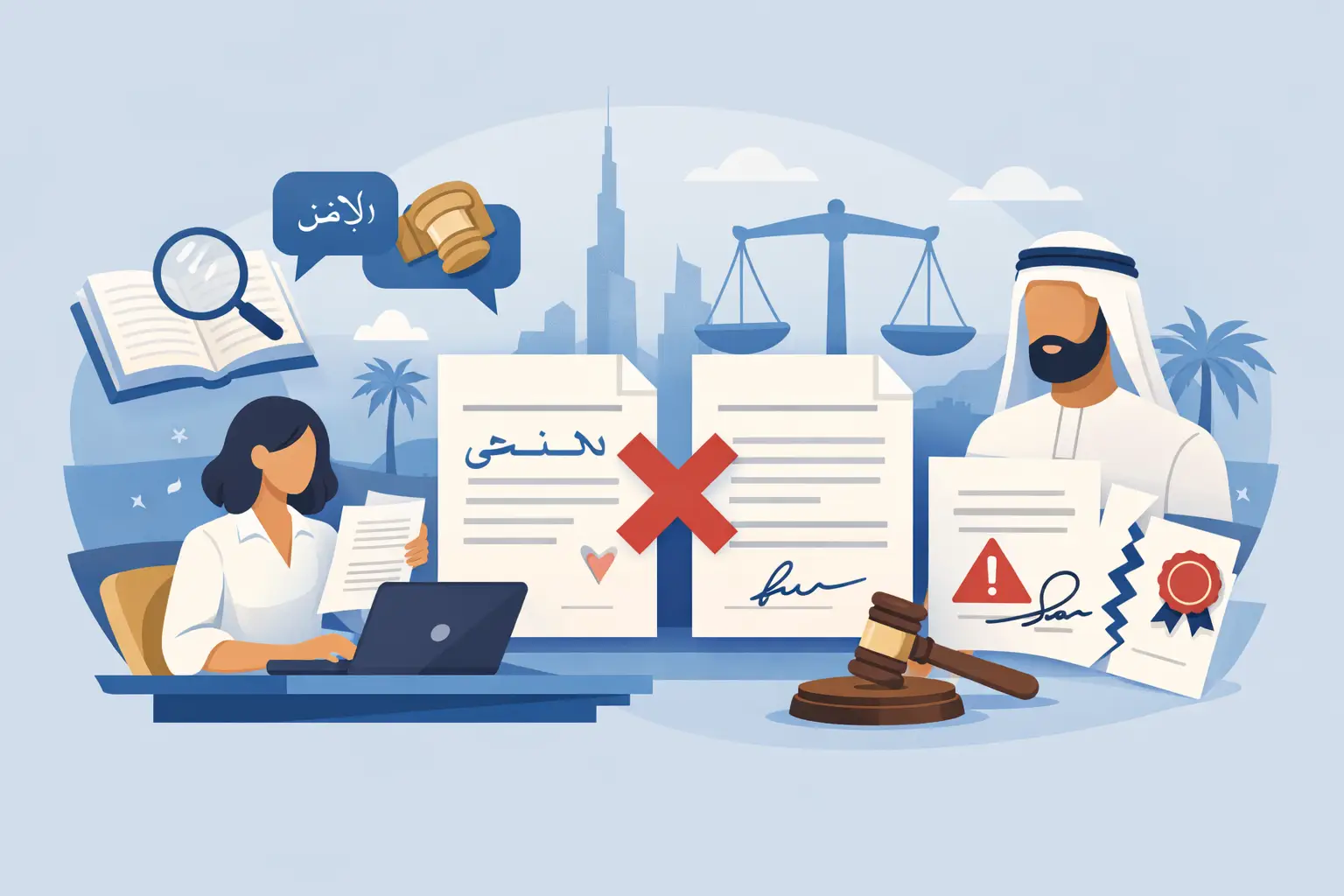
A single mistranslated authority in a Power of Attorney can stop a property transfer, delay a vehicle sale, or force a document to be drafted and notarized again. The top mistakes in legal translation are rarely obvious spelling errors. They are usually small wording, formatting, or certification failures that change what a UAE authority believes the document permits.
For UAE residents, overseas owners, investors, and business managers, legal translation is not a final administrative step. It is part of making the document usable. A translation must reflect the source document accurately while meeting the language, terminology, certification, and formatting expectations of the receiving authority. Getting it right at the beginning protects both your timeline and your legal position.
Why Legal Translation Errors Cause UAE Delays
UAE legal processes often involve Arabic documents or Arabic translations, particularly where a document is submitted for notarization, court use, government processing, or an official transaction. The required format can differ depending on the Emirates, the notary, the court, the bank, the property authority, or the purpose of the POA.
This is why a perfectly readable English translation may still be rejected. The question is not whether the text sounds natural. The question is whether it creates the same legal meaning as the original and satisfies the authority reviewing it.
For a Power of Attorney, that distinction matters immediately. A representative may need authority to sell a specific property, sign transfer documents, collect funds, manage a company, renew a license, or complete a vehicle transaction. If the Arabic and English versions do not align, the version recognized by the relevant UAE authority may control the outcome.
Top Mistakes in Legal Translation That Affect POAs
Translating legal meaning word for word
Literal translation is one of the most common sources of risk. Legal phrases do not always have a direct word-for-word equivalent between Arabic and English. A translator must preserve the legal effect, not merely replace each word with its dictionary definition.
For example, language granting a person the ability to “manage” an asset may not authorize them to sell, mortgage, gift, or receive sale proceeds. Similarly, a broad phrase in English may become narrower when translated into Arabic if the relevant actions are not stated clearly. In a Special POA, this can make the document unusable for the exact transaction it was created to complete.
The right approach depends on the purpose. A POA for a one-time property sale needs specific powers. A General POA may need broader but carefully controlled authority. The translation should be drafted around the intended legal action, not adapted from a generic template after the fact.
Using an unapproved or uncertified translator
A bilingual employee, friend, or general language translator may understand both languages well, but that does not make the translation acceptable for a UAE legal filing. Authorities may require a translation from a properly licensed or certified legal translator, especially when the document supports notarization, court proceedings, or an official government transaction.
Certification is not just a stamp added at the end. It is an accountability requirement. The translator confirms that the translated document corresponds to the source, and the receiving authority can identify the translator and their authorization.
Before translating, confirm what the receiving body requires. Requirements can vary by document type and authority. Using the right certified legal translation service from the start is normally faster and less expensive than correcting a rejected filing under urgent time pressure.
Omitting a power that appears in the source document
Omissions can be more damaging than obvious mistranslations because they may go unnoticed until the attorney-in-fact tries to use the POA. A skipped clause relating to signing, collecting payments, appearing before an authority, or delegating limited authority may leave the representative unable to complete the transaction.
This risk is especially high when the source document contains schedules, handwritten notes, exhibits, property details, company information, or additional pages. Every page, reference, number, and annex should be reviewed. A translation that covers only the main body but excludes the attached identification or asset information may fail the verification process.
For property POAs, confirm that the translated title details, plot or unit references, project name, and owner information match the supporting records exactly. For business POAs, check trade license details, company names, shareholder information, and signatory powers with the same care.
Changing names, dates, or identification details
Legal translation requires precision at the character level. A difference in the spelling of a name, a misplaced digit in an Emirates ID or passport number, or a date converted incorrectly can create a mismatch with official records.
Arabic and English transliteration can make this more complicated. A name may have several acceptable English spellings, but the legal document should follow the spelling shown in the passport, Emirates ID, title deed, trade license, or other primary record used for the transaction. Do not rely on how a name is commonly written in emails or business cards.
Dates also need careful handling. A translator should identify the date format used in the source and ensure it is not confused during conversion. If a document uses a non-Gregorian date, the treatment of that date must be clear and consistent with the authority’s requirements.
Leaving key terms vague or inconsistent
A POA should not refer to the same person as “agent,” “representative,” “attorney,” and “authorized person” without a clear reason. Inconsistent terminology can create doubt about whether the document refers to one person or several roles.
The same principle applies to assets and authorities. If a document says “the property” in one clause and “all properties” in another, the scope may be unclear. If it authorizes a representative to “sign documents” but does not state which documents or for what transaction, the receiving authority may request clarification or reject the POA.
Legal translators should use established terminology consistently, while the underlying drafting should define the scope in plain, specific terms. Precision does not mean making the document unnecessarily complicated. It means removing ambiguity before notarization.
Ignoring the hierarchy between language versions
Bilingual legal documents may specify which language prevails if there is a discrepancy. In many UAE official contexts, Arabic is the operative language for review. If the Arabic text is incomplete, overly broad, or inconsistent with the English source, relying on the English version later may not solve the problem.
This is why translation should be reviewed before the document is executed, not after it has been signed, notarized, legalized, or sent abroad. Once a document has completed several formal steps, correction can require a new version and repeat processing.
Ask early whether the document must be prepared in Arabic, translated into Arabic from English, or issued bilingually. The answer depends on where it will be used and whether it is being signed inside or outside the UAE.
Forgetting notarization and legalization requirements
A correct translation alone does not make a foreign document valid for use in the UAE. If a POA is signed outside the country, it may also need notarization, legalization, authentication, attestation, and Arabic legal translation before it can be accepted. The required sequence depends on the country of signing and the UAE authority receiving the document.
A frequent mistake is translating too early, before the final signed and legalized version is available. Another is translating a document that later changes during notarization, leaving the Arabic version out of sync. The safest process is to establish the required document path first, then translate the final version that will be submitted.
Treating formatting as cosmetic
Legal formatting carries information. Page numbering, stamps, seals, signatures, translator certification, attached documents, and paragraph order all help establish that the translation is complete and connected to the source.
A translation should preserve the document structure where practical and clearly identify stamps, seals, signatures, and illegible portions. Removing these elements because they are not part of the main text can lead an authority to question whether the translation reflects the entire document.
For urgent cases, quality control should still include a final side-by-side check of names, IDs, dates, asset details, authorities, page count, and attachments. Speed is valuable only when the document remains legally usable.
A Safer Process for UAE Legal Documents
Start by defining exactly where the document will be used and what the representative must be able to do. Then prepare the source POA with those specific actions in mind, confirm the language and certification requirements, and submit the complete final document for legal translation. This sequence reduces rework because the translator is working from a complete, transaction-ready document.
A reliable provider should also flag practical issues before filing, such as missing passport details, conflicting spelling, unclear property descriptions, or powers that are too narrow for the stated purpose. UAE POA Online supports this document-sensitive process with certified legal translation and coordinated POA preparation, notarization, and legalization support when required.
Do not wait for a rejection to test whether your translation works. Before signing or submitting, make sure every authority, name, number, and attachment says exactly what the transaction requires. That final review can be the difference between completing a UAE matter on schedule and starting the process again.
Leave a Reply