

What if your carefully notarised legal document is rejected at the bank counter because you missed a single specific phrase? In the Emirates, financial institutions operate on a “strict inclusion” basis. If a particular banking action isn’t explicitly named in your document, your representative will likely be turned away. It’s a common and frustrating hurdle that turns a simple delegation into a costly administrative nightmare.
We understand that the complexity of legal Arabic terminology and the fear of bank rejection can make the process feel overwhelming. This guide explains how to successfully secure a UAE power of attorney for bank accounts that meets every compliance standard. You’ll learn the exact clauses required by local banks, the latest Ministry of Justice digital notarisation steps, and how to manage these requirements even if you aren’t currently in the country. We provide a clear path to ensuring your representative has the legal authority they need to manage your accounts without delay.
- Understand the “Specific Intent” rule and why a dedicated UAE power of attorney for bank accounts is essential for meeting the strict compliance standards of local financial institutions.
- Compare the practical differences between General and Special POAs to see why banks prioritize limited, task-specific authorisations for managing your funds.
- Identify mandatory clauses for 2026, including explicit permissions for opening or closing accounts, requesting debit cards, and accessing internet banking credentials.
- Master the digital notarisation process through the Ministry of Justice portal, ensuring your bilingual documents are correctly formatted and uploaded for official approval.
- Learn how to use MOJ-certified legal translation and bank pre-verification strategies to guarantee your document is accepted on the first attempt.
Understanding the UAE Power of Attorney for Bank Accounts
A Power of Attorney (POA) acts as a legal bridge between you and your financial obligations. In the Emirates, a UAE power of attorney for bank accounts is a highly specialised instrument. It defines exactly how a representative can interact with your funds; whether that involves withdrawing cash, managing investments, or settling debts. This document is far more than a simple letter of intent. It is a formal, MOJ-notarised mandate that banks rely on to verify the legitimacy of your agent’s actions.
Standard documents often fail at the bank counter because they lack the “specific intent” required by local compliance departments. Banks are risk-averse. They fear legal repercussions if they allow a third party to access funds without ironclad proof of authorisation. This is why a generic document you might use for utility bills or car registration is rarely sufficient for financial tasks. Whether you are managing assets from abroad or preparing for unexpected medical incapacity, your documentation must be precise and bank-compliant from the start.
Legal Framework for Financial Delegation
The UAE Civil Code establishes the foundation for agency and delegation. However, the Central Bank of the UAE heavily influences how these laws are applied in a banking context. To satisfy “Know Your Customer” (KYC) protocols, banks require bilingual documentation. Every POA must be drafted in both Arabic and English to be legally binding. The Arabic text serves as the primary legal record, while the English translation ensures transparency for all parties involved. Without this bilingual format, most local branches will reject the document instantly. The regulatory environment is designed to protect your assets, but it demands strict adherence to these formatting standards.
Who Can Be Appointed as an Attorney-in-Fact?
Choosing an agent is a decision that requires both trust and strategic thinking. In the UAE, an agent must be at least 21 years old to legally accept these responsibilities. You can appoint family members, but many individuals now opt for professional representatives to handle complex business banking. While the law allows for broad delegation, granting wide-reaching financial powers to a third party carries significant risk. It’s often safer to use a Special POA that limits your agent to specific accounts or predefined transaction limits. This protects your capital while still allowing your representative to handle essential daily operations without unnecessary exposure.
General vs. Special POA: Which Do UAE Banks Prefer?
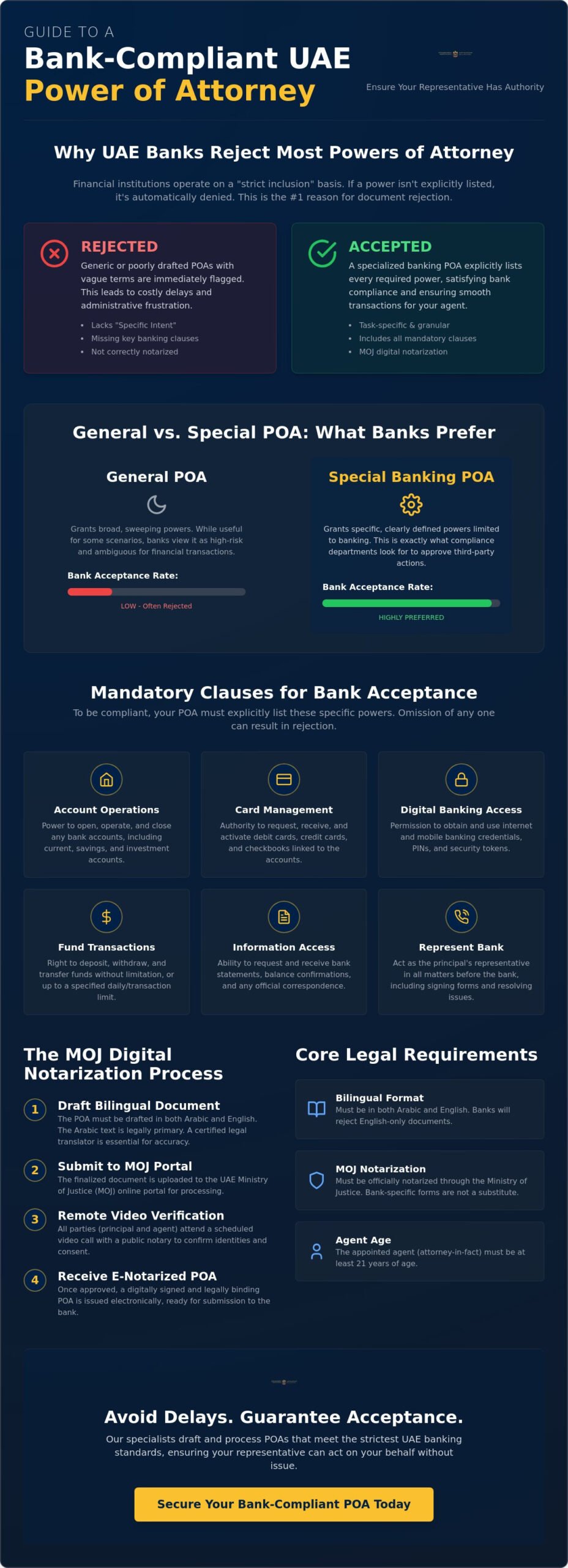
Banks in the Emirates operate under a “Specific Intent” rule. This means they often view a General Power of Attorney with suspicion. While you might assume a broad mandate covers every possible task, bank compliance officers typically look for granular detail. If your document doesn’t explicitly mention the right to “open, close, or operate bank accounts,” the branch will likely reject it. This strict approach is a vital safeguard against fraud, but it creates a significant hurdle for those trying to manage their finances through a representative.
To bridge this gap, many financial institutions now require an internal “Letter of Indemnity.” This is an additional bank-specific form where you formally agree to hold the bank harmless for any actions your agent takes. Combining this with a robust UAE power of attorney for bank accounts ensures your representative can move forward without being stalled by the legal department. It’s about providing the bank with the exact level of certainty they require to release control of your assets.
When a General POA is Acceptable
A general power of attorney UAE isn’t entirely off the table for banking. However, it must contain a dedicated section for financial affairs. For corporate entities, a general mandate is often necessary to allow a manager to handle multiple operational accounts. The key is ensuring the text includes specific banking powers that align with Central Bank regulations. If you’re unsure if your broad document will pass, it’s wise to consult with a specialist who understands current bank compliance trends. The shift toward the digital power of attorney issuance service has made it easier to update these documents. If your existing general mandate is too vague, you can quickly issue a more specific version online.
The Advantages of a Special Banking POA
Choosing a Special Power of Attorney offers a higher level of security and acceptance. By isolating banking tasks within a UAE power of attorney for bank accounts, you limit your agent’s authority to exactly what’s needed. This precision reduces the risk of unauthorised transactions and speeds up the bank’s internal review process.
- Defined Actions: Explicitly grant the power to request cheque books, initiate international transfers, or manage internet banking credentials.
- Account Specificity: You can limit the agent’s access to specific account numbers rather than your entire portfolio.
- Expiry Dates: Set a clear end date for the authorisation, which is ideal for temporary absences or specific business deals.
Banks prefer this focused approach because it leaves no room for interpretation. It provides a clear, legally sound framework that protects both the account holder and the financial institution from potential disputes.
Essential Clauses for a Bank-Compliant POA in 2026
Precision is paramount when drafting a UAE power of attorney for bank accounts. In 2026, vague language remains the primary cause of document rejection at the branch level. To satisfy compliance teams, you must include explicit authority to open, close, and operate specific accounts. This level of detail extends to modern banking tools; ensure you include clauses for requesting internet banking credentials and issuing debit or credit cards. Without these specific mentions, your agent may find themselves locked out of digital platforms, even with a notarised document in hand.
The “Right to Sign” cheques remains a cornerstone of local commerce. Your document should clearly state that the agent can sign financial instruments on your behalf. Additionally, as banks operate under Federal Decree-Law No. (10) of 2025, the POA must acknowledge the agent’s role in fulfilling Anti-Money Laundering (AML) and Know Your Customer (KYC) requirements. This includes the authority to provide source-of-funds documentation and beneficial ownership details. For a deeper look at the legalities, a Power of Attorney for Banking in Dubai guide can provide further foundational context on how these mandates are structured.
Provisions for managing fixed deposits and investment portfolios are also critical. If your agent needs to liquidate a deposit or move funds into a savings bond, the bank will look for a clause that specifically mentions “investment management” or “liquidation of assets.” Without this, your capital could remain inaccessible during a time of need.
Handling Property Transaction Proceeds
Recent Dubai Land Department (DLD) regulations from June 2025 have fundamentally changed how sale proceeds are handled. All funds from a property sale must now be transferred directly to the bank account of the individual named on the title deed. While your agent can still manage the sale process, they can no longer receive the payment on your behalf. When drafting your UAE power of attorney for bank accounts, include clauses that allow the agent to “deposit” cheques but explicitly restrict “withdrawal” of these specific sale proceeds. This ensures compliance with the latest financial transparency circulars and prevents the transaction from stalling at the final stage.
Corporate Banking Authorisations
For companies, the requirements are even more stringent. A business power of attorney UAE must authorise the agent to manage the Wage Protection System (WPS) for salary transfers. It should also delegate the power to apply for corporate loans or credit facilities if the business requires financing. Since corporate account approvals can take 2 to 8 weeks, having these clauses ready is essential to avoid restarting the clock with bank compliance. Ensure the document also covers the management of corporate credit cards and the authority to settle utility bills linked to the business account.
The Step-by-Step Online Notarisation Process
Digitalisation has transformed how you secure a UAE power of attorney for bank accounts. What once required physical presence and hours of waiting is now a streamlined, paperless experience. The process starts with a precision-drafted bilingual document. After your draft is finalised; you upload it along with your supporting identification to the Ministry of Justice (MOJ) or Dubai Courts portal. This digital shift ensures that your document is stored securely and remains verifiable via a QR code at any time.
Identity verification is the most critical step in this digital chain. You’ll use the UAE PASS app to authenticate your signature and consent. Once the system verifies your identity, you’ll be scheduled for a brief virtual session with a Notary Public. During this video call, the notary confirms your identity and the scope of the powers you’re granting. Upon approval, you receive a digitally signed and stamped electronic POA via email, ready for immediate submission to your bank’s compliance department.
Digital Notarisation for Residents
For residents, the online power of attorney UAE system is remarkably fast. By leveraging your UAE PASS credentials, the system pulls your verified data, reducing the risk of clerical errors. You’ll need your original Emirates ID and the specific details of the bank accounts you intend to delegate. In most cases, the entire digital authorisation can be processed within 24 to 48 hours, provided your documentation is in order. To ensure your application is approved without delay, you can get started with our MOJ notary services today.
Notarising from Abroad for UAE Banks
Non-residents face a slightly more complex path, but it remains fully manageable through digital channels. If you’re outside the country, you may need to visit a UAE Embassy or use the Ministry of Foreign Affairs (MOFA) attestation portal. Some jurisdictions allow for “Remote Notary” options where the video call replaces the physical embassy visit. The final document must always receive a local MOFA attestation stamp before a UAE bank will recognise its validity. This multi-step verification confirms that your foreign-issued document meets the high security standards of the Emirates financial system.
Ensuring Your Bank POA is Accepted: Expert Tips
Securing your document through the Ministry of Justice is a major milestone; however, bank acceptance remains the ultimate measure of success. Many individuals assume that a notarised document is a guaranteed pass. In reality, bank compliance departments apply a separate layer of scrutiny that focuses on risk mitigation and regulatory alignment. To better understand these frameworks, you can explore Anti-Money Laundering (AML) Compliance with CTC Tax & Accounting. To avoid delays, always share your draft with your bank’s compliance manager before you proceed with final notarisation. This pre-verification step allows you to adjust specific wording to meet that particular institution’s internal policies without paying for a second round of legal fees.
Legal Translation is another critical factor. Every UAE power of attorney for bank accounts must be translated by an MOJ-certified professional. This isn’t just a formality. The Arabic text is the primary legal record used by local courts and bank legal teams. If the translation is imprecise, it can lead to a “frozen” account status where neither you nor your agent can access funds until the document is corrected. Precision in language ensures that your intent is perfectly mirrored in both English and Arabic; leaving no room for interpretation by bank tellers or compliance officers.
If your circumstances change, remember that a POA isn’t permanent. You can revoke or update your banking authorisation at any time through a similar digital process. Government fees for cancellation typically range from AED 100 to AED 1,500 depending on the speed and type of notary service you choose. Keeping your authorisations current is essential for maintaining control over your financial legacy.
Common Reasons for Rejection
Rejections often stem from small clerical oversights rather than major legal flaws. Banks look for exact matches between your legal documents and their internal records. Common hurdles include:
- Missing Regulatory References: Failing to mention the “Central Bank of the UAE” or specific “Local Banks” can lead to a document being deemed too narrow.
- Expired Identification: If the passport or Emirates ID used during the POA drafting has since expired, the bank’s KYC system will flag the document as invalid.
- Signature Card Inconsistencies: The agent’s signature on the bank’s internal cards must perfectly align with the representative’s details in the POA.
The UAE POA Online Advantage
We’ve mastered the complexities of regional banking requirements to provide a seamless digital experience. Our team focuses on professional drafting that anticipates the needs of major UAE financial institutions. We handle everything from Special POA and General POA creation to MOJ Notary Services and Legal Translation; ensuring your document is bank-ready from day one. By choosing a secure, digital-first approach, you gain the peace of mind that your representative can act with absolute authority, whether you are in Dubai or overseas. Draft your bank-compliant POA with UAE POA Online today and experience a streamlined path to successful account delegation.
Secure Your Financial Delegation with Confidence
Navigating the banking landscape in the Emirates requires more than just trust; it demands absolute legal precision. You’ve seen how a generic document can lead to frozen accounts and administrative delays. By focusing on specific banking clauses and leveraging the Ministry of Justice’s streamlined digital portals, you ensure your representative has the exact authority needed to manage your assets without disruption. The transition to a paperless, verifiable system has made it easier than ever to maintain financial continuity from anywhere in the world.
Our team bridges the gap between complex regulation and efficient execution. We provide a 100% online process that caters to both residents and non-residents, ensuring your UAE power of attorney for bank accounts is drafted with the specific compliance clauses major banks demand. With MOJ-certified legal translators and a deep understanding of local financial circulars, we eliminate the stress of bureaucratic rejection. Start your Bank POA application online today to secure a document that protects your interests and respects your time. Your financial peace of mind is just a few clicks away.
Frequently Asked Questions
Do UAE banks accept a General Power of Attorney for all transactions?
No, banks in the Emirates generally do not accept a General Power of Attorney for all financial transactions. They operate under a “Specific Intent” rule; requiring explicit clauses that name banking activities. If your document lacks the phrase “opening and operating bank accounts,” the compliance department will likely reject it. Using a Special POA is the most reliable way to ensure your representative can act without being stalled by bank legal teams.
Can I use a POA to open a bank account in the UAE while I am abroad?
Yes, you can authorise a representative to open a bank account while you are outside the Emirates. This process requires a UAE power of attorney for bank accounts that has been attested by the UAE Embassy in your current country and the Ministry of Foreign Affairs in the UAE. Be prepared for a timeline of 2 to 8 weeks for corporate account approvals; as banks will conduct rigorous KYC checks on both the principal and the agent.
How long is a Power of Attorney valid for banking purposes in the UAE?
A Power of Attorney remains legally valid until the principal revokes it or the document reaches its specified expiry date. However, many UAE banks have internal policies that require the document to be “recent;” often issued within the last two years. If your document is older, the bank may ask for a “Letter of Confirmation” from the notary to prove it hasn’t been cancelled or revoked.
Does a bank POA need to be in Arabic?
Yes, all legal documents used in UAE financial institutions must be in Arabic or a bilingual format. The Arabic version is the legally governing text in local courts. To ensure acceptance, your document must be prepared by an MOJ-certified legal translator. Banks will not accept documents that are only in English; even if they have been notarised abroad, because the Arabic text is mandatory for official processing.
Can a POA holder withdraw cash from my UAE bank account?
A representative can only withdraw cash if the document explicitly grants that power. This is why Special POAs are preferred; they allow you to define the exact scope of authority. You can permit your agent to deposit funds while restricting their ability to withdraw cash or issue cheques. This granular control is essential for protecting your capital while allowing for necessary daily administrative tasks.
What happens to a banking POA if the principal passes away?
The authority granted by a Power of Attorney terminates immediately upon the death of the principal. Under UAE law, the document becomes void; and the agent can no longer legally operate the accounts. At this stage, the bank will freeze the accounts until the legal heirs provide a succession certificate from the court. Any actions taken by an agent after the principal’s death are considered legally invalid and unenforceable.
Are digital POAs accepted by all banks in the UAE?
Yes, digital POAs are now the standard and are accepted by all major banks in the UAE. These documents feature a secure QR code that allows bank compliance officers to verify the document’s authenticity instantly via the Ministry of Justice portal. This digital system has significantly reduced the risk of document fraud; making the verification process faster and more reliable for residents and non-residents alike.
How much does it cost to notarise a bank POA in the UAE?
Government fees for notarisation vary depending on the service level and the residency status of the applicant. For example, cancelling a POA through a Public Notary typically costs between AED 100 and AED 200. Non-resident applications often incur additional administrative charges of around AED 499. While drafting fees for a UAE power of attorney for bank accounts vary by provider; the digital notarisation process itself is designed to be cost-effective and efficient.
Comments
One response to “UAE Power of Attorney for Bank Accounts: A Complete Guide to Banking Authorisations”
-
[…] “To deal with all banking matters” is often too broad on its own. It may be accepted in a business POA, but banks frequently need their own mandate to identify whether the person can sign checks, […]
Leave a Reply