

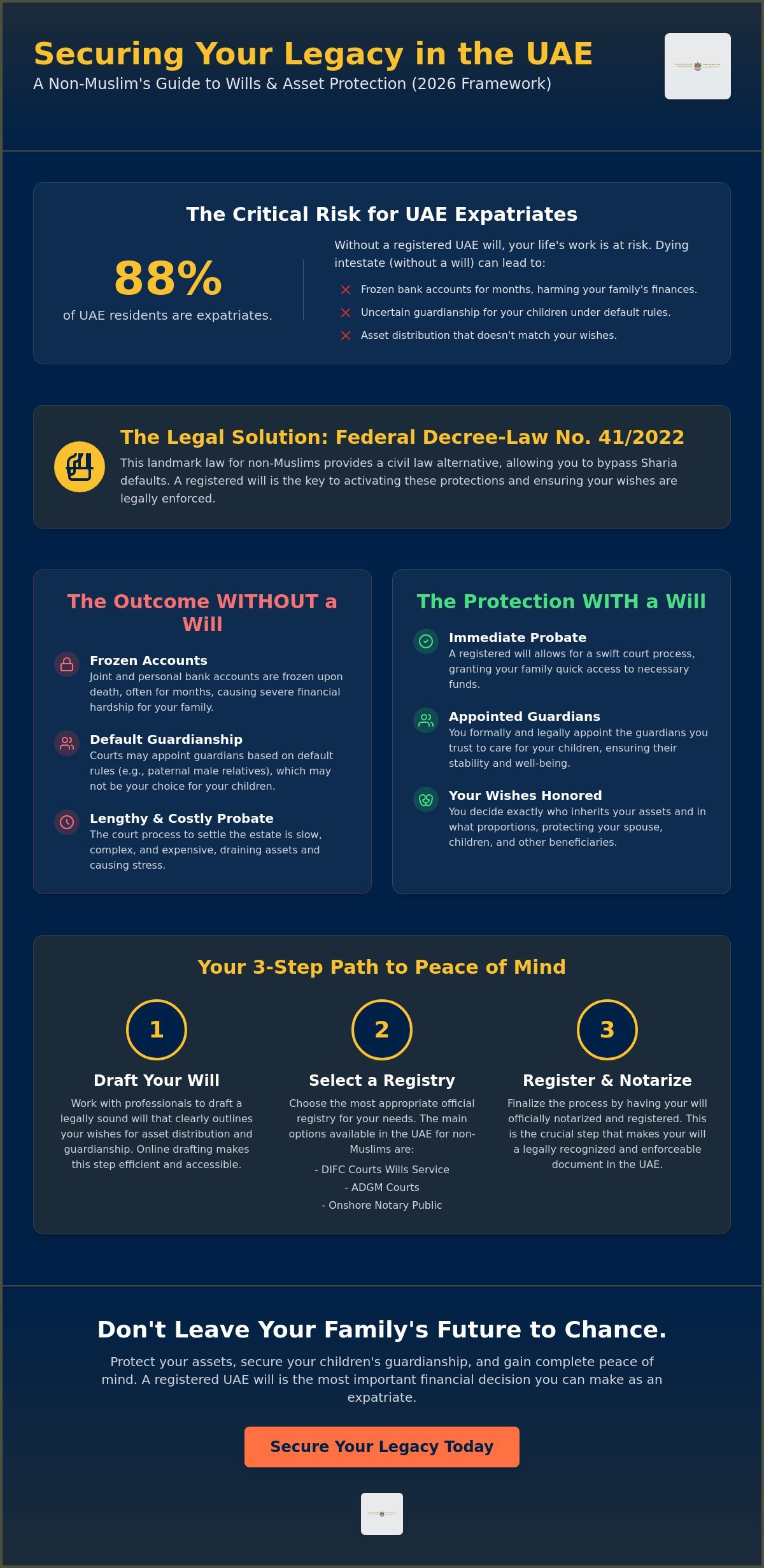
If you passed away tomorrow, would your family have immediate access to your bank accounts, or would your life’s work be frozen by the courts for months? For the 88% of UAE residents who are expatriates, this uncertainty is a significant financial risk. You’ve worked hard to build a life here, but without a registered UAE will for non-muslims, your assets and even the guardianship of your children could be subject to default distributions that don’t align with your goals. It’s natural to feel overwhelmed by the choice between DIFC, ADGM, or onshore registries, especially when you want a solution that is both legally airtight and efficient.
This guide shows you exactly how to secure your legacy and protect your loved ones using the latest 2026 legal frameworks. You’ll discover how to bypass Sharia defaults, understand the impact of the legal age of majority being lowered to 18, and compare the most professional registration options available today. We’ll walk through the streamlined steps to ensure your estate is handled with the speed and precision your family deserves, giving you total peace of mind regarding your UAE assets.
Key Takeaways
- Master Federal Decree-Law No. 41/2022 to ensure your assets are distributed according to civil law rather than default Sharia principles.
- Evaluate the differences between DIFC, ADGM, and onshore courts to select the most secure registry for your specific UAE will for non-muslims.
- Secure your children’s future by formally appointing guardians and executors through a legally binding and professional registration process.
- Navigate the transition from digital drafting to official notarization with a clear, step-by-step roadmap optimized for the 2026 legal landscape.
- Protect your estate from the administrative paralysis of intestacy to avoid frozen bank accounts and lengthy, expensive probate delays.
Why Every Non-Muslim Resident Needs a UAE Will in 2026
Secure your legacy with a UAE will, a formal legal instrument registered with national authorities to dictate exactly how your assets are distributed and who cares for your children. For expatriates, relying on a will from your home country is a gamble that rarely pays off. UAE authorities generally require a locally registered document to process the transfer of real estate and local bank funds efficiently. Without this document, you fall into the “intestacy trap,” where the state determines the future of your estate based on default legal frameworks rather than your personal wishes.
The most immediate risk of dying without a registered document is the sudden freezing of bank accounts. In the UAE, when a resident passes away, banks are often notified quickly. They may freeze all accounts held by the deceased, including joint accounts, until the court issues a succession certificate. This process can take months, leaving surviving family members without access to essential funds for daily expenses, school fees, or rent. Having a registered UAE will for non-muslims ensures that the probate process starts immediately, significantly reducing the time your assets remain inaccessible and protecting your family from financial paralysis.
Bypassing Sharia Law Defaults
Traditional inheritance rules in the region often distribute assets among a wide range of heirs, which might not align with your specific intentions for your spouse or children. However, the Legal System of the UAE underwent a major transformation with the introduction of Federal Decree-Law No. 41 of 2022. This law provides a civil alternative for non-Muslims, allowing you to opt out of Sharia-based distribution. By registering a will, you secure your right to choose your own beneficiaries. This ensures your heirs receive the specific proportions you intended rather than a state-mandated split that could complicate asset ownership.
Protecting Minor Children and Guardianship
Securing your children’s future is perhaps the most critical reason to formalize your plans. Without a registered document, the UAE courts may follow default procedures that prioritize paternal male relatives for permanent guardianship. This can lead to distressing and lengthy legal battles for a surviving mother. A professional UAE will for non-muslims allows you to take control of these outcomes. You can appoint permanent guardians who share your values and define temporary guardians who can step in immediately if both parents are absent. This step ensures your spouse retains full custody and decision-making power, providing your family with a clear, legally enforceable shield during a difficult time.
Understanding the UAE Civil Personal Status Law for Non-Muslims
The legal landscape for expatriates changed fundamentally with the implementation of Federal Decree-Law No. 41 of 2022. This legislation provides a dedicated civil framework for personal status matters, effectively separating non-Muslim inheritance from traditional religious codes. It grants you the legal authority to apply the laws of your home country or follow the specific civil provisions outlined in the decree. This shift is designed to increase transparency and provide a predictable environment for the millions of residents who call the Emirates home.
Article 11 of this law is particularly significant for those who haven’t yet formalized their plans. It establishes a default distribution where 50% of the estate goes to the surviving spouse and the remaining 50% is divided equally among the children. Notably, this distribution does not distinguish between male and female heirs, ensuring gender equality in inheritance. While this is a step forward, relying on Article 11 still requires a court process that can be avoided with a proactive UAE will for non-muslims.
Article 13 emphasizes that while you have the freedom to choose your beneficiaries, your will must be formally registered with the relevant authorities to be recognized as valid. This registration is the only way to ensure the courts follow your specific instructions rather than the statutory defaults. As highlighted by Forbes on UAE Estate Planning, a registered document is crucial for maintaining business continuity and ensuring a seamless transition of assets. If you’re ready to secure your family’s future, you can start your application online to ensure your documentation meets these strict legal mandates.
Key Provisions of Decree-Law No. 41/2022
This decree-law represents a modern shift toward civil principles in marriage, divorce, and succession. It removes the ambiguity that previously surrounded non-Muslim estates by creating a clear hierarchy of heirs. The precedence of a registered will over statutory defaults is absolute. If a valid will exists, the court must follow its terms, allowing you to bypass the equal-share rules if you prefer a different allocation for your beneficiaries.
Eligibility and Application
To qualify under this framework, you must be a non-Muslim resident or investor with assets located within the UAE. The law applies regardless of your nationality, provided you are not a citizen of a country where Sharia law is the primary source of legislation for personal status. For foreign investors, this law provides a predictable civil framework that protects capital and real estate holdings against traditional local defaults.
Comparing UAE Will Registries: DIFC, ADGM, and Onshore
Selecting the right registry for your UAE will for non-muslims depends on your asset portfolio and your long-term family goals. Each jurisdiction offers distinct advantages in terms of cost, legal framework, and ease of enforcement. In 2026, the three primary options are the DIFC Wills Service Centre (DIFC), the ADGM Wills and Probate Service (ADGM), and the onshore Ministry of Justice (MOJ) registries. Choosing correctly determines how your estate is processed and which specialized courts have jurisdiction over your legacy.
The DIFC Wills Service Centre is a premier choice for those seeking a common law framework. Under its governing legislation, the DIFC Courts have exclusive jurisdiction over the enforcement of wills registered there. This eliminates the need for separate onshore court orders for assets located within the UAE, which speeds up the probate process significantly. The ADGM Wills and Probate Service provides a similarly robust common law alternative, often favored by residents who want a fully digital experience. Registering a UAE will for non-muslims through these common law registries ensures your estate is managed by specialized courts familiar with international estate standards.
DIFC vs. ADGM: Common Law Protections
Expats from countries like the UK, US, or Australia often prefer these common law registries because they mirror the legal logic of their home countries. You can choose from several tailored options to suit your needs. A Full Will covers all UAE-based assets and guardianship, while a Property Will specifically protects real estate holdings. If your primary concern is your children, a Guardianship Will is a focused option. Both the DIFC Wills Service Centre and the ADGM Wills and Probate Service offer virtual registration appointments. This allows you to secure your assets from anywhere in the world without physically visiting a court office.
The Onshore Registration Process
The onshore path involves registering your document with the Ministry of Justice or a relevant judicial department. This is a civil law process that is often more budget-friendly. For example, registration with one of the judicial departments currently costs approximately AED 950 for a single will, making it the most affordable government option in the country. Other judicial departments offer a mid-range alternative, with fees typically between AED 2,150 and AED 2,167.
A critical requirement for this path is a certified legal translation UAE. Every document must be translated into Arabic by a licensed professional before it can be notarized. While the administrative steps are straightforward, the language requirement makes professional drafting essential. It ensures no legal nuances are lost during the translation process. This route is ideal for residents who want national-level recognition across all seven Emirates at an efficient price point.
Critical Components of a Valid Non-Muslim Will
Drafting a legally binding UAE will for non-muslims requires more than just a list of beneficiaries. You must include specific clauses that address the practicalities of asset distribution and personal care. A well-structured document acts as a roadmap for the courts, ensuring your intentions are carried out without the need for lengthy judicial interpretations. By including these essential components, you eliminate ambiguity and provide your family with a clear path forward during a stressful time.
Reducing the pressure of estate planning is part of a holistic approach to a healthy life; for those who value wellness as much as legal security, you can discover Magnesiumnu.nl for high-quality supplements that help maintain balance.
Choosing an Executor and Trustee
The executor is the individual responsible for managing your estate, paying off debts, and distributing assets to your heirs. Choosing a reliable person is vital for a smooth transition. Under current 2026 regulations, non-residents are permitted to act as executors, which allows you to appoint a trusted family member or professional from your home country. Your will should also provide for administrative costs and funeral expenses. This ensures your executor has immediate access to funds to handle these requirements without using their personal finances.
Asset Scheduling and Documentation
Precision is your best defense against legal delays. Your will must include a detailed schedule of your UAE assets, including real estate title deeds, bank account numbers, and corporate shares. For company owners, it’s essential to ensure your will’s instructions align with your business power of attorney UAE. This coordination prevents conflicts between your corporate governance documents and your personal estate plan. Asset clarity prevents probate delays by providing the court with an undisputed roadmap of your holdings. If you need help organizing your documentation, you can consult with our specialists today to ensure every detail is legally sound.
Guardianship remains the most sensitive component for many residents. You must name both permanent guardians and interim guardians. Interim guardians are local residents who can take immediate custody of your children while the permanent guardians, who may live abroad, travel to the UAE. This dual-layered approach ensures your children are never placed in state care while logistics are finalized.
How to Draft and Register Your UAE Will Online
In 2026, the process of securing a UAE will for non-muslims has transitioned into a fast, digital-first experience. It’s no longer necessary to spend days navigating government offices in person. Instead, you can follow a methodical five-step process that ensures your assets are protected with professional precision. The journey begins with a detailed consultation where legal documentation experts help you define your specific requirements, from identifying heirs to selecting executors.
Once your needs are clear, the next phase involves professional drafting that strictly adheres to current UAE Personal Status Laws. This ensures your document is airtight and enforceable across the Emirates. For those choosing onshore registration, a certified legal translation into Arabic is the third essential step. Following this, we coordinate with the relevant authorities, whether it’s the MOJ Notary or common law registries like DIFC and ADGM, to finalize the execution. The process concludes with secure digital storage and the distribution of your notarized document, providing you with instant access whenever it’s needed.
The Efficiency of Digital Notarization
Digital transformation has revolutionized how residents handle estate planning. In 2026, online notary services allow you to verify your identity and sign documents through secure video calls. This technology works in tandem with an online power of attorney UAE, creating a comprehensive digital legal shield for your family. By eliminating the need for physical visits to government buildings, you save time while ensuring your documents meet the highest standards of regional administrative compliance. It’s a streamlined approach that prioritizes your schedule without compromising on legal validity.
Professional Drafting vs. DIY Templates
Using a generic template is one of the most common mistakes residents make. These templates often fail to account for the specific nuances of local law, such as the requirements for interim guardianship or the precise language needed for property bequests. A professionally drafted document ensures your UAE will for non-muslims is fully compatible with other legal instruments, such as a special power of attorney UAE. This integration is crucial for business owners and property investors who need their personal and professional legacies to align seamlessly. Don’t leave your family’s security to chance with unverified forms. Secure your family’s future today with UAE POA Online’s professional will services and gain the peace of mind that comes with expert legal guidance.
Take Control of Your Family’s Future Today
Securing your legacy in the Emirates is no longer a complex or manual burden. By leveraging the 2026 legal landscape, you can effectively bypass Sharia defaults and ensure your assets are distributed exactly as you intend. Whether you choose a common law framework or a national-level onshore registry, the key is to act before the “intestacy trap” creates unnecessary delays for your loved ones. A professionally registered UAE will for non-muslims is the most reliable shield you can provide for your family and your business interests.
Our team simplifies this transition through a tech-savvy digital drafting process that prioritizes your time and security. We manage every detail, including expert MOJ Notary coordination and certified legal translation, so you can focus on what matters most. Don’t leave your estate to chance when a legally binding solution is just a few clicks away.
Protect your family and assets with a professional UAE Will today.
Your future in the UAE is bright; make sure your legacy is just as secure and well-guided.
Frequently Asked Questions
Is a will from my home country valid in the UAE for non-Muslims?
A will from your home country isn’t automatically recognized for your UAE-based assets. Local authorities and banks require a document registered within the UAE to process the transfer of property or funds effectively. Relying on a foreign document often leads to expensive attestation costs and significant delays in the probate process, as the UAE courts must first verify the document’s validity under local standards.
What happens to my UAE bank accounts if I die without a will?
Bank accounts are usually frozen as soon as the bank is notified of a death. This includes joint accounts in many cases, which can leave surviving family members in a difficult position. These funds remain inaccessible until the court issues a formal succession certificate. This process can take several months; making it vital to have a registered document that streamlines the release of assets.
Can I name a guardian for my children in my UAE will?
Yes, you can name both interim and permanent guardians to ensure your children’s safety and well-being. Interim guardians handle immediate care while permanent guardians, who may live abroad, make their way to the UAE to take over custody. Without this specific clause, guardianship defaults to paternal male relatives under traditional rules, which might not align with your family’s wishes or the children’s best interests.
How much does it cost to register a non-Muslim will in the UAE?
Registration costs vary significantly depending on the registry you select for your estate planning. Options like the Abu Dhabi Judicial Department are generally the most cost-effective for government fees. In contrast, common law registries like the DIFC involve higher administrative costs but provide specialized English-language legal protections. You should also factor in the costs of professional drafting and any required legal translations.
Do I need to translate my will into Arabic for it to be valid?
Arabic translation is required for all wills registered through the Ministry of Justice or the Dubai Courts. This must be a certified legal translation performed by a licensed professional to be accepted by the notary. If you choose the DIFC or ADGM registries, the process is conducted entirely in English, which removes the need for translation but involves different administrative procedures and fees.
Can I register a UAE will if I am currently outside the country?
You can register a UAE will for non-muslims remotely through virtual notarization systems that have been streamlined in recent years. Many registries now offer secure video conferencing for identity verification and document execution. This makes it possible to protect your assets even if you are currently residing or traveling outside the country, provided you have the necessary identification and residency documents ready for the digital meeting.
What is the difference between a DIFC will and an Onshore will?
A DIFC will operates under English common law principles and is handled entirely in English. Onshore wills follow the UAE’s civil law framework and require Arabic documentation for notarization. While the DIFC is often preferred for complex international estates and assets specifically located in Dubai, onshore registration is a practical, national-level solution that covers assets across all seven Emirates at a different price point.
How often should I update my UAE will?
It’s best to update your documentation every few years or immediately after significant life changes. Events such as the birth of a child, a change in marital status, or the purchase of new real estate should trigger a formal review. Regular updates ensure your UAE will for non-muslims remains accurate and legally enforceable as your assets grow and your family circumstances evolve over time.
Leave a Reply