
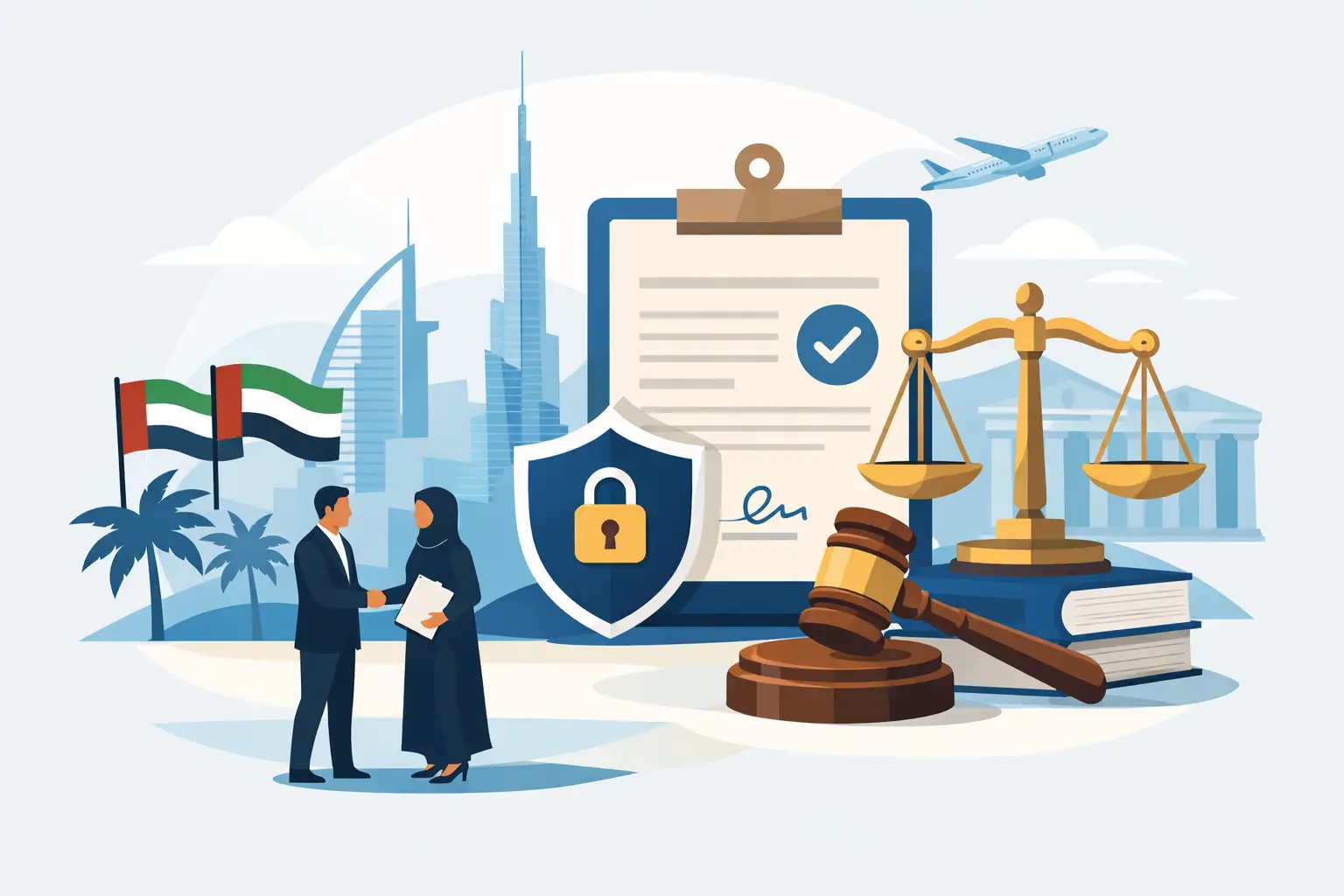
A signed mandate can look complete and still be rejected when it is needed most. A bank may refuse to act, a property transfer may pause, or a government authority may ask for further authentication. That is why mandates need legalization when they will be presented across borders or relied on by UAE authorities. Legalization confirms that the document and the signatures behind it can be recognized through the required official channels.
For UAE residents, overseas property owners, investors, and business owners, this is not a minor administrative step. It is often the difference between giving a trusted representative usable authority and handing them a document they cannot act on.
What Is a Mandate in UAE Legal Practice?
In everyday language, a mandate is an authorization that allows one person to act for another. In UAE legal matters, this is commonly prepared as a Power of Attorney, or POA. The person granting authority is the principal, while the person receiving it is the attorney-in-fact or authorized representative.
The scope can be narrow or broad. A Property POA may authorize a representative to manage a sale, sign transfer documents, or deal with developers and government offices. A Car POA can cover registration, sale, export, or vehicle-related transactions. A Business POA may permit a partner or manager to sign contracts, represent a company, or complete licensing procedures.
The document must clearly state what the representative can and cannot do. But clear wording alone is not always enough. The receiving authority must also be satisfied that the mandate was properly executed and is legally acceptable for use in the UAE.
Why Mandates Need Legalization Before UAE Use
Legalization creates a verifiable chain of authenticity. It helps the UAE authority reviewing the mandate confirm that the signature, notarial act, and issuing jurisdiction are genuine. This is especially relevant when the principal signs a POA outside the UAE.
A foreign-issued document starts in a different legal system. A UAE court, notary, land department, bank, or government entity cannot simply assume that every overseas notary stamp or signature meets its requirements. Legalization bridges that gap by having the document authenticated by the appropriate authorities before it is used locally.
Without that process, a document may be valid where it was signed yet unusable in the UAE. This distinction causes many avoidable delays. Validity in the country of execution and acceptance by a UAE receiving authority are related, but they are not the same question.
Notarization and Legalization Are Different Steps
Notarization generally confirms the identity of the person signing and records that they signed voluntarily before a notary. It is an essential step in many POA processes, but it does not automatically make a foreign document acceptable in the UAE.
Legalization, sometimes called attestation, is the additional authentication process that follows when required. Depending on where the mandate was signed, it may involve the local government authority, the UAE embassy or consulate in the country of issue, and the UAE Ministry of Foreign Affairs. The exact route depends on the country, the document type, and the authority that will receive it.
Some countries use an Apostille process under an international convention. However, clients should not assume that an Apostille alone will meet every UAE requirement or every transaction-specific requirement. The document’s destination matters. Before signing, it is wise to confirm the acceptance standard with the relevant UAE authority or obtain professional guidance based on the intended use.
When Legalization Is Usually Required
Legalization is most commonly needed when a mandate is signed abroad and will be used in the UAE. This includes non-resident owners selling or managing UAE property, expatriates authorizing a relative to complete a vehicle transfer, and shareholders appointing a representative to handle company matters.
It can also become necessary when an authority requests proof of a foreign corporate document, a passport copy, a board resolution, or supporting paperwork connected to the POA. A correctly legalized mandate can still be delayed if its supporting documents are incomplete, expired, or not translated in the required format.
For mandates executed inside the UAE, the path may be different. A UAE notary process may be sufficient when the document is drafted, signed, and notarized locally for local use. Even then, the required wording and approvals depend on the transaction. A broad General POA may not be accepted for a specific property, banking, or corporate action if the receiving party requires express authority.
The Cost of Skipping the Process
The most common consequence is rejection at the point of use. By then, the principal may be overseas, a sale deadline may be approaching, and the representative may have already arranged appointments and payments. Correcting the issue can require a new document, fresh notarization, additional attestations, and certified legal translation.
There are also practical risks. An unclear or improperly authenticated mandate can raise questions about fraud, identity, outdated authority, or whether the agent has permission to complete a high-value transaction. Receiving authorities are cautious for good reason. A POA can authorize actions with serious financial and legal consequences.
Legalization protects the principal as well as the institution receiving the document. It provides a more reliable basis for relying on the authority granted, particularly where the principal is not physically present to confirm instructions.
Legalization Does Not Fix a Poorly Drafted Mandate
A legalization stamp cannot repair vague wording. If a client wants an agent to sell a specific apartment, collect proceeds, sign transfer forms, and appear before the relevant UAE authority, those powers should be stated with precision. If the authority is limited to managing a property, the mandate should not accidentally provide unrestricted rights to sell or mortgage it.
This is where the document must be tailored to the task. General authority can be convenient, but it may create unnecessary risk. Special authority is often more appropriate for a defined sale, a particular vehicle, a court matter, or a single business transaction.
The same principle applies to expiration and revocation. A mandate should reflect whether it remains valid until revoked, expires on a set date, or ends once a defined transaction is completed. Where circumstances change, revocation should be handled properly and communicated to the relevant parties.
Translation Is Part of Legal Readiness
If a mandate or its supporting documents are not in Arabic, certified legal translation may be required for UAE use. Translation is not merely converting words from one language to another. Names, passport details, property information, company details, and legal powers must match the source document accurately.
An inconsistency in a name spelling or company designation can lead to questions at the notary stage or when the document is presented to another authority. This is particularly relevant for clients who have documents issued in English or another language and need them accepted within the UAE legal system.
The best approach is to plan drafting, notarization, legalization, and translation as one coordinated process. Handling them separately can create gaps, such as legalizing a document that later needs changes or translating a text that does not meet the receiving authority’s required wording.
How to Prepare a Mandate Without Delays
Start with the exact purpose of the mandate. Identify the transaction, the receiving authority, the representative’s powers, and where the principal will sign. These facts determine whether a Special POA, General POA, Property POA, Car POA, or Business POA is the appropriate format.
Next, confirm whether the document will be signed in the UAE or abroad. For an overseas principal, establish the required legalization path before arranging notarization. This avoids using a notary or authentication route that does not meet the UAE requirement.
Then review the supporting documents early. Identification, title documents, trade licenses, company resolutions, and other records may be needed depending on the matter. Where Arabic translation is required, use a certified legal translation that preserves the document’s legal meaning and identifying details.
For urgent or document-sensitive matters, professional coordination can save considerable time. UAE POA Online supports clients through POA drafting, online notary arrangements, legalization guidance, and certified legal translation, including for clients outside the UAE. The goal is not simply to produce a signed document, but to prepare one that is ready for the authority that must rely on it.
A mandate should make life easier when you cannot be present in person. Getting its wording, notarization, legalization, and translation right before a deadline gives your representative the authority to act with confidence – and gives you greater control over what happens next.
Leave a Reply