

In 2026, simply handing over a Power of Attorney is no longer enough to finalize a real estate deal in Dubai. A single missing clause or an outdated template can now trigger an immediate rejection from the Land Department. You’re likely feeling the weight of these shifting regulations, especially if you’re trying to manage a high value asset from thousands of miles away. The stress of coordinating with the Ministry of Justice and the fear of legal delays are common hurdles for any property owner.
This guide provides the exact roadmap to authorize someone to sell property UAE residents and overseas investors can rely on, ensuring your documentation meets every new compliance standard. We’ll walk through the mandatory digital verification steps, the specific legal wording required for a successful transfer, and the vital 2026 rules regarding how sale proceeds must be handled. You’ll gain a clear path to a valid, notarized Property POA that facilitates a smooth transaction without you ever needing to step foot in the country. By the end of this article, you’ll understand how to navigate the digital portal and the new bank account requirements for non-residents to ensure your sale is both secure and legally binding.
Key Takeaways
- Understand why a Special Power of Attorney is mandatory for real estate transfers to meet the strict 2026 Dubai Land Department compliance standards.
- Follow a proven 5-step roadmap to authorize someone to sell property UAE, ensuring every document is precisely drafted and legally translated for official use.
- Identify the specific “Right to Sell” and NOC authorization clauses required to prevent transaction delays at the developer and land authority levels.
- Navigate the overseas attestation chain by learning how to coordinate notarization and Ministry of Foreign Affairs (MOFA) certification from your home country.
- Streamline the entire legal process through digital MOJ Notary integration, allowing for secure document validation without a physical presence in the UAE.
Understanding the Legal Framework for Property Authorization in the UAE
The legal foundation for property transactions in the Emirates rests on a robust system of verification and compliance. When you choose to create a Power of Attorney (POA), you’re establishing a legally binding instrument that allows a third party to act as your representative. This isn’t a simple letter of permission; it’s a formal document that requires validation by the Ministry of Justice (MOJ) to ensure it meets strict national standards. These standards exist to protect you from unauthorized transfers and fraudulent activity. Under the new UAE Civil Code that came into effect on June 1, 2026, the legal system has further tightened these protocols to align with global transparency benchmarks, making precise drafting more critical than ever.
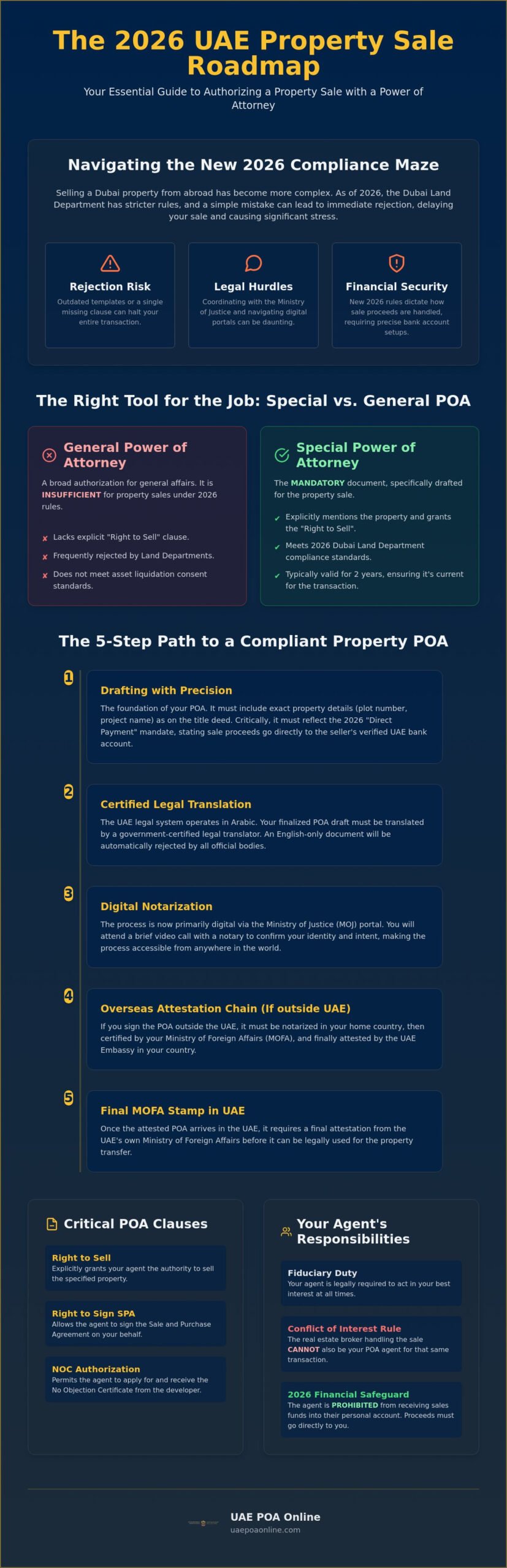
Special POA vs. General POA: Which do you need?
You might already hold a general document for managing your affairs, but it’s likely insufficient for a real estate sale. To authorize someone to sell property UAE authorities require a Special Power of Attorney. This specific document must explicitly mention the “Right to Sell” and “Right to Sign” the Sale and Purchase Agreement (SPA). Generic “management” POAs are frequently rejected by land departments because they don’t provide the explicit consent needed for asset liquidation. It’s also vital to remember that a Property POA in the UAE usually has a limited validity period of two years. Understanding the exact power of attorney validity period UAE rules for your specific transaction type is essential, as an expired document will be rejected at the time of transfer, potentially causing your sale to collapse at the final hour.
The Role of the Agent (Attorney-in-Fact)
Choosing your representative is a decision that carries significant weight. You can legally appoint a friend, family member, or a professional representative. However, strict conflict-of-interest rules apply. You cannot appoint a real estate agent to act as your POA if they’re also the broker handling that specific transaction. This safeguard prevents unethical practices and ensures your interests remain the priority. Your authorized agent holds a fiduciary duty to you. They are legally liable for any actions taken outside the scope of the powers you’ve granted. They must act with integrity, especially now that 2026 regulations prohibit POA holders from receiving sale proceeds directly into their own accounts. This change ensures that funds go directly to you, the seller, adding an extra layer of financial security to the entire process.
The 5-Step Process to Authorize Someone to Sell Your Property
Moving from legal theory into practice requires a methodical, five-step approach. To authorize someone to sell property UAE land departments demand a level of detail that leaves no room for ambiguity. Every step, from the initial draft to the final handover, must align with the latest 2026 administrative protocols to ensure your transaction remains on track.
Step 1: Drafting with Precision
The first step is drafting the document with absolute precision. You must include the exact property type, plot number, and project name as they appear on the original title deed. A Special POA is the only valid tool for property disposal in 2026. Beyond identifying the asset, you must clearly define the scope of authority granted to your representative. While your agent can sign the Memorandum of Understanding (MOU) or the final Sale and Purchase Agreement (SPA), you must account for the recent “Direct Payment” mandate. Since June 2026, Dubai regulations prohibit POA holders from receiving sale proceeds in their own name. Your draft should reflect that funds will be directed only to your verified UAE bank account, preventing any last-minute rejections by the Dubai Land Department.
Step 2 & 3: Translation and Notarization
Once the draft is finalized, it must be translated into Arabic by a certified legal translator. The UAE legal system operates primarily in Arabic, and any document submitted in English alone will be immediately dismissed by the authorities. Following translation, the notarization occurs through the Ministry of Justice (MOJ). In 2026, this process has transitioned almost entirely to the MOJ digital portal. You’ll participate in a brief video verification session where a notary confirms your identity and your willing intent to authorize someone to sell property UAE assets. Using a specialized service for MOJ Notary coordination can significantly reduce the risk of technical errors or document mismatches during this digital phase.
Step 4 & 5: Attestation and Handover
If you’re issuing the document from outside the UAE, step four involves a specific attestation chain. This starts with notarization in your current country of residence, followed by certification from that country’s Ministry of Foreign Affairs (MOFA) and the UAE Embassy. Once the document reaches the UAE, it requires a final local MOFA stamp. The fifth and final step is the handover. Your representative must hold the original notarized document, or a digitally verified equivalent, to present to the developer and the land department. Ensure your agent also has a valid Emirates ID or passport copy that matches the details listed in the POA to avoid identity verification delays during the final transfer.
Critical Clauses to Include in Your Property POA
To authorize someone to sell property UAE land authorities require specific legal terminology. Vague language is the primary reason for document rejection at the Dubai Land Department (DLD). Your POA must explicitly state the “Right to Sell” and the “Right to Sign” the Sale and Purchase Agreement (SPA). Without these exact phrases, your representative cannot legally commit you to a sale. It’s a high-stakes document, and the wording needs to be bulletproof to withstand scrutiny during the final transfer.
Additionally, your agent needs the authority to apply for a No Objection Certificate (NOC) from the developer. This document is a prerequisite for any sale in the UAE, confirming that all service charges are paid and there are no outstanding liabilities. Finally, the POA must grant the power to represent you at the Land Department for the final ownership transfer. This includes signing the official transfer forms and receiving the final settlement documentation on your behalf.
Financial Safeguards for the Seller
Many owners worry about the security of their funds when granting a POA. In 2026, you have clear options to limit your agent’s powers. You can restrict their authority to “signing only,” which allows them to handle the paperwork while ensuring they cannot touch the sale proceeds. For maximum security, stipulate that all sale proceeds must be issued as a manager’s cheque in your name or transferred directly to your verified UAE bank account. This aligns with current anti-money laundering regulations and ensures the agent acts only as a facilitator. If you’re managing this process from outside the country, check out our How to Sell Property Without Being in the UAE: The 2026 Remote Guide for more on secure remote transactions.
Property-Specific Information Requirements
Your Property POA shouldn’t be a generic template. It must include the Title Deed number and a comprehensive description of the asset, including the unit number, building name, and plot details. Specifying the developer, such as Emaar, Nakheel, or Damac, is also essential. This specificity helps the developer’s office verify the authorization quickly when your agent applies for the NOC. Ensure the document explicitly uses the terms “selling” and “transferring ownership.” The DLD will often reject a document if it only mentions “disposal” or “management.” Precise wording ensures that the legal chain of authority is unbreakable from the moment the agent signs the MOU to the final handover of keys. If your situation involves a contested asset, you may also need a power of attorney for property dispute UAE that meets the specific litigation standards now enforced by the Dubai Land Department.
Authorizing from Abroad: The Overseas POA Chain
Overseas owners face a unique set of bureaucratic hurdles when they decide to authorize someone to sell property UAE real estate. The process, often called the “attestation chain,” ensures that a document signed in London, New York, or Mumbai carries the same legal weight as one signed in Dubai. You must begin by notarizing the document in your current country of residence. Following this, the document travels to your local Ministry of Foreign Affairs (MOFA) for certification and then to the UAE Embassy for legalization.
Once the document arrives in the UAE, the chain continues. It requires a final stamp from the UAE Ministry of Foreign Affairs and must undergo certified legal translation into Arabic. While this sounds exhaustive, each step is a safeguard to prevent fraud in high value transactions. Missing even one stamp can lead to a total rejection at the land department; this can cost you a motivated buyer and weeks of wasted time. The coordination of these international bodies requires a methodical approach to ensure every seal is valid and recognized by the Dubai Land Department.
Avoiding Common Delays for Overseas Owners
Precision is your best defense against delays when you authorize someone to sell property UAE assets from abroad. Ensure that your name matches your passport and the Title Deed exactly. Even a small discrepancy, like a missing middle name, can halt the process. Digital notarization through the MOJ portal is now a faster alternative for many, often bypassing the slow traditional embassy route. It’s also vital to remember that for property sales, reviewing the power of attorney validity period UAE requirements is critical, as a POA issued outside the UAE typically has a validity period of two years and if your document is nearing this limit, it’s safer to issue a new one rather than risk a mid-transaction expiration. For a deeper dive into these requirements, see our Special Power of Attorney UAE: The Comprehensive 2026 Guide.
The Validity of Foreign POAs
A foreign document must still align with specific local property laws, such as the new UAE Civil Code that came into effect on June 1, 2026. Many owners make the mistake of using a template from their home country, only to find it lacks the “Right to Sell” clauses required by regional authorities. To avoid this, most investors choose to have their document drafted by a UAE specialist first. This ensures the language is compliant before it ever reaches a notary. If you need assistance navigating these international requirements, you can get expert help with your overseas POA drafting today to ensure your document is accepted on the first attempt.
Streamlining Your Sale with UAE POA Online
The transition from understanding the law to executing a legal document can feel overwhelming, especially with the strict 2026 Ministry of Justice (MOJ) protocols now in place. UAE POA Online acts as your expert intermediary, translating these complex regional requirements into a seamless digital experience. When you decide to authorize someone to sell property UAE land authorities expect a document that is both technically perfect and legally current. We specialize in drafting Special Property POAs that bypass the common pitfalls of generic templates, ensuring your representative has the exact powers needed to finalize your sale without delay.
Our team understands that a real estate transaction is often your most significant financial undertaking. By utilizing certified legal experts who stay ahead of Land Department rule changes, we reduce the risk of document rejection. A single incorrectly phrased clause can lead to a cancelled sale or a missed closing date. We prevent these setbacks by providing precise, MOJ compliant drafts that reflect the latest 2026 standards for asset disposal and financial transparency.
Our Digital-First Approach
We’ve designed our service to meet the needs of a global clientele. Whether you’re in Dubai or thousands of miles away, our online consultations and drafting services accommodate every time zone. We don’t just provide a document; we manage the entire lifecycle of your authorize someone to sell property UAE request. This includes coordinating certified legal translations and setting up your digital notarization appointment. In 2026, the MOJ has fully integrated digital signatures and video verification, making the process faster than ever. For a detailed look at how this works, read our Online Power of Attorney UAE: The Complete Digital Notarization Guide. We handle the technical coordination so you can focus on your property sale goals.
Secure Your Property Transaction Today
Professional drafting is a vital investment when managing a multi-million dirham asset. It’s the difference between a secure, legally binding transfer and a bureaucratic nightmare. Our team provides specialized support for Real Estate POAs and Property Disputes, ensuring your interests are protected at every turn. Don’t leave your transaction to chance or outdated templates that won’t pass modern scrutiny. Contact our team today to obtain a Special POA tailored to your specific property and representative needs. Let us handle the complexities of the UAE legal system while you enjoy a hassle-free, secure selling process from anywhere in the world.
Finalize Your Property Transfer with Confidence
Navigating the 2026 legal landscape requires more than just trust; it demands technical accuracy and strict adherence to Ministry of Justice standards. You now understand that a precisely drafted Special POA is the only way to ensure your representative can legally sign the SPA and handle NOC applications without rejection. Whether you’re a resident or an overseas investor, the digital notarization process is now the most efficient path to completing your transaction.
To authorize someone to sell property UAE land authorities must see specific, compliant wording that protects your financial interests and aligns with the latest Civil Code. Our team of MOJ Notary Experts and certified legal translators specializes in Real Estate POAs, providing you with a secure bridge to the Dubai Land Department. We handle the complexities of drafting and validation so you can focus on your next investment with total peace of mind.
Authorize your property sale today with UAE POA Online. Your property sale is a significant milestone. With the right legal documentation in place, you can complete your transaction smoothly and securely from anywhere in the world.
Frequently Asked Questions
Can I authorize someone to sell my property if I am not in the UAE?
Yes, you can authorize a representative while you are abroad by using the international attestation chain or digital notarization. If you choose the traditional route, you must notarize the document in your country of residence and have it certified by the UAE Embassy. Alternatively, the 2026 Ministry of Justice digital portal allows for remote video verification, which is often faster for overseas owners who meet the specific identity requirements.
Does the Power of Attorney for property sale need to be in Arabic?
Yes, all legal documents submitted to UAE Land Departments or developers must be in Arabic. If your document is drafted in English or another language, it requires a certified legal translation from a translator licensed by the UAE Ministry of Justice. Most owners choose to draft the document in a bilingual format to ensure clarity for both the owner and the local authorities during the transfer process.
How long is a Property Power of Attorney valid for in the UAE?
A Power of Attorney for property sales is typically valid for two years from the date of notarization. The Dubai Land Department and other regional authorities strictly enforce this 24 month limit to ensure that the authorization remains current and reflects the owner’s present intent. If your document exceeds this period, you must issue a new one to authorize someone to sell property UAE assets legally.
Can a real estate agent act as my Power of Attorney for a sale?
No, a real estate agent cannot act as your representative if they are the broker handling that specific sale. UAE regulations prohibit this to prevent conflicts of interest and protect the seller’s rights. You should appoint a trusted family member, a friend, or a professional legal representative who is not financially involved in the brokerage side of the transaction to ensure a secure and compliant transfer.
What is the difference between a General and Special POA for property?
A Special POA is property-specific and is the only document accepted for real estate sales in 2026. While a General POA provides broad authority over various personal and business matters, it lacks the specific property details required by land authorities. To authorize someone to sell property UAE officials require a Special POA that explicitly lists the Title Deed number, property description, and the “Right to Sell” clause.
Is an online notarized POA accepted by UAE Land Departments?
Yes, online notarized documents are fully accepted provided they are processed through the official Ministry of Justice digital portal. These documents use secure digital signatures and video verification to establish validity. In 2026, this digital approach has become the standard for both residents and non-residents, allowing for a faster and more secure verification process that is instantly recognized by the Dubai Land Department and other government bodies.
What happens if I want to revoke the authorization before the sale?
You can revoke the authorization at any time by notarizing a formal “Revocation of Power of Attorney” through the Ministry of Justice. Once notarized, you must legally serve this notice to your representative and provide copies to the relevant Land Department and property developer. This ensures that the agent’s power is officially cancelled in the government systems, preventing them from proceeding with any further actions regarding your property.
Can I authorize more than one person to sell my property?
Yes, you can appoint multiple agents in a single document. You must specify whether they act “jointly,” meaning all agents must sign together, or “severally,” which allows any one of them to sign individually. Appointing agents severally is often more efficient for property sales, as it ensures the transaction can proceed even if one of your representatives is unavailable at the time of the final transfer.
Leave a Reply