

Imagine standing at a government registration office, ready to finalize a high-stakes property sale, only to have the transaction halted because your document is exactly one day past its expiration. It’s a frustrating and expensive reality for many residents across the UAE who assume a notarized signature remains valid indefinitely. In 2026, the power of attorney validity period UAE depends entirely on the nature of the transaction and the specific emirate where it’s being used.
We understand the anxiety that comes with navigating bureaucratic timelines and the fear of a document rejection during a critical business deal. You need a solution that’s fast, compliant, and legally sound. That’s why UAE POA Online has compiled this comprehensive guide to help you master the current legal landscape. You’ll learn the exact duration limits for property and bank transactions, the difference between digital and physical notarization, and how to use the Ministry of Justice portal to ensure your document meets the latest blockchain verification standards. This checklist provides the clarity you need to keep your plans on track and your documents rejection-proof.
Key Takeaways
- Learn the bilingual drafting standards and agent limitations required for full legal compliance under 2026 regulations.
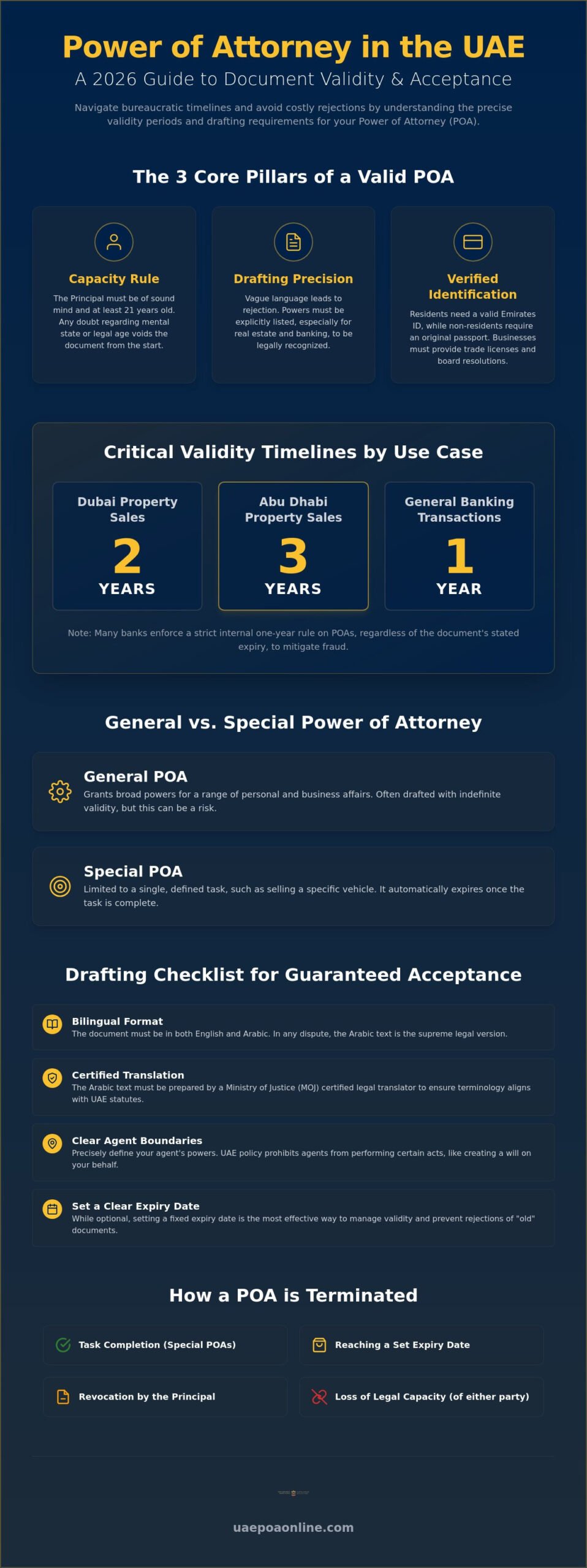
- Pinpoint the precise power of attorney validity period UAE for your transaction, ranging from two years for Dubai property sales to three years in Abu Dhabi.
- Leverage UAE Pass and Ministry of Justice digital tools to secure e-notarization that is valid across all emirates.
- Avoid unexpected rejections by understanding the one-year bank rule and how the loss of legal capacity affects your document.
- Streamline your filing process with expert coordination to ensure your POA is accepted on the first attempt without wasting government fees.
The Core Pillars of a Valid Power of Attorney in the UAE
A Power of Attorney (POA) serves as the legal backbone for thousands of transactions across the Emirates every day. Under UAE Federal Law No. 5 of 1985, also known as the Civil Transactions Law, this document creates a binding relationship where a ‘Principal’ grants authority to an ‘Attorney-in-Fact’. This isn’t just a simple permission slip; it’s a high-stakes legal instrument that must adhere to strict national standards to be recognized by government entities and financial institutions.
The first pillar of validity is the Capacity Rule. To sign a POA, the principal must be of sound mind and have reached the legal age of 21. If there’s any doubt regarding the principal’s mental state or legal age, the document is void from the start. This rule ensures that all legal authorizations are made with full intent and understanding of the consequences.
Precision is equally vital. UAE authorities, particularly the Dubai Land Department and various national banks, have zero tolerance for vague drafting. If your document doesn’t explicitly list a specific power, such as the right to sign mortgage contracts or represent you in a specific property dispute, it’ll likely be rejected. This drafting precision directly impacts the power of attorney validity period UAE. A document that’s rejected due to poor wording has an effective validity of zero days, regardless of when it was signed. We focus on “first-time-right” drafting to prevent these costly delays.
Determining the Scope: General vs. Special POA
The scope of your document defines its lifespan and utility. A General POA provides broad powers for personal and business affairs. While it’s often drafted with indefinite validity, many UAE institutions will still question its age after two or three years. In contrast, a Special POA is limited to a single, defined task, such as selling a specific vehicle or handling a one-time court matter. These documents typically expire the moment the task is completed. For a deeper look at specific use cases, see our Special Power of Attorney UAE: The Comprehensive 2026 Guide. Understanding these differences is crucial for managing your power of attorney validity period UAE effectively.
Identification and Corporate Capacity Requirements
Validity also hinges on verified identification. Residents must provide a valid Emirates ID, while non-residents must present their original passport. For businesses, the requirements are more complex. You’ll need to prove corporate capacity through trade licenses, Memorandums of Association, and board resolutions. If you’re managing company assets, you can find more details in our guide on the business power of attorney UAE. Additionally, any POA involving asset management requires the verification of ownership documents, such as Title Deeds or a Mulkiya, to ensure the principal actually has the right to delegate those powers.
Checklist: Drafting Your POA for Guaranteed Legal Acceptance
Drafting a POA isn’t just about listing your wishes; it’s about meeting strict technical criteria that government portals demand in 2026. If the document lacks specific phrasing, it won’t matter how long the power of attorney validity period UAE is intended to be because the Notary Public will likely reject it during the verification process. You must ensure the document follows a mandatory bilingual format. In the UAE, the Arabic text is the supreme legal version. Most expatriates use a side-by-side English and Arabic translation, but the Arabic portion must be prepared by a Ministry of Justice (MOJ) certified legal translator to ensure the terminology aligns with local statutes.
You also need to define the boundaries of your agent’s power clearly. UAE public policy prohibits agents from performing certain acts, such as making a will on behalf of the principal. Additionally, consider the “No Delegation” clause. Without explicit permission to delegate, your agent cannot appoint a sub-agent. This could stall your business if your primary agent is suddenly unavailable. Setting a clear expiry date is the most effective way to manage the power of attorney validity period UAE. While you can leave it open-ended, many entities have internal policies that reject documents older than two or three years to mitigate fraud risks.
Mandatory Clauses for Real Estate Transactions
Real estate transactions require the highest level of specificity. You can’t simply authorize someone to “sell property” in general terms. The document must list the exact plot number, building name, and unit number as they appear on the Title Deed. It’s essential to include explicit powers to sign the Memorandum of Understanding (MOU) and receive consideration, specifically cheques in the principal’s name. For a deeper dive into this process, read our guide on how to authorize someone to sell property UAE.
Language and Translation Standards
Language standards are non-negotiable for legal acceptance. Rejections at the Land Department often stem from literal translations that fail to use proper Legal Arabic. For instance, using colloquial terms rather than the precise legal terminology required by the Ministry of Justice can invalidate the entire document. This is why professional MOJ Notary coordination is vital for ensuring your document is accepted on the first attempt. We ensure that every clause is translated with the precision required to withstand scrutiny from any UAE authority.
The Notarization Audit: Physical vs. Digital Validity
The landscape of legal documentation in the Emirates has undergone a digital revolution. In 2026, the gateway to any valid digital document is a “Verified” UAE Pass account. Without this biometric-linked identity, you cannot access the Ministry of Justice (MOJ) portal, which has become the national standard for e-notarization. This digital shift directly impacts the power of attorney validity period UAE, as blockchain-backed documents are now instantly verifiable by banks and government departments. While regional portals exist, the MOJ standard ensures your POA is recognized from Abu Dhabi to Fujairah without the need for additional local attestations.
One of the most significant advantages of digital notarization is the inclusion of a secure verification code. Any third party, whether a bank officer or a real estate agent, can check the current status of the document on the MOJ website. This eliminates the risk of using a revoked or expired document. However, physical notarization hasn’t disappeared entirely. Some older banking systems or specific high-value transactions still require a “wet ink” signature on physical paper. If you’re dealing with a traditional institution, it’s wise to confirm their preference before choosing your notarization method. A physical document often requires more manual verification, which can slow down urgent transactions.
The 2026 Digital Notarization Workflow
The modern workflow is designed for speed and precision. The process follows a structured path to ensure national recognition:
- Draft Upload: You upload your MOJ-compliant bilingual draft to the unified national portal.
- Identity Verification Call: You’ll join a brief, recorded video session with a Notary Public. They’ll confirm your identity using your UAE Pass credentials and verify your intent to grant the powers listed.
- Digital Issuance: Once approved, you receive a digitally signed PDF. This file contains a unique QR code that serves as the ultimate proof of authenticity for third-party verification.
Validating a POA Issued from Outside the UAE
Managing assets while abroad requires a specific hybrid process to maintain legal integrity. If you’re outside the Emirates, your POA must first be notarized in your current country of residence. Following this, it must be attested by the UAE Embassy in that country. The final step occurs back in the Emirates, where the Ministry of Foreign Affairs (MOFA) must provide a local attestation. This sequence is mandatory for the document to be legally recognized by the Dubai Land Department or local banks. For those navigating this from afar, our How to Sell Property Without Being in the UAE: The 2026 Remote Guide provides a step-by-step roadmap for these remote specifics. This rigorous process ensures that the power of attorney validity period UAE remains intact even for documents originating across borders.
Critical Scenarios: When Does a Power of Attorney Expire?
Even a perfectly drafted document can lose its legal force in an instant. Under UAE law, a Power of Attorney is automatically invalidated by the death of either the principal or the agent. This termination is immediate. Any actions taken by the agent after the principal’s passing are legally void and can lead to significant complications during probate. Similarly, if the principal loses their legal capacity due to mental illness or other cognitive impairments, the authority granted to the agent ceases. This rule ensures that the agent cannot act without the principal’s ongoing, conscious consent, protecting the principal’s interests when they are most vulnerable.
The nature of the document also dictates its lifespan. A Special POA, which we discussed earlier regarding real estate, expires as soon as the specific transaction is completed. For example, if you authorize an agent to sell a specific vehicle, their power ends the moment the Mulkiya is transferred. However, the most common hurdle for residents is the “Two-Year Rule”. While a General POA might not have a printed expiry date, UAE banks and the Dubai Land Department frequently reject documents older than 24 months for high-value transactions. This internal policy acts as a security measure against outdated authorizations. Managing your power of attorney validity period UAE requires proactive updates to avoid these institutional rejections.
If you need to ensure your document remains compliant with current banking standards, you can coordinate your MOJ Notary services with our specialists today.
The Formal Revocation Process
Ending a POA’s validity isn’t a silent affair. You must draft a formal Notice of Revocation and have it notarized through the MOJ portal. Simply telling your agent the arrangement is over isn’t enough to protect you legally. You’re obligated to notify the agent and any relevant third parties, such as your bank or the Land Department, of the revocation. Silent revocation is risky. If a bank isn’t notified officially, they might still honor the agent’s signature, leading to complex legal battles over unauthorized transactions that could have been easily avoided with a formal filing.
Handling Property and Business Disputes
In the event of a property dispute or business litigation, a POA’s validity is often the first thing challenged in UAE courts. To represent a principal in court, the document must contain very specific language authorizing “representation before judicial authorities” and the power to settle or appeal. General wording won’t suffice in a courtroom setting. If an agent exceeds these defined powers, they face personal liability for any damages caused to the principal. For those facing active conflicts, understanding how to structure a power of attorney for property dispute UAE is critical to ensuring your representative has the exact authority required to defend your interests in court. Courts scrutinize the power of attorney validity period UAE to ensure the agent’s authority was active at the exact time the disputed action occurred, making precise dating and notarization essential for any legal defense.
Expert Assistance: Ensuring Your UAE POA is First-Time-Right
Attempting to draft a legal document without professional guidance often leads to a cycle of rejections and wasted government fees. In the Emirates, a single mistranslated term or a missing plot number can stall a multi-million dirham property deal. Many residents try to use generic templates found online, but these rarely account for the specific power of attorney validity period UAE requirements enforced by local banks or the Dubai Land Department. By the time a rejection occurs, you’ve already paid for legal translation and notary fees, forcing you to start the expensive process from scratch.
The value of professional MOJ Notary coordination becomes clear during the digital filing process. In 2026, notarization is no longer just a signature; it’s a technical submission into a unified national system. Our experts ensure that your document isn’t just legally sound but also formatted for immediate blockchain verification. We streamline the entire workflow, from drafting the initial bilingual text to managing the final attestation sequence. This “first-time-right” approach saves you days of administrative back-and-forth and provides the peace of mind that your legal representation is secure.
Before you submit your document for notarization, perform this final audit to ensure its validity:
- Bilingual Accuracy: Confirm the Arabic text was prepared by an MOJ-certified translator.
- Asset Specificity: Double-check that all plot numbers, unit details, or vehicle chassis numbers match your ownership documents exactly.
- Duration Clause: Ensure a clear expiry date is set to manage the power of attorney validity period UAE effectively.
- Delegation Powers: Verify if the “No Delegation” clause needs to be adjusted for your specific business needs.
- Identity Readiness: Ensure all parties have a “Verified” UAE Pass account ready for the identity verification call.
Why Choose UAE POA Online?
We provide direct access to certified legal documentation experts who understand the nuances of national regulations across all seven emirates. Our team handles the complexities of the MOJ portal so you don’t have to. Beyond POAs, we offer comprehensive support for writing a will in UAE, ensuring your entire estate plan is robust and compliant. If you’re facing an urgent deadline for a property sale or a business merger, our fast-track coordination services are designed to meet those high-pressure timelines with precision.
Ready to Secure Your Legal Representation?
Starting your application is simple and entirely digital. You can follow our step-by-step instructions for an online power of attorney UAE to begin the process from your home or office. For clients with complex corporate structures or unique estate planning needs, we offer detailed consultations to ensure every clause serves your specific interests. Don’t leave your legal authority to chance. Draft your valid Power of Attorney with UAE POA Online today and experience a seamless, expert-led notarization process.
Future-Proof Your Legal Authority in the UAE
Mastering the power of attorney validity period UAE is essential for avoiding the bureaucratic bottlenecks that often stall major life decisions. We’ve detailed how 2026 standards prioritize MOJ digital verification and why institutions strictly enforce the two-year rule for property sales. A valid document is your most powerful tool in the Emirates. It ensures your agent can act with absolute certainty while protecting your assets from legal ambiguity or sudden rejection at the Land Department.
Don’t let a minor drafting error or an overlooked expiry date jeopardize your next business merger or real estate transaction. Our team specializes in MOJ-certified legal documentation and offers 100% remote notarization support, allowing you to secure your interests from anywhere in the world. We provide expert property and business authorization that meets the highest compliance standards, giving you a clear path toward your goals. Our process is designed to be efficient, transparent, and completely stress-free.
Secure Your Legal Rights with a Valid UAE POA – Start Online Now
Take the first step toward a seamless legal experience today. With the right expert guidance, your documentation will be a reliable asset rather than a source of stress. We’re here to ensure your legal authority remains robust and ready for action whenever you need it.
Frequently Asked Questions
How long is a General Power of Attorney valid in the UAE?
A General Power of Attorney technically remains valid until it’s revoked or the principal passes away, but practical limits apply. Most government departments and banks in Dubai restrict the power of attorney validity period UAE to two years for property matters. In Abu Dhabi, the limit is generally three years. It’s best practice to renew your document every two years to ensure it’s accepted without institutional delays.
Is a Power of Attorney from another country valid in the UAE?
Yes, a foreign POA is valid provided it undergoes a specific attestation chain. It must be notarized in the country of origin, attested by the UAE Embassy there, and then receive a final attestation from the UAE Ministry of Foreign Affairs (MOFA). It also requires a certified legal translation into Arabic by a Ministry of Justice licensed translator before it can be used for local transactions.
Do UAE banks accept a Power of Attorney older than two years?
Most UAE banks apply a strict internal policy that rejects any Power of Attorney older than two years. Some institutions even require the document to be issued within the last twelve months for high-risk transactions like closing accounts or large fund transfers. Always check your bank’s specific compliance rules before attempting a transaction to avoid a last-minute document rejection.
Can I issue a valid Power of Attorney if I am on a visit visa?
You can absolutely issue a Power of Attorney while on a visit visa in the UAE. You’ll need to present your original passport and entry stamp to the Notary Public. While residents use their Emirates ID, the legal system fully recognizes the passport as a valid identification document for tourists or investors who need to formalize legal representation while in the country.
What is the difference between a notarized POA and an attested POA?
Notarization is the process where a UAE Notary Public witnesses the signing of a new document to verify its authenticity. Attestation is the secondary verification of a document that was already signed elsewhere, such as a foreign document or a corporate resolution. Both steps are crucial for ensuring the document is legally enforceable and recognized by UAE government entities.
Does a Power of Attorney expire upon the death of the principal?
A Power of Attorney expires immediately upon the death of the principal. Under UAE law, the agent’s authority is tied to the principal’s legal existence. Once the principal passes away, the document becomes void, and the agent can no longer act on their behalf. Any actions taken after death are legally invalid and could lead to significant liability for the agent during probate.
How can I check the validity of a UAE Power of Attorney online?
You can verify a document’s status instantly through the Ministry of Justice (MOJ) portal or the relevant local notary website. By entering the document’s reference number or scanning the secure QR code found on digital POAs, you can confirm if the document is still active, revoked, or expired. This blockchain-backed system provides real-time transparency for banks and government departments.
Do I need a lawyer to draft a valid Power of Attorney in the UAE?
While you aren’t legally required to hire a lawyer, professional drafting is the only way to guarantee the power of attorney validity period UAE is maintained. Vague language or incorrect legal Arabic terminology is the primary cause of document rejection at the Land Department. Using a certified documentation expert ensures your POA meets all 2026 MOJ standards and banking compliance requirements.
Leave a Reply