

What if you could finalize a multi-million dirham real estate transaction in Dubai or Abu Dhabi without ever stepping foot in an airport? Many international owners believe that physical presence is mandatory for a successful transfer, but the reality of the 2026 market is far more efficient. You don’t need to endure high travel costs or navigate the complexities of the land registry in person to liquidate your assets.
We understand the stress of managing foreign investments, especially with stricter KYC protocols and the recent requirement for sale proceeds to land in a UAE bank account matching your Title Deed. It’s common to fear that a single missing signature or a misunderstood Ministry of Justice requirement will lead to a costly document rejection. This guide shows you exactly how to sell property without being in UAE by leveraging a precisely drafted Property POA. You’ll discover the specific steps to secure a valid power of attorney, manage attestation timelines, and navigate the latest DLD and RERA regulations from anywhere in the world. We have outlined the path to a seamless, remote transfer that protects your interests and your schedule.
Key Takeaways
- Understand the legal roles of the Principal and Attorney to ensure your remote transaction remains fully compliant with current UAE regulations.
- Identify why a specialized Property POA is the only way to sell property without being in UAE while avoiding the common risks of document rejection.
- Navigate the Ministry of Justice digital notary system to complete your legal authorizations via secure video calls from any global location.
- Follow a clear, five-step roadmap for drafting and translating your documents to meet the latest 2026 land registry standards.
- Learn how modern digital platforms eliminate the need for physical travel, reducing your transaction costs and streamlining the entire sale process.
Can You Legally Sell Property Without Being in the UAE?
The short answer is a definitive yes. The UAE legal system has undergone a significant digital transformation, making it entirely possible to sell property without being in UAE. This modernization means that physical presence at a land registry office is no longer a mandatory requirement for a successful Title Deed transfer. The Ministry of Justice and local land departments have established a robust framework that allows international investors to liquidate their assets with the same legal certainty as a resident.
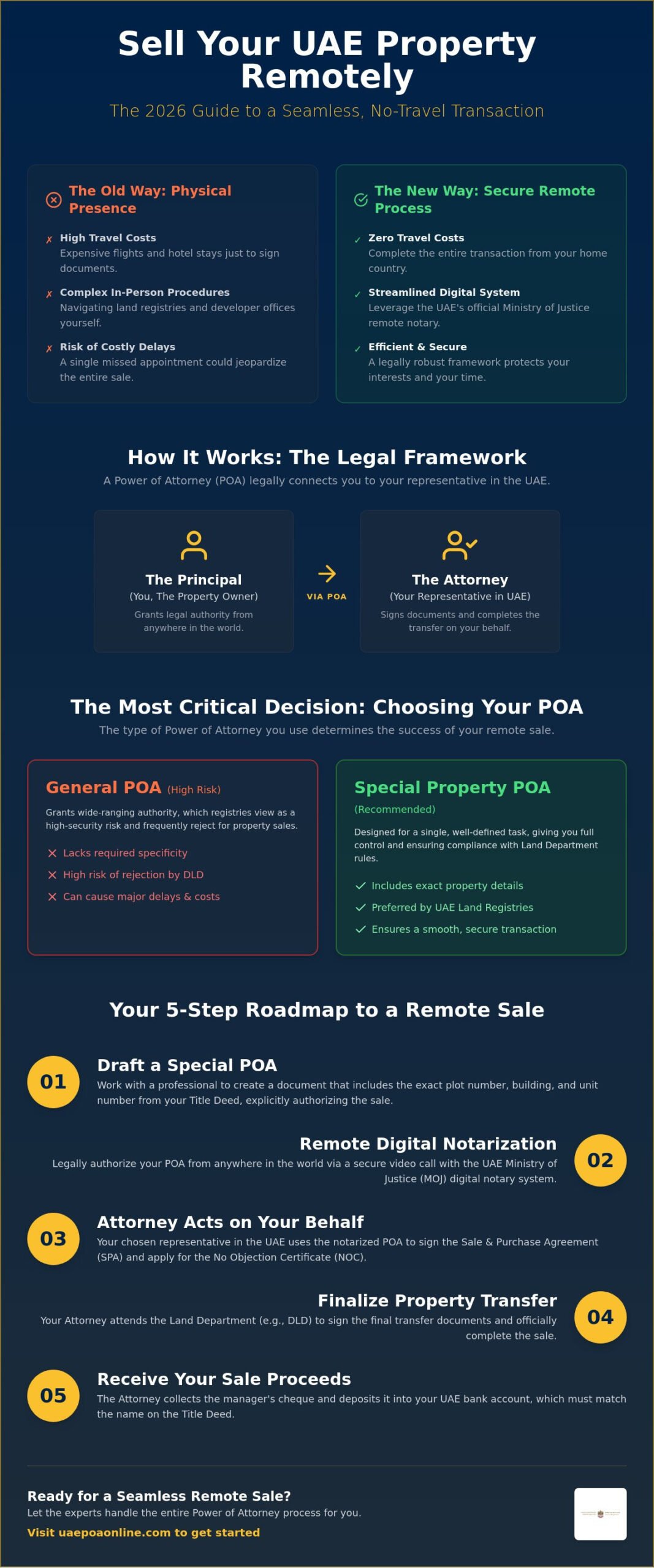
In this remote transaction, the legal framework identifies two primary roles: the Principal and the Attorney. As the owner of the asset, you are the Principal. You grant specific legal authority to an “Attorney” (your chosen representative) to sign documents and complete the transfer on your behalf. This relationship is formalized through a Power of Attorney, which serves as the bridge between your location and the administrative requirements in the UAE. By using a Special Power of Attorney UAE, you can ensure that your representative has exactly the amount of power needed to close the deal without overstepping their bounds.
The Legal Validity of Remote Transactions
The Ministry of Justice (MOJ) now recognizes digital signatures and remote identity verification as standard practice. This shift has eliminated the need for costly flights and hotel stays just to sign a few pages of paperwork. However, the validity of your transaction depends heavily on the type of authorization you provide. While a General POA offers broad powers, many land registries in the UAE prefer or even require “Special” authorizations for real estate transactions to prevent fraud. A Property POA is a specific legal instrument for asset liquidation.
Who Can Act as Your Representative?
Selecting the right individual or entity to act as your Attorney is a critical step in the remote selling process. You can appoint a trusted friend, a family member, or a professional service provider. To be legally eligible, your representative must be at least 21 years old and possess full legal capacity. It’s important to be aware that the Dubai Land Department (DLD) has specific regulations regarding who can sign at the transfer table. For instance, while you can appoint a real estate broker, there are strict rules to prevent conflicts of interest if they are also the listing agent for the property. Using an unregulated or inexperienced representative increases the risk of document errors, which can lead to the land registry rejecting your application and delaying your sale proceeds.
Selecting the Right Property Power of Attorney
Choosing the right document is the most critical decision in your remote selling journey. If you intend to sell property without being in UAE, you must understand that not all authorizations are equal. Many sellers mistakenly assume a broad, multi-year General POA will suffice for a high-value real estate transfer. In reality, the Dubai Land Department and other regional authorities often enforce strict criteria that a general document might fail to meet.
The primary reason for document rejection at the land registry is a lack of specificity. A General POA grants your representative wide-ranging authority, which registries view as a high-security risk for significant asset transfers. Most authorities now require a document that was issued or validated recently, often within the last two years, and specifically mentions the property in question. Understanding the power of attorney validity period UAE regulations demand is essential, as using an expired or soon-to-expire document is one of the most common causes of transaction failure at the land registry. Using a document tailored for a single transaction is the most effective way to demonstrate clear intent and prevent administrative delays. To understand exactly how to authorize someone to sell property UAE regulations now demand, it’s essential to review the latest 2026 compliance standards before drafting your authorization.
Special POA for Property Sales
A Special POA is designed to limit your representative’s authority to a single, well-defined task. This document must include the exact property details, such as the plot number, building name, and unit number, as they appear on your Title Deed. It should also explicitly authorize the Attorney to sign the Sale and Purchase Agreement (SPA), apply for the No Objection Certificate (NOC) from the developer, and collect manager cheques on your behalf. This streamlined approach is the most reliable way to sell property without being in UAE while maintaining full control over the process.
Including these precise clauses ensures there is no ambiguity when your representative stands before the land department officials. You can find more detailed Special Power of Attorney UAE drafting tips to help you structure these specific permissions correctly.
General POA: When Is It Appropriate?
While a General POA is useful for day-to-day administrative tasks, it carries significant risks for non-residents. Granting broad power over all your affairs to someone else can be dangerous if the relationship sours or the document is misused. Additionally, many UAE banks and utility providers like DEWA or ADDC are hesitant to accept General POAs for closing accounts or transferring large sums of money. They often demand a “Special” authorization that mentions the specific account or property unit.
If you want to ensure your transaction proceeds without a hitch, it’s wise to consult with a specialist who understands the current registry requirements for 2026. This targeted approach protects your assets while providing your representative with the exact tools they need to close the sale.
5 Steps to Sell Your UAE Property from Abroad
Executing a remote sale requires a methodical approach to ensure every document survives the scrutiny of the land registry. To sell property without being in UAE successfully, you must navigate five distinct phases of documentation. While the process has been streamlined for 2026, skipping a single step or mismanaging the sequence can lead to the immediate rejection of your transfer application. We have broken down the journey into a clear, actionable roadmap that prioritizes legal validity and speed.
- Phase 1: Drafting. Create a Special POA that identifies the property and the specific powers granted to your representative.
- Phase 2: Translation. Convert the document into a bilingual format to meet local court requirements.
- Phase 3: Notarization. Verify your identity and intent before a recognized legal authority, either digitally or physically.
- Phase 4: Attestation. Secure the necessary government stamps from the Ministry of Foreign Affairs (MOFA) and relevant embassies.
- Phase 5: Execution. Your representative presents the finalized documents at a Real Estate Registration Trustee office to complete the transfer.
Step 1: Drafting and Legal Translation
The foundation of your remote sale is the draft itself. It’s not enough to use a generic template; the wording must align with the current 2026 standards used by the Dubai Land Department or Abu Dhabi Municipality. Any ambiguity regarding the property’s plot number or the representative’s right to sign the Sale and Purchase Agreement will cause delays. Once the draft is finalized, you must obtain a certified legal translation UAE. This isn’t a standard translation. It must be performed by a translator licensed by the UAE Ministry of Justice to ensure the Arabic text carries the same legal weight as the English version. Common errors, such as misspellings of names as they appear on the Title Deed, are the most frequent causes of document failure during this stage.
Step 2: Notarization and Attestation
Once your bilingual document is ready, you must prove its authenticity through notarization. If you’re using the digital system, you’ll attend a secure video call with a UAE notary who will verify your identity via your passport and digital signatures. If you choose the traditional route from your home country, you must visit a local notary public, followed by an Apostille or attestation from your local foreign office. For non-residents, the UAE Embassy in your home country plays a vital role in this chain, acting as the final bridge of verification before the document reaches the UAE. Without the correct MOFA stamps, the land registry will not recognize the document, regardless of how well it was drafted. This chain of verification ensures that high-value assets are protected from unauthorized transfers.
Navigating MOJ Notary Services for Remote Sellers
Leverage the Ministry of Justice (MOJ) digital notary system to finalize your transaction without the need for international travel. This platform has revolutionized how global investors manage their portfolios. If you need to sell property without being in UAE, the digital notary is the engine that makes it possible. It replaces the traditional, time-consuming requirement of visiting an embassy or a physical court with a streamlined video verification process that can be completed from your home or office.
The system is designed for speed and security. Once your session is scheduled, you’ll join a secure video call with a UAE Notary Public who will witness your signature in real time. This process removes the logistical burden of mailing physical documents across borders and waiting weeks for manual verifications. Digital notarization has a legal weight equal to physical presence. This ensures that your Property POA is immediately recognized by the Dubai Land Department and other regional authorities as a valid, binding instrument.
The Digital Notarization Process
Success starts with having your documentation ready for upload. You’ll need high-resolution copies of your passport and the Title Deed for the property you’re selling. If you’re a UAE resident currently abroad, your Emirates ID and the UAE Pass app are essential for identity verification. The MOJ portal facilitates remote signatures for non-residents by using advanced encryption to link your digital signature to your verified identity. After the Notary Public confirms your intent and witnesses your signature, the system generates a digitally stamped POA. You’ll typically receive the finalized document via email within minutes of the session’s conclusion, allowing your representative to proceed with the sale immediately.
Avoiding Document Delays
Technical preparation is just as important as legal accuracy. You don’t want your session terminated because of a poor internet connection or an unreadable ID. Ensure you’re in a quiet, well-lit environment for the video call so the notary can clearly verify your facial features against your passport. Most importantly, you must have a pre-approved draft already uploaded to the system. The notary’s role is to witness the signing, not to edit legal clauses or fix drafting errors. Any mistake in the property description at this stage will result in the session being cancelled and the fee being forfeited.
We take the guesswork out of this digital transition. Our team coordinates these sessions for international clients, ensuring your draft meets all MOJ standards before the call begins. If you want to ensure your documents are accepted on the first attempt, secure our MOJ Notary Services to handle the technical and legal coordination on your behalf.
Streamlining Your Remote Sale with UAE POA Online
The legal framework for 2026 makes it entirely possible to sell property without being in UAE, but the success of your transaction depends on the technical precision of your documentation. Navigating the Ministry of Justice portals, ensuring bilingual accuracy, and coordinating video notarization sessions can be overwhelming for owners located thousands of miles away. We act as your digital bridge, translating complex regional requirements into a seamless, managed experience that protects your high-value assets.
By utilizing a specialized Online Power of Attorney UAE service, you eliminate the guesswork that often leads to document rejection. Our certified legal professionals draft every Property POA to meet the exact standards of the Dubai Land Department and Abu Dhabi Municipality. We don’t just provide a template; we provide a legally robust instrument tailored to your specific unit and transaction details. This proactive approach reduces the typical property sale timeline by weeks, as it bypasses the common back-and-forth caused by administrative errors.
Why Choose UAE POA Online?
We believe in absolute transparency and efficiency. Our service model is built on fixed-fee pricing, ensuring you know exactly what to expect without the hidden costs often associated with traditional law firms. Our team possesses an intimate, up-to-date knowledge of land registry requirements across all seven Emirates, allowing us to anticipate and resolve potential hurdles before they arise. For property owners who cannot travel, we provide a sense of security. You can rest assured that your legal interests are being handled by local insiders who understand the nuances of the regional administrative systems.
Our comprehensive coordination includes:
- Expert Drafting: Precise legal language that specifies exactly what your representative can and cannot do.
- MOJ Coordination: We handle the technical setup for your video notarization call, ensuring a smooth verification process.
- Certified Translation: Every document is translated by Ministry of Justice-licensed professionals to ensure bilingual validity.
- Attestation Support: Guidance on the final stamps required to make your POA active for the land registry.
Ready to Sell Your Property Remotely?
You can begin the process of securing your remote sale in under 10 minutes. Our digital intake system is designed for speed, allowing you to submit your requirements from any device. To get started, ensure you have a clear copy of your passport and the original Title Deed for the asset you intend to sell. If you have an Emirates ID, even an expired one, keep it ready as it can often assist in the verification chain. Our team will review your details immediately and begin drafting your document to ensure you can sell property without being in UAE as quickly as possible.
Secure your Property POA today and start your remote sale with the confidence that your documentation is in expert hands.
Finalize Your UAE Property Sale from Anywhere in the World
Remote real estate transactions in the Emirates have evolved into a streamlined digital experience. By securing a precisely drafted Property POA and utilizing the Ministry of Justice digital notary system, you can bypass the need for expensive travel and complex administrative hurdles. Success in 2026 depends on ensuring your documentation meets the exact standards of the land registry from the very first submission.
While managing the legal transfer of your property is essential, maintaining its long-term value often requires high-quality interior design; for bespoke home improvements, check out Bowkirk Kitchens & Bedrooms.
We provide a complete end-to-end solution to help you sell property without being in UAE with total confidence. Our team handles everything from expert MOJ Notary coordination and certified legal translation to facilitating digital notarization for clients worldwide. Don’t let distance delay your transaction or risk document rejection by using outdated templates. Our process is designed to be fast, secure, and fully compliant with current regional regulations.
Draft Your Property POA Online Now and take the first step toward a secure, efficient, and remote property transfer. Our modern approach ensures your legal needs are handled with both speed and professional integrity, giving you the freedom to manage your assets from any corner of the globe.
Frequently Asked Questions
Is a Power of Attorney from another country valid in the UAE?
Yes, a foreign POA is legally valid in the UAE provided it undergoes a full chain of legalization. This process typically involves notarization in the country of origin, followed by attestation from that country’s foreign office and the UAE Embassy. Once the document arrives in the UAE, the Ministry of Foreign Affairs (MOFA) must provide a final stamp before the document is translated into Arabic by a licensed legal translator.
How long does a Property POA remain valid for a sale?
In the UAE, a Property POA is generally valid for two years from the date of issuance specifically for real estate transactions. This time limit is strictly enforced by the Dubai Land Department and other regional authorities to maintain market security and prevent the use of outdated authorizations. If your document was issued more than 24 months ago, you’ll likely need to obtain a fresh authorization to complete your property transfer. For a full breakdown of duration limits by transaction type and emirate, review the power of attorney validity period UAE 2026 legal checklist before proceeding.
Do I need to visit the UAE Embassy in my country to sell my property?
You don’t necessarily need to visit a physical embassy if you choose the Ministry of Justice digital notary system. This modern platform allows you to verify your identity and sign documents via a secure video call from any global location. However, if you prefer the traditional paper-based route for documents issued outside the UAE, visiting the UAE Embassy in your home country remains a mandatory step in the manual attestation chain.
Can I give a POA to my real estate agent to sell my property?
Yes, you can appoint a real estate agent as your Attorney, but there are specific regulatory restrictions to navigate. While an agent can handle administrative tasks like applying for a developer’s NOC, the Dubai Land Department often prohibits brokers from signing the final transfer at the registration trustee’s office if they are also the listing agent for that specific transaction. It’s often more efficient to appoint a neutral third party or a professional service provider.
What is the difference between a Special and General POA for real estate?
A Special POA is a targeted instrument designed to sell property without being in UAE by limiting authority to a specific asset. It must include the exact plot number and building details as they appear on the Title Deed. A General POA grants broad power over all your legal and financial affairs. Because of the high risk of misuse, land registries and UAE banks frequently reject General POAs for high-value real estate transfers.
How much does it cost to get a Property POA for a remote sale?
The total cost depends on several factors, including government notarization fees, the requirement for certified legal translation, and the number of attestation stamps needed from the Ministry of Foreign Affairs. While these administrative costs vary based on the jurisdiction and the complexity of the document, they are significantly lower than the travel expenses and time commitment required to manage a property sale in person.
Can I revoke my Power of Attorney once the property is sold?
Yes, you can revoke your Power of Attorney at any time through a simple legal process at the Ministry of Justice or the notary public. It’s standard professional advice to cancel the authorization once the sale is finalized and the proceeds have been successfully transferred to your account. Revocation ensures that your representative no longer holds any legal power to act on your behalf regarding the asset.
What happens if my POA is rejected by the land registry?
If the land registry rejects your document, it’s typically due to a drafting error, an expired validity period, or a missing attestation stamp from the Ministry of Foreign Affairs. You’ll need to identify the specific technicality that caused the rejection and issue a corrected document. This is why we prioritize pre-approving drafts with the relevant authorities before the notarization session to ensure a successful transfer on the first attempt.
Leave a Reply