

What if the only thing standing between your residency permit and a flat rejection at the government counter is a single stamp you didn’t know you needed? It’s a common stressor for residents and investors because the difference between notarization vs attestation in UAE isn’t just a matter of semantics. It’s the difference between a legally binding document and a piece of paper that holds no weight. You shouldn’t have to guess whether your power of attorney or academic certificate is ready for official submission.
We understand that navigating the region’s administrative landscape can feel like a maze of terminology and shifting digital platforms. You’ve likely felt the frustration of wondering if you need to visit a private notary in person or if you can handle everything via the eDAS 2.0 system from your home. This guide clears that confusion by providing a definitive roadmap for your legal papers in 2026. We will break down the latest MOFA requirements, the essential role of the UAE Pass in your application, and the exact steps to ensure your documents are valid and accepted across all government departments with total confidence.
Key Takeaways
- Distinguish between local signature verification and the international authentication of document origins to ensure your paperwork is legally sound.
- Navigate the notarization vs attestation in UAE landscape to meet the latest 2026 standards and avoid costly document rejections.
- Identify which specific documents, such as POAs and Wills, require Ministry of Justice notarization before they can be used officially.
- Map out the multi-stage attestation chain necessary for foreign degree or marriage certificates to be recognized by UAE authorities.
- Understand how certified legal translation acts as the essential final bridge between your notarized documents and government acceptance.
Understanding the Legal Framework: Notarization vs. Attestation in the UAE
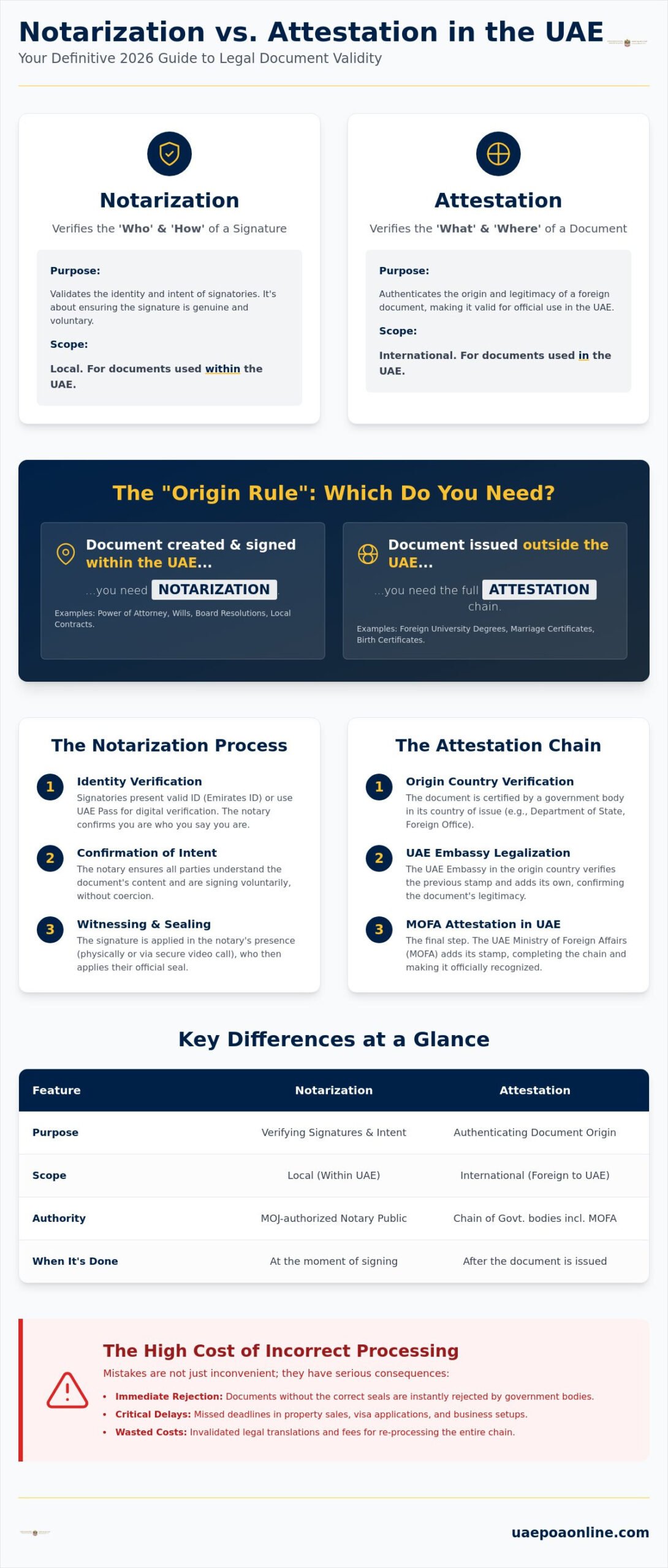
The UAE legal system relies on precise documentation to maintain security and trust in all transactions. Understanding the distinction between notarization vs attestation in UAE is the first step toward ensuring your documents are legally admissible. Notarization is a localized act where a Notary Public witnesses the signing of a document, verifies the identity of the parties, and confirms they have the legal capacity to enter the agreement. It validates the “who” and the “how” of a signature, ensuring that the person signing is who they claim to be and is doing so of their own free will.
Attestation, by contrast, is a multi-stage authentication process focused on the document’s origin. It proves that a certificate or contract is genuine and was issued by a legitimate authority in its country of origin. While notarization happens at the moment of execution, attestation occurs after the document already exists. It moves through a chain of government departments, often starting in a foreign country and culminating with a final stamp from the UAE Ministry of Foreign Affairs (MOFA). This process confirms the “what” and the “where” of your paperwork.
The “Origin Rule” helps you decide which path to take:
- Local Documents: If you’re signing a Power of Attorney, a Will, or a business authorization within the UAE, you generally require notarization.
- Foreign Documents: If your document was issued outside the UAE, such as a degree from the UK or a marriage certificate from India, it must undergo the full attestation chain to be recognized here.
Why Terminology Matters in UAE Law
Precision in language prevents costly delays. In the UAE, you’ll encounter both Public and Private Notaries. Both are authorized by the Ministry of Justice (MOJ), but Private Notaries often offer more flexible, digital-first workflows for 2026. You might also hear international partners use the term “Legalization.” In the UAE context, this is usually interchangeable with “Attestation.” The MOJ oversees these standards to ensure every document used in a court or government office meets strict evidentiary requirements, protecting all parties involved in the transaction.
The Consequences of Incorrect Processing
Mistakes in this phase are expensive. A document that lacks the correct MOFA stamp or the proper notary seal will be rejected immediately at the government counter. This rejection often causes a domino effect, leading to missed deadlines in property sales or corporate setups. Beyond administrative delays, these errors impact your certified legal translation UAE requirements. If the base document isn’t correctly verified, the translation itself cannot be legally certified, stalling your entire application and potentially leading to legal disputes over document validity.
The Notarization Process: Validating Signatures and Intent Within the UAE
In the UAE, notarization acts as a legal safeguard against fraud and coercion. A Notary Public ensures that every party signing a document understands the legal implications and is acting voluntarily. This differs from the broader scope of notarization vs attestation in UAE, as the notary focuses specifically on the moment of execution. The official’s primary duty is to verify your identity and confirm your legal capacity. If a party lacks the mental capacity or appears to be under duress, the notary will refuse to proceed. This protects the integrity of the document from the very start.
Specific documents must be notarized to be recognized by local courts and government bodies. These include:
- Powers of Attorney (General, Special, and Business)
- Wills and Inheritance declarations
- Articles of Association and Board Resolutions
- Commercial contracts and local service agent agreements
By 2026, the traditional requirement for physical presence has evolved significantly. While you can still visit a notary office in person, the Ministry of Justice has fully integrated digital notarization through the MOJ app and approved communication platforms like Botim. This allows residents and overseas investors to complete the process via secure video call. You must have a valid UAE Pass to use these digital services. It’s a streamlined approach that values your time and eliminates the need for travel. To understand how this digital transformation has reshaped the entire notarization landscape, the evolution of e-notary UAE services in 2026 provides a comprehensive breakdown of every platform and workflow now available to residents and investors.
Quality drafting is non-negotiable. A notary is not a proofreader, but they will reject documents that contain contradictory clauses or fail to meet MOJ standards. Before you book your session, ensure your document is legally sound. If you’re unsure about the structure, you can consult our experts for professional POA drafting to ensure a smooth approval.
Notarizing a Power of Attorney (POA)
Notarizing a special power of attorney UAE requires specific notarial stamps that limit the agent’s powers to a single transaction, such as a property sale or vehicle registration. This is far more restrictive than a General POA, which grants broad authority. For corporate entities, the requirement to notarize business documents UAE is a standard part of corporate governance. It ensures that managers are properly authorized to sign on behalf of the company.
The Role of Private Notaries in 2026
Licensed private notaries have transformed the administrative landscape for residents. They are authorized by the government and their stamps hold the same legal weight as traditional court-based notaries. The primary advantage is convenience. Private notaries often offer faster turnaround times and more flexible scheduling. While they handle the local verification of your signature, you should still refer to the official UAE government source for attestation if your document needs to be recognized internationally or was issued abroad.
The Attestation Chain: Authenticating Foreign Documents for UAE Use
When your document originates outside the Emirates, the legal requirement shifts from local verification to international authentication. This transition is where many residents find the most confusion regarding notarization vs attestation in UAE. If your paper was not issued by a UAE government body, a local notary does not have the authority to validate it. Instead, you must prove the document’s legitimacy through attestation. This process acts as a security measure to confirm that your certificate or contract is not a forgery and was issued by a genuine authority in your home country.
The Ministry of Foreign Affairs (MOFA) acts as the final gatekeeper within the UAE. It’s vital to understand that MOFA’s role is to validate the chain of previous government stamps rather than the specific truth of the document’s contents. For example, they confirm the signature of the embassy official is authentic, which in turn confirms the home country’s ministry was legitimate. Common documents that must follow this path include:
- Academic degrees and professional diplomas
- Marriage, birth, and death certificates
- Commercial registration and incorporation papers
- Foreign-issued Powers of Attorney
The International Attestation Workflow
The chain follows a strict hierarchy that cannot be bypassed. Step one begins in the country of origin with notarization followed by authentication from the national foreign ministry, such as the FCDO in the UK or the State Department in the US. Step two requires legalization by the UAE Embassy in that same country. Only after these steps are complete can you proceed to step three: the final MOFA attestation within the UAE. While the UAE’s advanced e-notary system has simplified local signatures, foreign documents still require this traditional, multi-layered approach.
Attesting a Foreign Power of Attorney
Using an overseas POA for UAE property transactions or business setups often introduces significant hurdles. Local authorities frequently have specific expiration limits and wording requirements that foreign documents might not meet. Furthermore, once the attestation chain is complete, your document must undergo certified legal translation into Arabic. This adds another layer of cost and time. If you want to avoid the logistical stress of international couriers and embassy queues, consider an online power of attorney UAE. This digital route allows you to execute a local document through the MOJ’s remote platform, often bypassing the need for the international attestation chain entirely.
Key Differences at a Glance: A Comparison of Purpose, Authority, and Scope
Choosing the wrong process leads to administrative gridlock. While the terms are often used interchangeably in casual conversation, the legal distinction between notarization vs attestation in UAE is absolute. Notarization is about the execution of a document; it validates that a specific person signed a specific paper on a specific date. Attestation is about the authentication of the document’s history; it confirms that the issuing body is legitimate and recognized by the UAE government. One looks at the signer, while the other looks at the paper itself.
The geographic scope is your clearest indicator for which service you need. If you are physically or digitally present in the UAE and need to sign a new document, you require a Notary Public. If the document already exists and was issued by an authority outside the UAE, you require the attestation chain. You should also consider the expiry rule. Most educational or birth attestations remain valid indefinitely, but notarized powers of attorney often have a specific shelf life, sometimes as short as two years for certain property or court transactions.
Comparison Table: Notarization vs. Attestation
| Aspect | Notarization | Attestation | Typical Timeline | Digital Option |
|---|---|---|---|---|
| Primary Purpose | Witnessing a signature and verifying identity. | Authenticating the document’s origin and legitimacy. | Immediate to 24 hours. | Yes, via UAE Pass/MOJ. |
| Authority | Ministry of Justice / Licensed Private Notary. | MOFA / Foreign Embassies / Home Ministries. | 3 to 10 business days. | Partial (eDAS 2.0). |
| Document Types | New POAs, Wills, Business Contracts. | Degrees, Marriage Certificates, Foreign POAs. | Variable by volume. | Only for QR-coded docs. |
| Presence | Required (Physical or via Video Call). | Not required; can be done via agents. | Same-day for digital. | Full digital for residents. |
| Cost Structure | Per signature and registration fee. | Fixed government fees (Personal vs. Commercial). | Varies by embassy. | Online payment required. |
The Hybrid Scenario: When You Need Both
There are instances where a single document requires both processes. This is common when managing a business power of attorney UAE for a foreign branch office. A document must be notarized in its country of origin before the attestation chain can even begin. Without that initial notary seal from the home country, the foreign ministry and the UAE Embassy will refuse to legalize the paper. Conversely, a document drafted and notarized within the UAE never needs “attestation” for use inside the country, as the MOJ stamp is already the highest form of local recognition. If you are currently abroad and need to avoid this complex dual-country chain, you can start your digital UAE notarization here to bypass international courier delays.
Navigating Legal Documentation in 2026: Choosing the Right Service for Your Needs
Your first step in any legal transaction is identifying the document’s country of origin. This single detail dictates whether you need a local notary or a multi-country attestation chain. If you’re dealing with local papers, you’ll find that the 2026 digital shift has made the process faster than ever. However, even with digital tools, the bridge between notarization and government acceptance is often a certified legal translation. Without this, your documents won’t be accepted by the Dubai Land Department or the Ministry of Labour, regardless of how many stamps they have.
The rise of digital-first services has particularly transformed sensitive tasks like writing a will in UAE. Residents can now secure their legacy through remote platforms that integrate directly with the courts. To prepare for a successful 2026 digital notary session, follow this checklist:
- Ensure your UAE Pass is active and updated to the highest security level.
- Verify that your Emirates ID has at least six months of validity remaining.
- Prepare a digital copy of your document in a searchable PDF format.
- Secure a quiet, well-lit environment for the mandatory video verification call.
Streamlining Your UAE Documentation
Professional drafting is the foundation of a successful application. A notary’s role is to verify the signature, but the legal weight of the document depends on its content. Coordinating between the Ministry of Justice (MOJ) and the Ministry of Foreign Affairs (MOFA) used to require multiple physical visits. At UAE POA Online, we manage this end-to-end process for you. We handle the drafting, coordinate the digital notary sessions, and ensure that your notarization vs attestation in UAE requirements are met with precision, saving you days of administrative legwork.
Expert Tips for 2026 Compliance
Compliance standards are strict. Always check if your specific transaction requires a ‘Certified True Copy’ attestation, as some banks and international entities won’t accept a standard scan. For real estate investors, property-specific authorizations must be drafted with exact plot numbers and DLD-approved terminology. Consult a specialist before you begin to avoid the common pitfalls that lead to document rejection. If you’re handling a property dispute or a high-value sale, getting the authorization right the first time is your best protection against legal delays.
Secure Your Legal Future with Digital Precision
Mastering the 2026 standards for document validity ensures your personal and business interests remain protected. By identifying whether your document requires local signature verification or international authentication, you eliminate the risk of rejection at government counters. The transition to a digital-first legal landscape means you don’t have to navigate these bureaucratic hurdles alone. Understanding the nuances of notarization vs attestation in UAE is the key to a seamless administrative experience.
Don’t let complex terminology stall your progress or delay your property transactions. Our team provides the expertise needed to handle your most critical legal papers with speed and absolute transparency. You can Draft and Notarize Your UAE Power of Attorney Online Today through our 100% digital workflow. As certified MOJ notary experts, we specialize in property and business POAs, ensuring your documents meet every regulatory requirement without the need for physical travel. Take control of your legal paperwork today and move forward with the confidence that your documents are fully valid and recognized across the Emirates.
Frequently Asked Questions
Is notarization the same as attestation in the UAE?
No, these are distinct legal processes with different objectives. Notarization involves a Notary Public witnessing a signature to verify the identity and voluntary intent of the signer. Attestation is a multi-step authentication of a document’s origin, proving it was issued by a legitimate authority. Understanding the difference in notarization vs attestation in UAE is essential because choosing the wrong path results in immediate document rejection at government counters.
Can I get a foreign document notarized in the UAE?
No, a UAE Notary Public does not have the authority to notarize documents issued outside the Emirates. Notarization must take place in the country where the document was originally signed. After that initial step, the document must move through the international attestation chain, including the UAE Embassy in that country and finally the Ministry of Foreign Affairs (MOFA) within the UAE, to be legally recognized locally.
Do I need to be physically present for notarization in 2026?
Physical presence is no longer a strict requirement due to the 2026 digital standards implemented by the Ministry of Justice. You can now complete the entire process via secure video call through the MOJ app or approved communication platforms. You must have a valid UAE Pass and an active Emirates ID to verify your identity digitally. This remote workflow allows residents and investors abroad to formalize papers without visiting a physical office.
How much does it cost to notarize a Power of Attorney in the UAE?
Government fees for notarization are standardized by the Ministry of Justice, though the total cost depends on the document type and the number of signatures involved. Private notaries often charge additional service fees for electronic registration or off-site visits. Because these regulatory fees are subject to periodic updates, it’s best to verify the current MOJ tariff during your application process to ensure your budget is accurate and compliant.
Which government body handles document attestation in the UAE?
The Ministry of Foreign Affairs (MOFA) is the primary authority responsible for final document attestation within the UAE. They verify the authenticity of stamps from foreign embassies or other local ministries. For business owners, the upgraded eDAS 2.0 platform now handles the attestation of commercial invoices and certificates of origin, providing a fully digital experience that integrates with the UAE Pass for secure identity verification.
How long is a notarized document valid for in the UAE?
Validity periods vary based on the document type and the specific requirements of the receiving department. While a notarized Will remains valid until it is revoked, a Power of Attorney (POA) often has a limited shelf life. Many UAE government bodies and banks refuse to accept a POA that is older than two years. Always confirm the current acceptance window with the specific authority, such as the Dubai Land Department.
Does a translated document need to be notarized or attested?
A translated document must be a certified legal translation performed by a professional licensed by the UAE Ministry of Justice. This certification acts as the bridge between your verified original and government acceptance. In most scenarios, the translation itself doesn’t require a separate notary stamp if it already bears the official seal of a licensed translator. This seal confirms the translation is an accurate and legally binding replica of the original.
What is a ‘Certified True Copy’ and when do I need it?
A Certified True Copy is a verified duplicate of an original document, stamped by a notary to confirm it is an exact match. You typically need this when you must provide proof of your credentials to multiple entities but need to keep the original document in your possession. This is a standard requirement for academic degrees, passports, or corporate trade licenses during bank account openings or residency applications. If you also need to submit a sworn statement alongside these documents, understanding how to make an affidavit in UAE ensures your supporting declarations meet the same rigorous MOJ standards.
Leave a Reply